Memorial QR Jewelry: Worth It? (2026)
Memorial jewelry with QR codes is a small but growing category — necklaces, dog tags, and keychains that hold a link to a digital memorial page. They're meaningful for some buyers and a gimmick for others. Here's how to tell the difference, what the real options are, and what the jewelry should actually be pointing to.
The Memory Murals Team • May 11, 2026
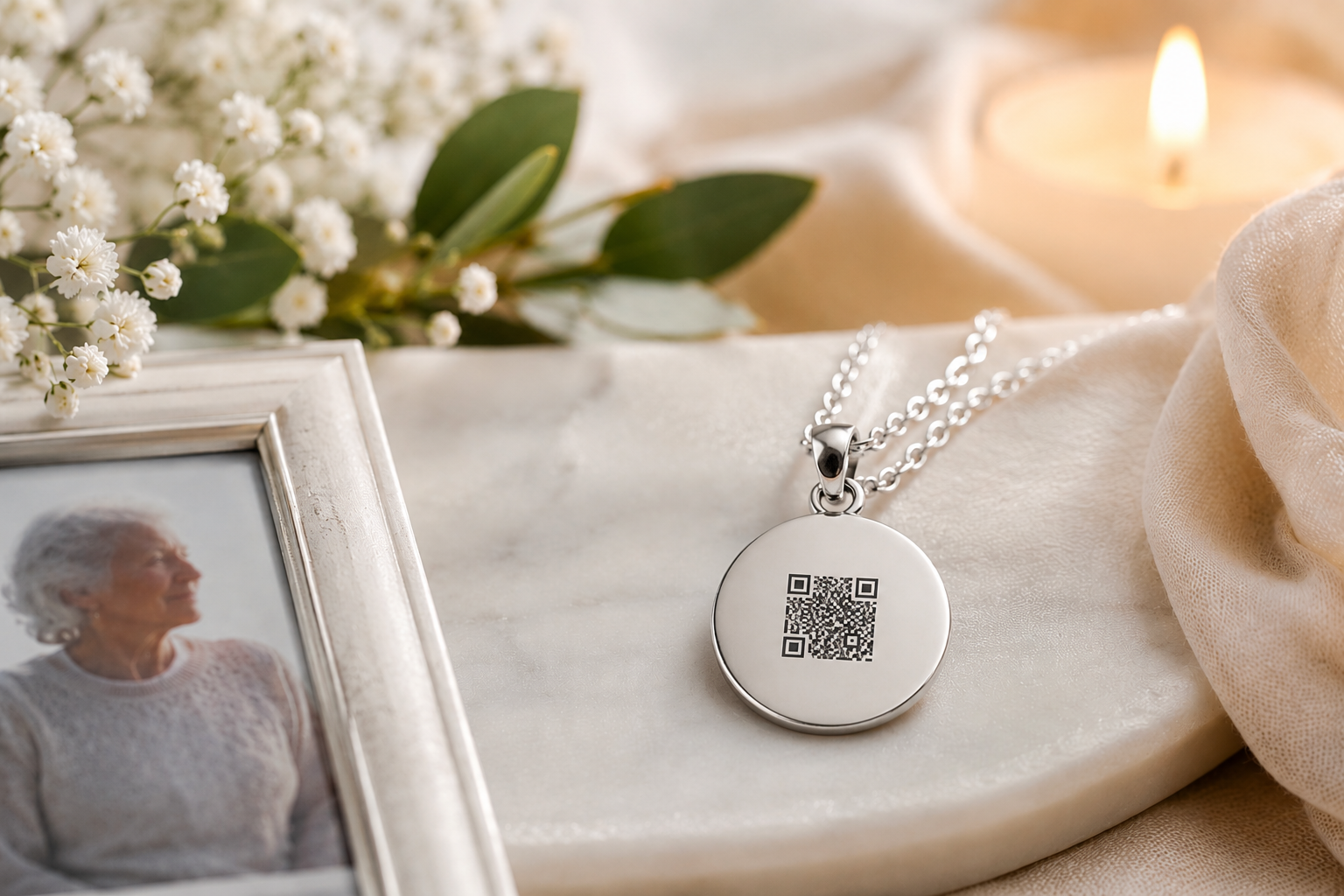
There's a category of memorial product you might not have heard of unless you've spent time on the grief-jewelry corner of the internet: necklaces, dog tags, and keychains with QR codes engraved or laser-etched into the metal. You scan the code, a digital memorial page opens — photos, stories, sometimes a recording of the deceased's voice. The pitch is portable remembrance. The reality, like most things in this category, is more uneven than the marketing suggests.
This post is the honest walkthrough. What memorial QR jewelry actually is, which brands sell it, what it costs, and the question of whether you actually need it — or whether the money is better spent on the archive the jewelry is supposed to point to.
Disclosure
We built Memory Murals, a private family archive. We don't sell QR-coded jewelry. We do think hard about where memorial content should live for the long arc, and that lens shapes the take here. If you're new to memorial QR codes generally, our explainer on how they work and what to ask before buying covers the fundamentals — the same four questions apply to jewelry as to gravestone medallions.
The 30-second answer
Buy memorial QR jewelry if wearing a physical link to the memorial matters to you emotionally, you've already chosen a durable archive for the underlying content, and you're not trying to substitute the jewelry for the archive itself.
Skip it if you're shopping in active grief, you haven't first figured out where the actual memorial content lives long-term, or the brand can't tell you what happens to the linked page if the company shuts down.
The thing the jewelry should point to matters more than the jewelry itself. We'll get to that.
A small piece of wearable jewelry — usually a pendant, dog tag, keychain, or charm — engraved with a QR code that links to a digital memorial page when scanned. The form factors range across:
- Pendants and necklaces. Most commonly heart-shaped or tag-shaped. Worn close to the chest. The QR is on the back or as part of the design.
- Dog tags. Standard military-style tag with the QR code laser-engraved on one face. Often paired with both a necklace chain and a keychain ring so the wearer can carry it however they prefer.
- Keychains and key fobs. Same QR concept, attached to keys instead of worn. Lower emotional intensity, higher practicality — the keychain stays with the wearer all day.
- Bracelets and bangles. Rarer. Some brands etch QR into thin metal bracelets, though the small surface area makes them harder to scan reliably.
- Charms for existing jewelry. A small QR-coded charm that can be added to an existing chain or bracelet. Lower commitment.
When a friend, family member, or stranger scans the code, the memorial page opens in their phone browser. Photos, biography, sometimes audio recordings. Same backend as gravestone QR products — usually the same companies sell both form factors.
Three honest buyer profiles, all real.
The bereaved spouse or child who wants a physical link. The most common buyer. A piece of jewelry that holds — actually holds — a connection to the memorial page is more present in daily life than a gravestone you only visit a few times a year. For some people, this is meaningful and grounding. For others, it feels like a gimmick. Both reactions are valid. Trust your own instinct on whether wearing the connection helps or distracts.
The grandparent buying their own legacy in advance. A growing buyer profile. Someone in their 70s or 80s who wants their grandchildren to have a wearable that links to their memorial page — set up while they're still alive, populated with the stories they choose, ready for whenever they're gone. This is a more interesting use case than the marketing usually highlights, because the buyer is also the storyteller, which solves a lot of the family-coordination problems memorial products usually have.
The pet owner. Memorial dog tags for pets are a real category. Same product, different emotional context. We don't have strong opinions on this one — if it helps, it helps. The same archive durability questions apply.
The category is small and the names overlap with gravestone QR vendors. Here's what's real as of mid-2026.
Memorygram. The most prominent name. Their Memorial QR Dog Tag Necklace is positioned as "the most advanced QR Dog Tag on the market" and is one of the few products in the category with voice support — the linked memorial page can play back audio recordings. The product bundles the tag, a silver necklace chain, and a keychain ring, so the wearer can choose how to carry it. We covered Memorygram in depth in our full product review. The voice feature is the genuine differentiator here.
Legacy Touch. Originally a fingerprint-jewelry brand, Legacy Touch has expanded into the broader memorial-keepsake category including dog tags and personalized pendants. They're stronger on the engraving/personalization side than on the QR-and-memorial-page side — the linked page features are basic if present at all. Pick Legacy Touch if the jewelry itself matters more than the digital memorial.
EVR Memories. US-based, focused on fingerprint dog tag necklaces. Like Legacy Touch, EVR is more of a personalization-and-keepsake brand than a digital-memorial brand. The fingerprint element is meaningful for some buyers; the QR/digital component is secondary.
Enchanted Memories. Anodized aluminum memorial dog tags, often with photo engraving. Affordable end of the market. Memorial page support is basic where it exists.
dogIDs. Brass and stainless steel memorial tags, originally for pet collars, now sold for human memorial use too. Durability is good (stainless is one of the longer-lasting metals in this category). Digital memorial component is light.
Generic Amazon QR pendants (YLYYJ and similar). A wide range of $10–30 personalized QR pendants exist on Amazon with customizable engraving. The product is cheap. The QR can be linked to any URL — including a Memory Murals page or a self-hosted memorial. The trade-off is no built-in memorial page hosting, which means you control where the QR points but you also have to maintain it.
The realistic price ranges as of mid-2026:
- Budget tier ($10–40): Amazon-sold engraved pendants, basic anodized aluminum dog tags, simple keychains. Durability is the trade-off — engravings can fade, plating wears, chain breaks within a few years of daily wear.
- Mid-tier ($40–120): Stainless steel dog tags, sterling silver pendants, brand-name memorial jewelry. Memorygram's QR Dog Tag Necklace sits in this range. Durability is the strong middle — 10+ years of daily wear if you don't drop it.
- Premium tier ($120–400): Solid silver, bronze, or 14k gold pieces. Custom engraving. Branded high-end memorial keepsakes. Durability is effectively permanent if cared for.
- Heirloom tier ($400+): Custom-commissioned pieces from a jeweler. Goldsmith-engraved QR, gemstone settings, family-crest incorporation. The QR is the small functional bit; the jewelry is the artifact.
A note on durability worth flagging: a QR code engraved into metal is less reliable over decades than a QR code printed on a sealed surface. Engraving creates depth variations that can degrade scan accuracy as the metal scratches. Laser-etched anodized surfaces tend to scan more reliably long-term than deep mechanical engravings. Most marketing skips this.
The same durability mismatch that haunts gravestone QR products applies double to jewelry. The jewelry is small and portable, which means it'll be worn daily — and daily wear is the harshest test for any QR scan accuracy. Then the page it points to is hosted on a vendor's servers, with no guaranteed long-term continuity plan.
A piece of memorial jewelry worn for thirty years against a leather shirt or under a wool sweater will look different than the day you bought it. The QR may still scan; it may not. The page it points to may still resolve; it may not. None of the marketing for these products tells you that.
The mitigation is the same as for gravestone QR: the archive should live somewhere durable and yours, separate from the jewelry vendor. The jewelry is a pointer. The pointer can be replaced. The thing it points to should be something you control.
We built Memory Murals explicitly to be the thing — a private archive that holds the voices, photos, and stories outside any single jewelry or medallion vendor's control. Any QR-coded pendant from any brand can link to a Memory Murals memorial. If the jewelry breaks, you order another and re-link it. The archive stays.
Portable, present, daily
A pendant or dog tag stays with the wearer constantly. For people who find comfort in physical proximity to the memorial, that's meaningful in a way a gravestone visit can't be.
Voice support is genuinely powerful
A few vendors (Memorygram leads here) link the QR jewelry to a memorial page that plays audio recordings. Hearing the voice on demand, anywhere, is the most emotionally significant feature in the category.
Cheaper than you'd expect
Quality stainless dog tag products run $40–120. Compared to gravestone medallions plus installation, jewelry is the most accessible price point in the QR memorial category.
Doubles as a personalization keepsake
Even if the QR scan eventually fails or the linked page disappears, the engraved metal pendant remains as a memorial object. Unlike a gravestone QR, the jewelry has standalone value.
Daily wear is hard on QR readability
Scratches, oxidation, and wear can degrade scan accuracy over years. Laser-etched anodized surfaces survive better than deep mechanical engravings, but no QR jewelry is permanent in scan reliability.
The vendor-hosted page is still the weak link
Same problem as gravestone QR — if the vendor disappears, the linked memorial page disappears, and the QR on the necklace points to nothing.
Marketing often skips the archive question
Most QR jewelry brands sell the pendant; they don't sell a robust archive. The page that the QR points to is usually basic templates with limited family contribution and unclear export options.
Easy to lose
A small piece of jewelry is easier to lose than a gravestone medallion. If the necklace is your only physical link, that's a single point of failure for the emotional connection.
If you're going to buy memorial QR jewelry, three questions separate a good purchase from a regrettable one.
1. Does it support voice? This is the single best filter. A QR pendant linked to a page with photos and a short biography is fine. A QR pendant linked to a page that also plays back the deceased's voice is meaningfully different. The voice is the part most people regret not capturing while they could. We wrote about this in our piece on recording a parent's voice before time takes it — the principle applies here. If the jewelry connects you to the actual sound of someone's voice, the product is doing something a photo can't.
2. Can you control the page it points to? Some products lock you into the vendor's memorial page templates. Others let you point the QR at any URL — including a memorial you control on a different platform. The second is strictly better for long-term durability. Ask before buying whether the URL is editable or fixed.
3. Is the engraving laser-etched anodized or mechanical depth? Laser-etched anodized surfaces (typically aluminum or coated steel) preserve QR scan reliability longer under daily wear. Deep mechanical engravings are prettier up close but scan worse as the metal scratches and accumulates wear. The pretty one is not the durable one.
The QR jewelry is a pointer. Where the pointer leads is where the actual memorial lives. Three options ranked by long-term durability:
A private family archive with export. What we built. Owned by your family, exportable, multi-contributor, voice-first. The QR can be linked to a memorial within the archive. If the jewelry fails or breaks, you re-engrave a new piece with the same URL. The archive outlasts the artifact. Our honest review of voice-recording memory books for grandparents walks through the trade-offs in adjacent products.
A vendor-hosted memorial page bundled with the jewelry. What most products ship with. Convenient. Pretty. Locked to a single vendor. Goes away if the vendor does. Acceptable as a display layer if the actual content is backed up elsewhere.
A self-hosted memorial site. Maximum control, requires technical know-how, somebody has to keep paying for hosting forever. Realistic for very few buyers but the most durable for those who can maintain it.
The honest verdict
Memorial QR jewelry is a meaningful product for the right buyer — particularly someone who finds comfort in carrying a physical link to the memorial, or a grandparent setting up a wearable legacy in advance for grandchildren. The voice-enabled options (Memorygram leads) are the strongest in the category because they deliver something a photo and biography can't. The catch: the jewelry vendor's memorial page is rarely the right place for the actual long-term archive. Buy the jewelry for the artifact; build the archive separately, somewhere you control.
If you haven't yet picked an archive for the underlying memorial content, give Memory Murals a try — and if you're shopping for a memorial gift for someone who recently lost a parent, our sympathy gift guide covers the category honestly.
Are memorial QR codes on jewelry just a gimmick?
Depends on the use case. For a buyer who wants a daily physical link to the memorial, or a grandparent setting up a wearable legacy for grandchildren in advance, the product is meaningful. For someone who already has a strong memorial elsewhere and doesn't need a wearable, it can feel like an unnecessary add-on. The QR jewelry is best understood as a complement to a larger memorialization plan, not a substitute for one.
Which memorial QR jewelry brand supports voice playback?
Memorygram leads here — their QR Dog Tag Necklace links to a memorial page that supports audio recordings, which most competitors don't offer as of mid-2026. If voice matters to you, that's the most reliable filter for picking a brand. Voice is the most emotionally significant feature in the category and the rarest.
How long does the QR code engraving last on a piece of jewelry?
Depends heavily on the engraving method. Laser-etched anodized surfaces (aluminum or coated steel) stay scan-reliable for 10+ years of daily wear in most conditions. Deep mechanical engravings on softer metals (silver, brass) scan well at first but degrade faster as the metal scratches and oxidizes. Stainless steel laser-etched is the most durable common combination. Solid gold and platinum are the most durable premium combination but the price gap is significant.
Can I use any memorial jewelry to point to a memorial I built somewhere else?
Sometimes. Some QR jewelry brands let you set the URL to any address you choose, which means you can point it at a memorial on a platform you control (like Memory Murals) rather than the vendor's default template. Other brands lock the QR to their own memorial page system. Ask before buying — the answer matters for long-term durability, and the vendors that let you control the URL are strictly better for the long arc.
What's a meaningful gift for someone who recently lost a parent?
Memorial QR jewelry is one option, but it's often too soon to be useful — the recipient needs space and presence more than another product to set up. Sympathy gifts that don't require any active work from the recipient tend to land better in the first few months. We covered the category honestly in our sympathy gift guide; the short version is that handwritten notes, meals, and presence outperform most physical objects in the early stages of grief.
Related Stories
Memorial QR Codes: How They Work, What They Cost, and Whether You Actually Need One (2026)
Someone you love passed. A funeral director or family member mentioned QR codes on gravestones. You're trying to figure out whether it's a meaningful idea or a gimmick. Here's the honest explainer — how the medallions work, what they actually cost, the privacy and durability questions nobody talks about, and whether your family actually needs one.
The Memory Murals Team • May 11, 2026
Memorygram vs Memory Murals: An Honest Full Product Line Comparison (2026)
Memorygram is the only major name in family memory preservation we hadn't reviewed yet. Here's the honest full-product-line breakdown — Legacy Book, QR Memorial Medallions, Memorial Dog Tags, jewelry keepsakes, Biography Services, FamilyDial — and exactly which buyer should pick which.
The Memory Murals Team • May 11, 2026

Voice Recording Books for Grandparents: What Actually Works (and What Feels Gimmicky)
A voice recording book can turn a grandparent's storytelling into something your kids will actually hear someday. But there's a wide gap between the gimmicky ones and the ones that really work. Here's what to look for.
The Memory Murals Team • April 14, 2026