Memorial QR Codes Explained (2026)
Someone you love passed. A funeral director or family member mentioned QR codes on gravestones. You're trying to figure out whether it's a meaningful idea or a gimmick. Here's the honest explainer — how the medallions work, what they actually cost, the privacy and durability questions nobody talks about, and whether your family actually needs one.
The Memory Murals Team • May 11, 2026
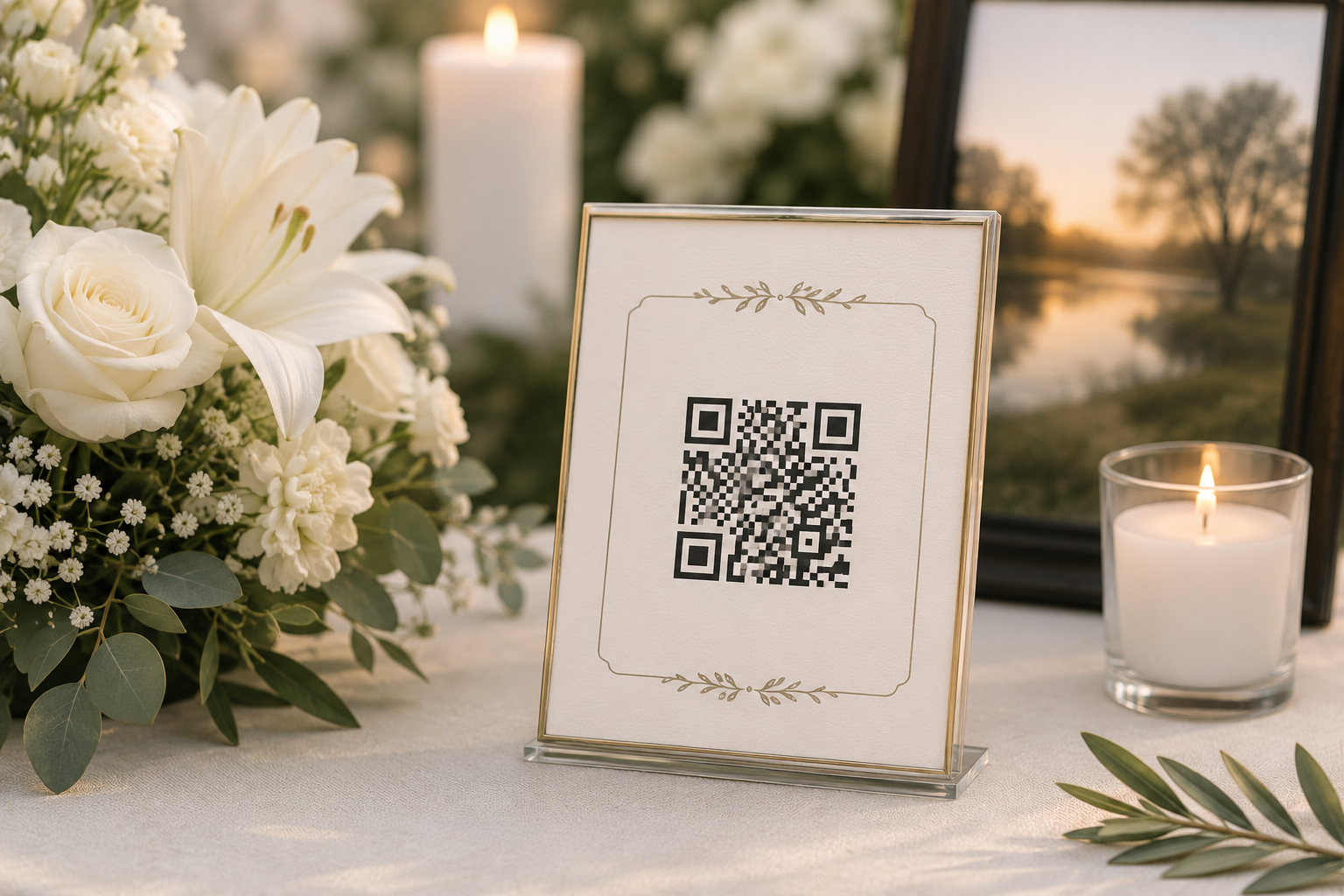
Someone you love passed. You're in the middle of arrangements — or maybe the arrangements are over and you're walking through the cemetery wishing you had something more than a name and two dates carved on a stone. A funeral director, a cousin, or a Google search has mentioned QR codes on gravestones. You're trying to figure out whether this is a meaningful idea, a gimmick, or just one more thing nobody asked for.
That's a fair question. Memorial QR codes are real — thousands of families use them — but they're also wildly inconsistent in quality, price, and durability. And the part that nobody in the marketing copy talks about: what happens to the digital memorial when the company hosting it shuts down.
This post is the honest walkthrough. What memorial QR codes actually are, how they physically work, what they really cost, the trade-offs nobody mentions, and the question of whether your family needs one at all.
Disclosure
We built Memory Murals, a private family memory archive. We don't sell QR medallions or gravestone hardware — but we are in a related space, and we have an opinion about which part of this category is worth your money and which part isn't. We'll be honest about both. If you want a direct comparison of the major QR medallion vendors, see our full Memorygram review for an honest take on the largest brand in the category.
The 30-second answer
A memorial QR code is a small scannable square — usually on a metal or ceramic medallion attached to a gravestone — that opens a digital memorial page (photos, stories, sometimes audio/video) when a visitor scans it with their phone.
Get one if the cemetery allows it, you've already chosen a long-term archive for the actual content the QR links to, and a grandchild visiting decades from now matters more than the upfront cost.
Skip one if you haven't first solved the durability question — what happens when the company hosting the memorial page goes away? — because the medallion outlasts the website by a lot.
A memorial QR code is a small square barcode — the same kind you see on restaurant menus and shipping labels — engraved or printed onto a durable surface (usually a small medallion, plaque, or tile) and attached to a memorial object. The memorial object is typically a gravestone, but it can also be an urn, a memorial bench, a tree marker, or a wearable piece of jewelry.
When a visitor opens their phone camera and points it at the QR code, the camera recognizes the pattern and prompts them to open a URL. The URL leads to a digital memorial page — usually hosted by the company that sold the medallion — that contains some combination of:
- Photos of the deceased
- Written stories, biography, or eulogy text
- Audio recordings of their voice (rare but increasingly common)
- Video tributes
- A digital guest book where visitors can leave notes
- Family contact information
No app is required. Modern smartphones (iPhone since 2017, Android since around 2019) have built-in QR scanning. A visitor just points the camera, taps the notification, and the memorial page opens in their default browser.
That's the whole product, mechanically. The marketing is more elaborate but the underlying tech is simple: an engraved barcode that points to a webpage.
There are three things bundled together when you buy a memorial QR code, and it helps to think about them separately because they have wildly different lifespans and quality levels.
1. The physical medallion or plaque. The thing that gets attached to the stone. Materials range widely:
- Adhesive vinyl labels — cheap (under $20), printed QR codes on weatherproof stickers. Last 3–7 years outdoors before fading.
- Anodized aluminum medallions — mid-range ($30–80), durable in most climates. Last 10–15 years.
- Ceramic tiles — higher-end ($80–150), often fired with the QR pattern baked into the glaze. Last 20–25 years.
- Stainless steel or bronze medallions — premium ($100–300), often custom-engraved. Last 25 years or more.
- QR codes etched directly into the headstone itself — by the monument company at the time of stone carving. Most durable; effectively permanent.
2. The digital memorial page. The webpage the QR links to. This is hosted by the QR company, on their servers, indefinitely — or for as long as the company stays in business. Most companies advertise "lifetime hosting" but very few explain what happens if they fold, get acquired, or shut down a product line. (More on this in a minute — it's the most important question in this whole category.)
3. The setup labor. Either you DIY-install the medallion with included industrial adhesive (10–15 minutes), or you hire the cemetery's monument company to drill and mount it ($50–200 depending on the cemetery). Some cemeteries require professional installation, which can roughly double the total cost.
The category is fragmented, so prices vary widely. Honest ballpark ranges as of mid-2026:
- Budget tier ($20–80 total): Adhesive vinyl labels with a basic memorial page. Brands like Monumark sit here (~$79 for a tag plus lifetime page hosting). Fine for trial-and-error, but the label won't outlast a decade.
- Mid-tier ($80–250 total): Anodized aluminum medallions with weatherproof adhesive, more polished memorial page templates, multi-media uploads (photos, video, sometimes audio). Brands like Turning Hearts and Memorygram sit here. Life's QR's $250 package adds a guest book.
- Premium tier ($250–600+ total): Ceramic tiles, stainless or bronze medallions, custom engraving, sometimes higher-end memorial page features. Often sold through monument companies as an add-on to a new headstone.
- Integrated tier (varies, often $100–500 added to a headstone purchase): The QR code is etched directly into the stone at the time of carving. Most durable, only available if you're buying a new headstone or upgrading an existing one.
Most companies use a one-time payment model — you pay once, the page is hosted "for life." A few use a subscription model (annual or every-few-years renewal). Read the fine print carefully. "Lifetime" usually means "as long as the company exists," which is not the same thing.
If you take nothing else from this post, take these four questions. They separate a meaningful purchase from a regrettable one.
1. What happens to the memorial page if the company shuts down?
This is the question nobody in the marketing copy answers. The QR code on the gravestone is good for decades. The website it points to is good for as long as the company exists. The asymmetry is real and it matters. Some companies have an export option (you can download all the memorial content as a backup). Most don't. If the company is acquired, sold, or goes out of business, the memorial page can simply disappear — and a grandchild scanning the QR in 2056 may get a "404 Not Found" instead of a tribute.
Ask the company directly: "If you go out of business, what happens to my memorial page?" If they don't have a clear answer — or if the answer is "we'll let you know" — that's a flag.
2. Can I export the content?
The corollary to the durability question. If the company gives you a way to download all the photos, stories, and recordings as a backup file (JSON, ZIP, PDF), you can preserve the memorial elsewhere even if the company disappears. If not, you're trusting a single vendor with content that's supposed to outlive you. We're biased here — we built our private archive explicitly around this principle — but the question applies to every product in the category, not just ours.
3. Does the cemetery actually allow it?
Many cemeteries have rules about what you can attach to a gravestone — including adhesive medallions. Before you buy, call the cemetery office or check the rules in writing. Some require professional installation by an approved monument company. Some prohibit anything attached after the fact and require the QR to be carved into the original stone. A handful prohibit them entirely. This is mostly a paperwork problem, but it's a real one, and it's worth resolving before the medallion ships rather than after.
4. Who controls the page over time?
Most companies tie the memorial page to a single login — usually the person who bought it. What happens when that person dies? Who has access to update photos, fix typos, add new family members who've passed? Some companies offer a "family contributor" model where multiple people can be added as page editors. Most are single-account by default. If you're the buyer and you want your kids to be able to maintain the memorial after you're gone, ask about account transfer or multi-editor access before you buy.
Used well, they solve a real problem.
Connecting a physical place of remembrance to a richer story. A gravestone gives you a name, two dates, and maybe a short inscription. A scannable code can give you photos, a voice recording, a paragraph about who the person actually was. For a great-grandchild visiting a grave decades from now, that's a meaningful difference. The most powerful version we've heard about: a teenager scanning her great-grandmother's headstone and hearing the great-grandmother's voice — recorded thirty years before — for the first time. That isn't a gimmick.
Distributing memorial content beyond people who knew the deceased. A funeral is for the people who showed up. A QR code lets a cousin who couldn't fly in, a future spouse of a grandchild, or a researcher in 2080 access something more than a name and date. That distribution is hard to replicate any other way.
A focal point for family contributions. Some companies let multiple family members add memories to the page over time. Done well, that builds a memorial that grows rather than freezing on the day of the funeral. (Done poorly — single-account, no contribution UI — it just freezes anyway.)
Three honest limitations.
They are not a substitute for an actual archive. A memorial QR code links to a memorial page — usually one page, with photos and a short biography. That's a public-facing summary, not a real family archive. If you want a place that holds the full family story — the recordings, the photos, the stories told between people who actually knew the deceased — you need a separate tool for that, and the QR code is at best a pointer to a sliver of it. We wrote about the longer-arc memorialization options in seven ways to memorialize a parent that actually last.
The durability of the link is shorter than the durability of the stone. A granite headstone lasts centuries. A QR-coded URL on a vendor's servers might last fifteen years before something — acquisition, bankruptcy, product sunset — breaks the link. The asymmetry is the most underdiscussed problem in this category. We'll keep saying it because nobody else does: the medallion outlasts the website, and you should plan for that.
They can feel impersonal if they're the only thing. A QR code is, mechanically, a small barcode bolted to a stone. If it's the only memorial gesture, it can read as cold. If it's part of a larger memorialization — a meaningful headstone, a yearly visit, a digital archive the family actually uses, a way to preserve the voice itself before time takes it — it's a complement, not a centerpiece.
Bridges physical and digital memorial
Adds photos, stories, and sometimes voice to a gravestone that would otherwise show only a name and two dates. Meaningful for visitors decades from now.
No app needed
Modern phones scan QR codes natively. A visitor opens the camera, points, taps the notification, and the memorial page opens in the browser. Zero friction.
One-time cost, often lifetime hosting
Most vendors charge once ($20–$300 depending on tier and material) and host the memorial page for the life of the company. Cheap relative to most cemetery upgrades.
Multi-media support
Most vendors support photos, written stories, and increasingly audio/video. Some allow family contributions over time.
Durability mismatch: stone lasts, website might not
The medallion can survive 25 years. The vendor hosting the memorial page might not. Almost no vendor publishes a clear long-term continuity plan.
Cemetery rules vary
Many cemeteries restrict what can be attached to gravestones. Confirm allowed materials and installation methods in writing before purchase.
Most pages are single-account, not family-collaborative
If the buyer dies, who maintains the page? Few vendors offer account transfer or multi-editor access by default.
Marketing oversells the artifact, undersells the archive
The medallion is what gets photographed in ads. The memorial page is where the actual memory lives — and most pages are thinner than the marketing implies.
Honest answer: most families don't, and that's fine.
You probably do want one if:
- You're commissioning or upgrading a headstone anyway, and the marginal cost is small relative to the stone itself.
- The cemetery is a place the family actually visits — graves on family land, a parish cemetery a grandparent attends regularly, a military cemetery where the QR link to a service record is meaningful.
- You want to leave something for descendants who won't have met the person — a great-grandchild scanning a code in 2055 is the design center of this product.
- You've already solved the more important question of where the actual story lives long-term — a private family archive, a digital legacy plan, a tool that survives beyond a single vendor.
You probably don't need one if:
- The funeral and memorial are recent and you haven't yet had time to think about what goes on the page. (Don't buy in grief; the medallion will still be there in six months.)
- The cemetery doesn't allow them, or only allows them at a price that doesn't match the meaningfulness of the addition.
- You haven't picked an archive for the actual content. A QR code linking to a half-finished page is worse than no QR code at all. Build the archive first; bolt the medallion on later.
The QR code is a pointer. The thing it points to — the story — is the part that matters. Some honest options for where the story should actually live, ranked by how well they survive a 50-year horizon:
A private family archive with export. Tools that let you build the family's stories, voices, and photos in one place, with a clear ownership model and the ability to export your data. We're in this category, full disclosure — Memory Murals is built around the idea that the family's story should outlast the company hosting it, and we publish our export options openly. The longer-arc case for archive durability is in our piece on digital vs physical memory books and which preserves a family's legacy longer.
A vendor-hosted memorial page. What you get bundled with most QR products. Convenient. Pretty. Goes away if the vendor does. Use this only if (a) you have a backup somewhere else, or (b) the vendor offers exportable data.
Self-hosted website. Highest control, requires technical know-how, and someone has to keep paying for hosting forever. Realistic for under 1% of families.
The cloud accounts of the deceased. Where most family memories actually live by default — and where most of them die when the person dies. We wrote about this in what happens to your photos when you die. The short version: a Google account that nobody can log into is not an archive.
The honest verdict
Memorial QR codes are a good idea wrapped in an uneven product category. The basic concept — connecting a stone in the ground to a richer digital memorial — is genuinely meaningful. The execution varies wildly between vendors, and the structural problem of the medallion outlasting the website is almost never addressed honestly in the marketing. Buy one if you've already solved the question of where the underlying story lives long-term, the cemetery allows it, and a visitor decades from now matters to you. Skip one (for now) if you're shopping in grief, you haven't picked an archive, or you don't have a clear answer to "what happens if the vendor disappears."
If you're trying to figure out where the underlying story should live, give Memory Murals a try — we built it specifically to be the archive a QR code can safely point to without depending on us being around forever.
What is a memorial QR code, exactly?
A scannable barcode (the same Quick Response code you see on restaurant menus) printed or engraved onto a durable medallion, plaque, or tile and attached to a memorial object — usually a gravestone, but also urns, benches, tree markers, or jewelry. When scanned with a smartphone camera, it opens a digital memorial page with photos, stories, and sometimes audio or video.
How much does a memorial QR code cost?
Wide range. Adhesive vinyl labels start under $20 (and last 3–7 years). Anodized aluminum medallions run $30–80 (10–15 years). Ceramic tiles and stainless or bronze medallions run $100–300 (20+ years). Premium options engraved directly into a headstone vary widely depending on the monument company. Most vendors include the memorial page hosting in the one-time price. Budget for $50–200 for typical installations, more if you need professional mounting by the cemetery's approved monument company.
Do cemeteries allow QR codes on gravestones?
Many do; some restrict materials or installation methods; a few prohibit them entirely. Always check with the cemetery office before purchasing. Some cemeteries require professional installation by an approved monument company. Others restrict adhesive medallions and only allow QR codes engraved into the stone at carving time.
What happens to the memorial page if the company shuts down?
This is the most important question to ask before buying and the one most vendors don't answer clearly. Some offer data export (download photos, stories, recordings as a backup); most don't. "Lifetime hosting" typically means "as long as the company exists." For a 50-year horizon, that's a real risk. The mitigation is to keep an independent backup of the memorial content — ideally in a tool that lets you export your data — separate from the vendor.
Can a memorial QR code include voice recordings?
Increasingly yes. Several vendors (Memorygram, Life's QR, others) support uploading audio recordings to the memorial page. Voice is rare but powerful — a great-grandchild can scan a code and hear the deceased's voice for the first time. If voice matters to you, ask the vendor directly whether the memorial page supports audio playback (not all do) and whether the audio files are exportable.
Related Stories
Memorygram vs Memory Murals: An Honest Full Product Line Comparison (2026)
Memorygram is the only major name in family memory preservation we hadn't reviewed yet. Here's the honest full-product-line breakdown — Legacy Book, QR Memorial Medallions, Memorial Dog Tags, jewelry keepsakes, Biography Services, FamilyDial — and exactly which buyer should pick which.
The Memory Murals Team • May 11, 2026

How to Memorialize a Parent: 7 Ways That Actually Last
Seven specific, lasting ways to memorialize a parent — from saving their voicemails before the carrier deletes them to planting something that outlives the grief. Pick one. Start this week.
The Memory Murals Team • April 26, 2026
How to Save a Deceased Loved One's Voicemail Before It's Gone Forever
Your phone carrier is counting down to the day your loved one's last voicemail disappears forever. Most families don't know this until it's too late. Here's exactly how to save it — on iPhone and Android — before the clock runs out.
The Memory Murals Team • April 19, 2026