Family History Preservation vs. Genealogy Platforms
Ancestry and MyHeritage help you research a family tree. Legacybox and EverPresent digitize your originals. Neither one preserves the story behind the documents. Here's how the three categories actually differ — and how to pick for securing old family papers.
Patrick Moore, Founder • July 1, 2026

My aunt spent four years and roughly a thousand dollars building out our family tree on Ancestry. It's genuinely impressive — she traced one branch back to a village in Sicily in the 1840s. When she passed the login to me, I went looking for the thing I actually wanted: the letters my great-grandmother wrote during the war, the ones my aunt used to talk about.
They weren't there. They'd never been there. The tree had names, dates, ship manifests, a census record or two. The letters were still in a plastic bin in my aunt's basement, exactly where they'd always been.
That's the gap almost nobody explains before you start. "Preserving your family history" sounds like one task. It's actually three different jobs, served by three different kinds of product, and the most famous names in the space only do one of them.
The 30-second answer
Genealogy platforms and preservation services are not competitors — they solve different problems, and you probably need more than one. Genealogy platforms (Ancestry, MyHeritage, free FamilySearch) research your lineage: historical records, family trees, DNA matches. They do not digitize or archive the physical documents you own. Digitizing services (Legacybox, EverPresent, Forever) convert your physical originals to files but don't add any context. Story archives like Memory Murals keep the digitized documents alongside the voices, dates, and stories that explain them — $99.99/yr, the layer neither of the others provides. To actually secure old family documents, you want a digitizer or an archive, not a genealogy subscription. Prices verified at time of writing.
The rest of this guide breaks down what each category actually does, where each one leaves you stranded, a side-by-side table, and how to pick based on what you're really trying to protect.
Why "preserving family history" is really three separate jobs
Before any product comparison, it helps to name the three jobs cleanly, because the marketing for all of them uses the same warm words — "legacy," "heritage," "preserve," "forever" — while doing very different things under the hood.
Job 1 — Research the lineage (who you're descended from)
Finding ancestors, building a family tree, searching census records, ship manifests, birth and death certificates, and matching DNA. This is genealogy. It's about discovering names and connections you didn't already have. Ancestry, MyHeritage, and FamilySearch own this job — and it's the one most people mean when they say "I want to do our family history."
Job 2 — Digitize the physical originals (what your family actually left behind)
Turning the shoebox — the photos, the handwritten letters, the recipe cards, the 8mm film, the slides — into digital files before the paper yellows and the tape demagnetizes. This is digitization. It protects the artifacts you already own. Mail-in services and DIY scanning own this job. Notably, none of the genealogy platforms do it for you.
Job 3 — Preserve the meaning (why any of it mattered)
A scan of a letter tells you it existed. It doesn't tell you that your grandmother read it aloud every Christmas, or who "Dearest Franny" was, or why the third paragraph made your mother cry. This is preservation of context — the voices, the stories, the dates and relationships that make a document legible to someone who never met the people in it. This is the job almost everyone forgets, and it's the one that decides whether your archive means anything in fifty years.
The trap is assuming one product does all three. It never does. A family tree with 2,000 verified ancestors and zero digitized letters is Job 1 with Jobs 2 and 3 wide open. A hard drive of 4,000 unlabeled scans is Job 2 with no Job 3. Knowing which job you're actually trying to do is most of the decision.
Genealogy platforms: powerful for research, not built to hold your documents
Ancestry, MyHeritage, and FamilySearch are extraordinary at what they do — searching billions of historical records and helping you assemble a tree you couldn't have built alone. But they're research tools, and it's worth being precise about what that means for your own documents.
What they're genuinely great at: record search across census, immigration, military, and vital records; automated hints that surface ancestors; DNA matching to living relatives; collaborative trees. If your goal is to discover your lineage, start here. FamilySearch is free forever (run by the Church of Jesus Christ of Latter-day Saints) and is the best no-cost on-ramp. For serious record access, Ancestry and MyHeritage are the paid heavyweights — we cover the trade-offs in detail on our Ancestry comparison and MyHeritage comparison pages.
Where they leave you stranded: they don't digitize the physical items in your house — your letters and recipe cards stay in the bin. What you upload lives inside their subscription; the historical-records access that makes the platform valuable typically ends when you stop paying. And a family tree, however deep, is a skeleton of names and dates. It doesn't hold your grandmother's voice or the story behind the photo — it was never designed to.
The honest way to think about it
Genealogy platforms answer "who am I descended from?" That's a real and wonderful question. But "who am I descended from" and "what did my family actually leave behind, and what did it mean" are different questions — and the second one is the one your grandchildren will care about. Use a genealogy platform for the first. Use a preservation approach for the second.
Digitizing services: they save the file, not the story
The second category is mail-in and DIY digitization — Legacybox, EverPresent, ScanMyPhotos, and Forever.com's scanning arm. Send in a box of physical media (or scan it yourself), get back digital files.
What they're great at: volume conversion of mixed physical formats — photos, film reels, VHS, slides, and increasingly letters and documents — without you touching a scanner. For a garage full of decaying tape, a mail-in service is the sane choice. (If you'd rather do it yourself, our guides on digitizing old photos at home and the best mail-in digitizing services walk through the trade-offs.)
The pricing shape: digitizers charge per item or per box, not per month. Legacybox, for example, runs from about $69.98 for 2 items up to $1,249.98 for 40 (with frequent sales), and other services price per scan or per project. That's very different from a subscription — it's a one-time spend scaled to how much media you have. Prices verified at time of writing; confirm live before you commit.
Where they leave you stranded: a digitizer converts, it doesn't contextualize. These services digitize your media, but they don't create new stories. You get back a drive of files named IMG_0442.jpg — no idea who's in them, when, or why they mattered. That's Job 2 done and Job 3 completely open. A pile of unlabeled scans is genuinely better than a decaying original, but it's not a preserved family history yet.
Story archives: keeping the document and the meaning together
The third category is where Memory Murals sits — and yes, we make it, so read this section with that in mind. A story archive assumes the digitizing is done (or helps you do it) and focuses on the job the other two categories skip: keeping each document alongside the voice, the date, the people, and the story that make it legible to someone who wasn't there.
Concretely, that means a scanned letter with a 90-second recording of your dad reading it in his own voice attached. A recipe card next to your grandmother explaining, out loud, why she always doubled the cinnamon. A photo tagged with who's actually in it and what was happening — searchable, private, and shareable with the whole family by a link, no app install required for relatives.
What an archive adds that the other two can't
Voice and story attached to each artifact; who/when/why context that survives the person who knew it; private, invite-only family access; everything searchable in one place instead of scattered across a tree, a hard drive, and a shoebox. It's the difference between storing your history and preserving it.
Where an archive is the wrong tool
It won't research your lineage — for building a tree from historical records, you still want a genealogy platform. And while it holds your digitized originals beautifully, a garage of 40 VHS tapes still needs a bulk digitizer to convert first. An archive is Job 3 (and part of Job 2), not Job 1.
Memory Murals is a flat $99.99/year or $12.99/month, with a free tier (1 GB, 2 members) and a 7-day trial, no card required. If you want the mechanics of building one, our guide to creating a private, secure family archive covers it end to end.
Family history preservation: the three categories compared
Here's the whole landscape in one view. Read the rows that map to what you're actually trying to protect — most families need something from more than one column.
| What you get | Genealogy platforms | Digitizing services | Story archives (Memory Murals) |
|---|---|---|---|
| Primary job | Research your lineage | Convert physical originals to files | Preserve documents + their story |
| Digitizes your own letters/photos? | No | Yes (that's the point) | Alongside voice/context |
| Keeps the story behind the item? | No (names + dates) | No (files only) | Yes (voice, who/when/why) |
| Private & invite-only for family? | Shared trees, not private | N/A (they return files) | Yes, link-based access |
| Access if you stop paying? | Records access ends | You keep the files | Export your archive anytime |
| Pricing shape | ~$20–55/mo or $199–299/yr; FamilySearch free | Per item/box ($70–$1,250) | $99.99/yr flat (free tier + trial) |
| Best example of the gap | Great tree, letters still in the bin | Great scans, no idea who's in them | Needs a bulk digitizer for garages of tape |
Primary job
- Genealogy platformsResearch your lineage
- Digitizing servicesConvert physical originals to files
- Story archives (Memory Murals)Preserve documents + their story
Digitizes your own letters/photos?
- Genealogy platformsNo
- Digitizing servicesYes (that's the point)
- Story archives (Memory Murals)Alongside voice/context
Keeps the story behind the item?
- Genealogy platformsNo (names + dates)
- Digitizing servicesNo (files only)
- Story archives (Memory Murals)Yes (voice, who/when/why)
Private & invite-only for family?
- Genealogy platformsShared trees, not private
- Digitizing servicesN/A (they return files)
- Story archives (Memory Murals)Yes, link-based access
Access if you stop paying?
- Genealogy platformsRecords access ends
- Digitizing servicesYou keep the files
- Story archives (Memory Murals)Export your archive anytime
Pricing shape
- Genealogy platforms~$20–55/mo or $199–299/yr; FamilySearch free
- Digitizing servicesPer item/box ($70–$1,250)
- Story archives (Memory Murals)$99.99/yr flat (free tier + trial)
Best example of the gap
- Genealogy platformsGreat tree, letters still in the bin
- Digitizing servicesGreat scans, no idea who's in them
- Story archives (Memory Murals)Needs a bulk digitizer for garages of tape
How to choose, based on what you're actually protecting
Skip the "which is best" framing — they're not competing. Match the tool to the job in front of you.
If you want to discover ancestors you don't know about
Start with a genealogy platform. Try free FamilySearch first; move to Ancestry or MyHeritage when you hit a record wall. This is pure Job 1 — and none of the preservation tools will do it for you.
If you have a garage of decaying tape, film, and slides
Start with a bulk digitizer. A mail-in service converts mixed formats without you buying equipment. Get the files back first — you can't preserve or contextualize what hasn't been digitized yet.
If you have a few fragile letters, photos, or recipe cards
Digitize them yourself, then archive with context. For low volume, a phone scan or flatbed beats paying per item. Then attach the story — see our specific guides to digitizing family letters and preserving handwritten recipes.
If your real worry is losing the voices and stories
This is the job everyone forgets — prioritize it now. People outlast their stories by exactly one generation of neglect. Record the older relatives while you can — our guide to recording family video interviews is the fastest place to start — and keep the recordings with the documents they explain.
The honest bottom line
No single product "preserves your family history" — that phrase hides three different jobs. Use a genealogy platform (start free with FamilySearch) to research your tree. Use a digitizing service to convert a garage of physical media, or DIY it for a few fragile items. Use a story archive like Memory Murals to keep the digitized documents alongside the voices and context that make them mean something in fifty years. The families who get this right don't pick one — they use the right tool for each job, and they treat the "capture the stories" job as the urgent one, because it's the only piece with a deadline.
The tree gives you the names. The scans give you the files. Neither one, on its own, gives your grandchildren the reason any of it mattered. That last part is the whole point — and it's the part with a clock on it.
Want to keep your documents and the stories behind them in one private place? Start your family archive free →
Get 50 questions to ask your parents — before the stories are gone
The exact prompts families use to draw out the stories nobody ever wrote down. Free, straight to your inbox.
No spam. Unsubscribe anytime.
Frequently asked questions
What's the difference between a family history preservation service and a genealogy platform?
A genealogy platform (Ancestry, MyHeritage, FamilySearch) helps you research your lineage — it searches historical records, builds a family tree, and matches DNA. It does not digitize or store your own physical documents. A family history preservation service is anything that secures your actual originals: mail-in digitizers like Legacybox and EverPresent that scan photos, letters, and film; permanent-storage services like Forever.com; and story archives like Memory Murals that keep the documents alongside the voices and context behind them. Genealogy platforms answer 'who am I descended from.' Preservation protects 'what my family actually left behind.'
Do genealogy platforms like Ancestry store my old family documents?
Not in the way most people assume. Ancestry and MyHeritage let you upload photos and attach them to people in your tree, but they are built for research and records access, not archival preservation of your originals — content lives inside their subscription ecosystem, and if you stop paying, access to their historical records goes away. They also don't digitize physical items for you: your fragile letters, recipe cards, and slides still sit in a shoebox. For securing the physical originals you own, you need a digitizing service or a preservation archive, not a genealogy subscription.
What is the best way to preserve old family documents and letters?
Digitize them first (a phone-scan app for sturdy items, a flatbed for fragile ones, or a mail-in service for volume), then store the files somewhere durable with the context attached — who wrote it, when, and why it matters. The mistake most families make is stopping at the scan: a folder of 400 unlabeled document images is only marginally better than the shoebox. Pairing each document with a short recorded or written note about its story is what turns a scan into something a grandchild can actually understand in fifty years.
How much do family history preservation services cost?
It varies by category. Genealogy research subscriptions run roughly $20–$55/month depending on plan and term (Ancestry), or about $199–$299/year (MyHeritage Complete); FamilySearch is free. Mail-in digitizing is priced per item or per box — Legacybox runs from about $69.98 for 2 items up to $1,249.98 for 40, with frequent sales. Story-and-preservation archives like Memory Murals are a flat subscription — $99.99/year (or $12.99/month), with a free tier and a 7-day trial. Prices verified at time of writing; confirm current figures on each provider's site.
Can I use both a genealogy platform and a preservation service?
Yes, and for serious family historians it's the normal setup. They solve different jobs and don't overlap. Use a genealogy platform (Ancestry, MyHeritage, or free FamilySearch) to research your tree and find historical records; use a digitizing service to convert the physical originals you already own; and use a preservation archive to keep those digitized documents alongside the voices and stories that explain them. The tree tells you the names and dates. The archive keeps the meaning.
About the author
Patrick Moore, Founder of Memory Murals
Patrick Moore is the founder of Memory Murals. He built it after realizing how much of his own family's history had quietly slipped away — to help families preserve their stories, voices, and photos while they still can.
Related Stories
How-To Guides
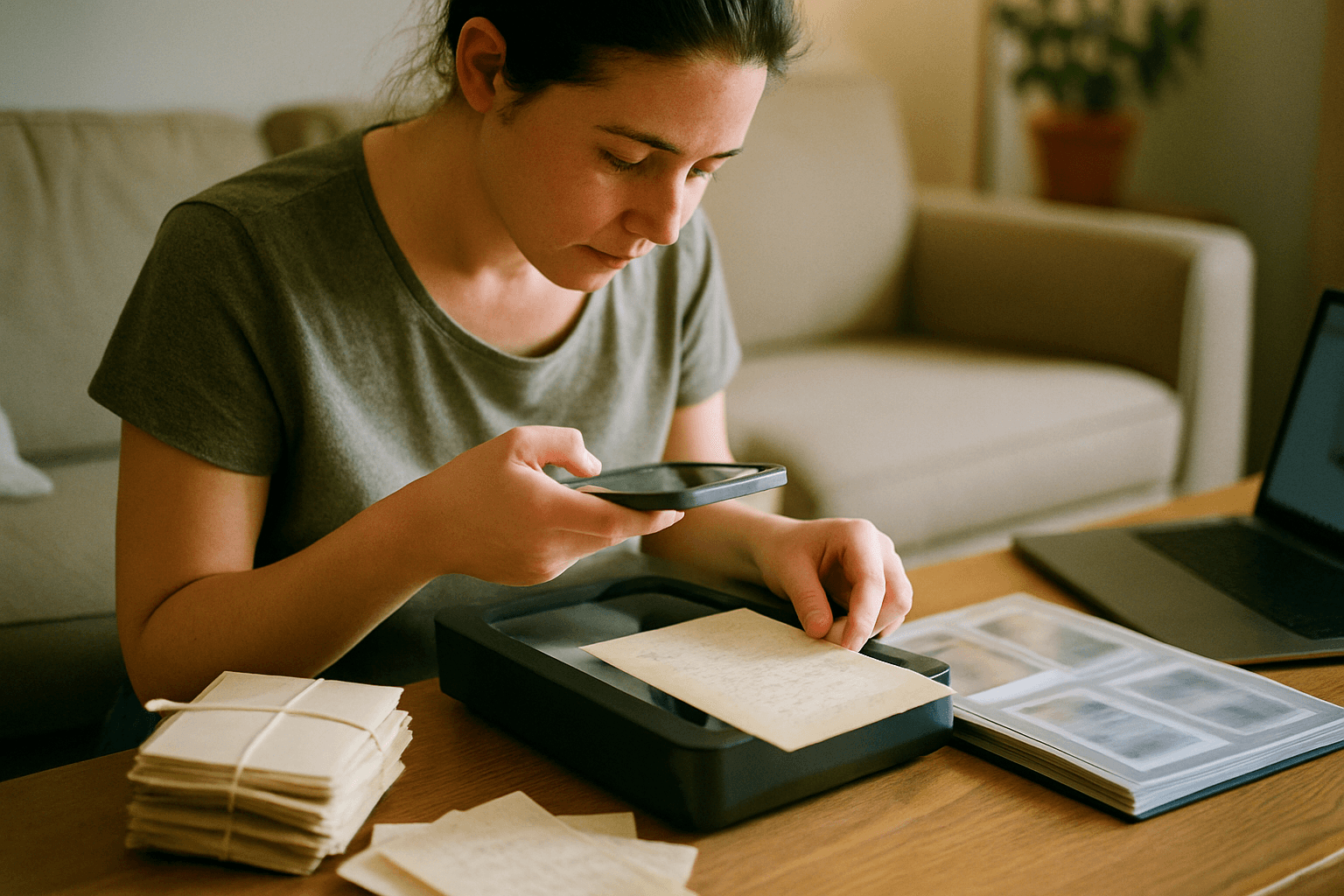
How to Digitize and Archive Family Letters (Without Damaging the Originals)
Old handwritten letters are the most fragile — and most story-rich — thing in the box. Here's how to digitize them safely (phone, flatbed, or mail-in), and how to archive them so the meaning survives, not just the image.
Patrick Moore • July 1, 2026

How-To Guides
How to Preserve Handwritten Family Recipes and the Stories Behind Them
A grandmother's recipe card isn't just instructions — it's her handwriting, her margin notes, the splatter on the corner. Here's how to preserve handwritten recipes and the stories behind them before the cards fade for good.
Patrick Moore • July 1, 2026

Pillar Articles
Memory-Making Activities With Your Kids (and How to Keep Every One)
Not every activity has to just fill an afternoon — some quietly become the memories your kids carry for life. Here are memory-making activities worth doing with your kids, each paired with a 30-second way to capture it, so the moment becomes a keepsake instead of just a nice Tuesday.
Patrick Moore • July 10, 2026
See the version we built.
Voice-first, multi-contributor, and priced on one page — $12.99/mo, $99.99/yr, or a $7 weekend pass. Free for 7 days.