
Memory-Making Activities With Your Kids
Not every activity has to just fill an afternoon — some quietly become the memories your kids carry for life. Here are memory-making activities worth doing with your kids, each paired with a 30-second way to capture it, so the moment becomes a keepsake instead of just a nice Tuesday.
Patrick Moore, Founder • July 10, 2026
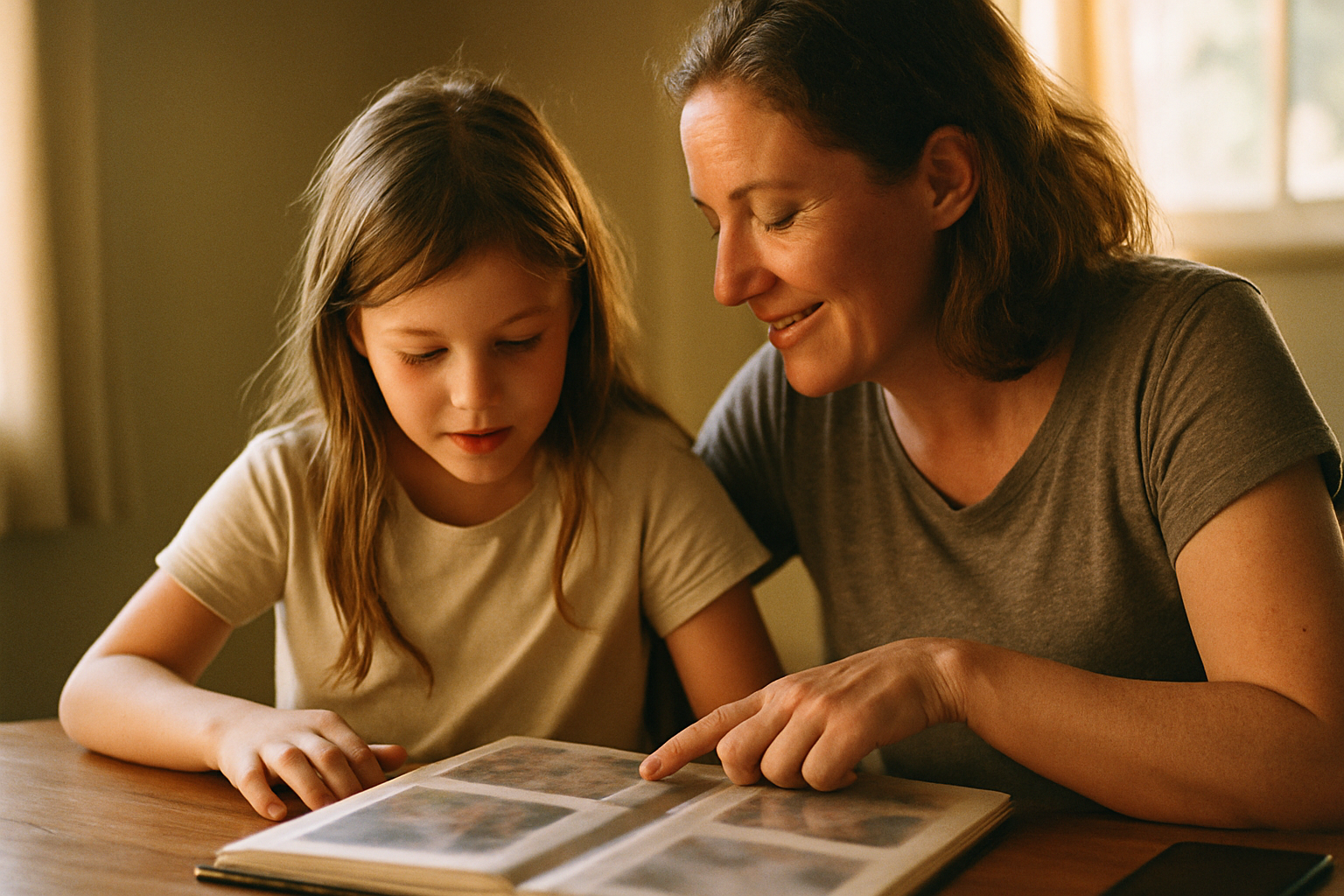
There are two kinds of activities you do with your kids. One kind fills an afternoon — it keeps small people busy until dinner, and then it's over. The other kind quietly becomes a memory they carry for the rest of their lives.
Most of us spend a lot of energy on the first kind and stumble into the second by accident. This is a guide to doing the second on purpose.
The difference between the two isn't the activity itself — cooking together can be either. The difference is whether the moment leaves something behind: a recording, a photo with its story attached, a tradition that repeats. So every activity below comes with the part everyone skips — a 30-second way to capture it — because a memory-making activity you don't capture is just a nice Tuesday you'll forget by fall.
The short answer
Memory-making activities are the ones that leave something behind. Do things that are simple, repeatable, and personal — cook a family recipe, run a yearly birthday interview, start a small tradition, make a time capsule, record bedtime stories in your own voice — and pair each one with a 30-second capture (a photo with context, a voice note, a short video). The activity creates the moment; the capture turns it into a keepsake you can revisit for decades. If you only build one habit, build the capture habit.
Activity + capture = keepsake
Here's the whole framework, and it's simple enough to remember forever: the activity makes the moment, and a 30-second capture makes it last. Skip the capture and even the most meaningful afternoon dissolves into the general blur of "when they were little." Add it, and an ordinary evening becomes something your kid can hear and see twenty years from now.
This is the same principle behind capturing your kids' childhood memories in general — grab the moment, add a scrap of context, keep it in one place. The activities below are just the best occasions to do it.
Small, everyday memory-makers
You don't need a special day. These fit into a normal week and reward repetition.
Cook a family recipe together
Make the dish that came from a grandparent. Capture it: photograph their hands in the flour and record the older relative telling the story of the recipe — the voice and the story are the real inheritance, not the recipe card.
Record bedtime stories in your voice
Read the bedtime book, but hit record. Capture it: the audio of you reading to them, and later of them reading to you, is something they'll want to play for their own kids.
The 'highlight of the week'
Each week, everyone names one favorite moment. Capture it: record 30 seconds of it once a month; it's a running log of what actually mattered to your kids, in their words.
Make something and date it
Draw, build, bake — then photograph it with the date and a one-line note. Capture it: you can't keep every creation, but a dated photo keeps the story of the phase.
Annual activities that compound
These happen once a year, which makes them easy to remember — and powerful, because the yearly repetition turns them into a time-lapse.
- The birthday interview. Ask your child the same questions every year and record the answers. It's the single highest-return memory activity there is — enough that it has its own guide and full question set.
- A time capsule you add to yearly. A drawing, a recording, a note — one thing a year, sealed to open at eighteen.
- A "day in the life" film. Once a year, capture a completely ordinary day — the morning chaos, the school run, dinner. The mundane is exactly what disappears and exactly what you'll miss.
- A letter to their future self. Write or voice-record a short letter each year; it doubles as your own record of who they were.
Several of these are the seeds of tradition — if you want to turn a one-off into a ritual your kids count on, we cover family traditions worth starting and how to make them stick.
Activities that pull the whole family in
Memory-making gets richer when it's not a solo mission. These invite kids, partners, and grandparents into the same story.
Family storytelling games
Photo scavenger hunts, 'then and now' map-making, interviewing each other. Capture it: these are built to involve kids in memory-keeping — a full set of games is in our guide to family storytelling for kids.
Return to a meaningful place
Revisit the hospital, the first home, a favorite park — recreate an old photo. Capture it: the side-by-side of then and now is a whole story in two images.
Interview a grandparent, together
Have your kids ask the questions. Capture it: record it — you're preserving a generation and teaching your kids to be memory-keepers at the same time.
Build the family playlist
Everyone adds the songs that mean something this year. Capture it: note who added what and why; music is one of memory's strongest triggers.
Where every captured moment should live
If you do even a few of these, you'll start generating something valuable: photos with context, voice recordings, yearly clips, dated art. The failure mode is letting them scatter — some on your phone, some on your partner's, some on a feed, some in a drawer — until the collection you worked to build is impossible to actually sit down and enjoy.
One private home for it all
Every recipe video, birthday interview, and bedtime recording lives together, in order, both parents can add to it, and you own it and can hand it down.
Scattered across apps and phones
The moments happened, but the record is fragmented and half-lost — and no one can ever sit down and experience the story you actually made.
That's what Memory Murals is for: a private, family-only place where the memories you make actually stay together — searchable by person and date, open to the whole family, and yours to keep. The activities create the moments; this is where they become a story you can revisit.
Pick one activity from this page and do it this week — then capture it, and give it a home. Do that on a loop, and the ordinary afternoons quietly become the childhood your kids remember. Start your family's private archive for free and keep the first one tonight.
Get 50 questions to ask your parents — before the stories are gone
The exact prompts families use to draw out the stories nobody ever wrote down. Free, straight to your inbox.
No spam. Unsubscribe anytime.
Frequently asked questions
What are good memory-making activities to do with kids?
The best memory-making activities are simple, repeatable, and personal: cooking a family recipe together, a yearly birthday interview, starting a small tradition, making a time capsule, recording bedtime stories in your own voice, a photo scavenger hunt, or a 'then and now' return to a meaningful place. What makes an activity memory-making rather than just fun is that it produces something you keep — so pair each one with a quick photo, voice note, or video.
What's the difference between keeping kids busy and making memories?
Keeping kids busy fills time; making memories creates something you both keep. A boredom-buster activity is done when it's over. A memory-making activity leaves a residue — a recording, a photo with context, a tradition that repeats — that you can revisit years later. The activity itself can be identical; the difference is whether you captured it and kept it somewhere you'll find it again.
How do you make everyday moments with kids more memorable?
Add a tiny bit of intention and capture. Turn an ordinary activity into a repeatable ritual, involve your child in the doing, and take 30 seconds to record the moment with its context — what happened, what they said, how old they were. The memorability comes less from the activity being special and more from you noticing it, marking it, and keeping it.
What memory-making activities work for toddlers versus older kids?
For toddlers, focus on capturing their voice and current obsessions — record them talking, photograph their art, do a simple yearly interview even if the answers are one word. For older kids and teens, lean into co-created activities: cooking family recipes, making time capsules, recording family stories together, and 'day in the life' videos they help make. The capture habit stays the same at every age; only the activity matures.
About the author
Patrick Moore, Founder of Memory Murals
Patrick Moore is the founder of Memory Murals. He built it after realizing how much of his own family's history had quietly slipped away — to help families preserve their stories, voices, and photos while they still can.
Related Stories
How-To Guides
How to Capture Your Kids' Childhood Memories (a Simple System That Sticks)
You have thousands of photos and almost none of the story behind them. Here's a simple, all-ages system for capturing your kids' childhood memories — the everyday ones you'll actually want back — in under a minute at a time, and keeping them somewhere they won't get lost.
Patrick Moore • July 10, 2026
Lists & Roundups
Questions to Ask Your Kids Every Year: the Simplest Memory Tradition
Ask your child the same short list of questions once a year and record the answers. It takes ten minutes, and by the time they're grown you'll have something almost no parent has: their actual voice, changing year by year. Here's the question set and how to make it a tradition that sticks.
Patrick Moore • July 10, 2026
Lists & Roundups
Family Traditions to Start (That Are Actually Worth Remembering)
The best family traditions aren't expensive or elaborate — they're small, repeatable, and they quietly become the thing your kids remember most. Here are traditions worth starting this year, plus the one habit that turns any tradition into a keepsake you can revisit for decades.
Patrick Moore • July 10, 2026
Preserve your family's memories in one private place.
Start free in minutes. No credit card required.