
The Swsh App Pivot & Your Photos
The recent news about Swsh, a popular college photo-sharing app, pivoting to become an AI-powered data business is a stark reminder. This post breaks down why that matters for your family's memories and illustrates the hidden risks of sharing on 'free' platforms.
Patrick Moore, Founder • June 17, 2026

A few weekends ago, I was cleaning out a closet and found a dusty shoebox labeled “College.” Inside were hundreds of glossy 4x6 prints of people I barely recognize, including a much younger, blurrier version of myself. There were photos from late-night study sessions, goofy road trips, and formals I’d long forgotten. Looking at them felt strangely intimate and private, a conversation just between me and my past.
That feeling of contained nostalgia is a world away from the endless scroll of a social feed. It made me think about the apps that tried to capture that same collegiate magic, like Swsh. For a while, it was the go-to app on campus for sharing photos from last night’s party or that big win on the quad. It felt ephemeral, fun, and mostly harmless.
But a recent headline from Fortune changed that perception entirely. It revealed that Swsh, the college photo app, had become an “AI-powered fan data business.” The ground had shifted under its users' feet, and the photos they shared in good faith were now potentially fuel for a completely different engine.
The short answer
Recent reports indicate the Swsh app has pivoted from a college photo-sharing platform into an AI-powered fan data business. For users, this raises serious privacy concerns. It means the personal photos and data shared on the app could now be analyzed by AI for commercial purposes, a use case far beyond what users originally signed up for. This highlights the risk of using 'free' services where your data is the actual product.
From Campus Photos to Consumer Data
The story of Swsh isn’t unique, but it’s a powerful, modern parable about digital privacy. According to the exclusive report in Fortune, the app that started its life as a simple tool for college students has fundamentally changed its mission. It’s a classic bait-and-switch, even if it’s a legal one buried in pages of updated terms and conditions.
The new business model is described as an “AI-powered fan data business,” reportedly backed by music executive Scooter Braun. While the specifics of what this entails aren't public, the description itself tells a story. It suggests that the content users uploaded—photos of friends, events, and daily life—is no longer just a digital scrapbook. It's now a dataset. This data can be analyzed by artificial intelligence to identify trends, understand consumer behavior, and generate business insights.
Your memories, your friendships, your fleeting moments of joy, become data points. The platform you trusted to hold those memories now has a primary incentive to extract value from them. And you are not the customer in that transaction.
'Free' Photo-Sharing Apps
They are often frictionless and easy to start using. The social component allows for wide sharing and quick feedback from friends and family, which can be gratifying. There's no upfront cost, making them accessible to everyone.
'Free' Photo-Sharing Apps
The business model often relies on monetizing your data. The terms of service can change at any time, pivoting the app's purpose without your direct consent. Your private memories can become training data for AI or be sold to third parties, and the platform's longevity is tied to its profitability, not its promise to preserve your photos.
Private Family Archives
You are the paying customer, which means the company's sole focus is on serving and protecting you. Privacy is the core feature, not an afterthought. They are built for long-term preservation with features designed for storytelling and family connection, not public performance.
Private Family Archives
They typically require a subscription fee. They are not designed for wide, public sharing, which means they serve a different purpose than social media. The focus is on depth and security over virality and engagement metrics.
When Your Memories Are the Product
We’ve all heard the saying: “If you’re not paying for the product, you are the product.” The Swsh story is a textbook example. A free app needs to make money somehow, and the most valuable asset a social platform has is its users' data. Every photo you tag, every event you attend, every connection you make—it all paints a picture of who you are. For a data business, that picture is worth a fortune.
This isn't about fear-mongering; it's about understanding the transaction. The global conversation around AI and data privacy, from G7 discussions to Apple's latest on-device AI changes, is grappling with this exact issue. AI models require enormous amounts of data to learn and become more powerful. Where does that data come from? Often, it comes from public or semi-public spaces where we’ve shared our lives.
When a company's business model depends on analyzing user data, its incentives will always be in conflict with user privacy. The temptation to find new ways to parse, package, and sell insights from your life is baked into their financial structure. This is the fundamental problem with using a public-facing, ad-supported, or data-driven platform as a de facto family archive. It’s like storing your family heirlooms in a bank that reserves the right to rent them out. (For services built the other way around, our roundup of private family photo sharing apps is a good starting point.)
An Explicit Privacy Pledge
A true archive states clearly that your data is yours. It won't be sold, shared, or used to train AI models. The privacy policy should be simple and human-readable.
A Sustainable Business Model
Look for a subscription-based service. When you pay a fee, you are the customer. The company's success depends on keeping you happy and your data safe, not on selling you out.
A Family-First Focus
The platform should be designed for preservation and storytelling, not for likes and shares. Features should facilitate deep, meaningful connections with a small, trusted circle.
Permanent, Portable Ownership
You should be able to easily download your entire archive at any time, in a non-proprietary format. Your memories belong to you, and you should never be locked into a single platform.
Building a True Sanctuary
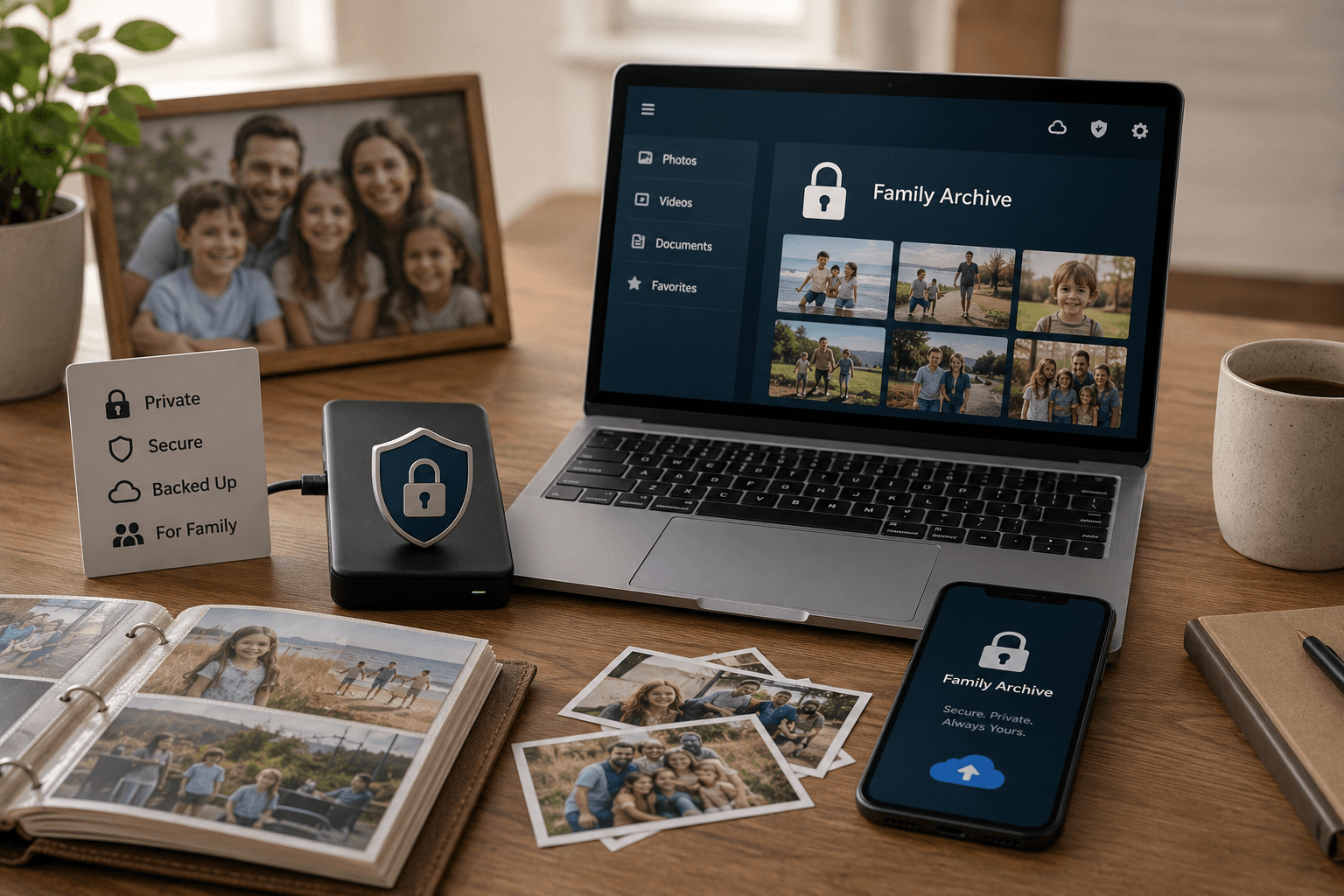
This brings us to the idea of a digital sanctuary. A place built not for performance or data collection, but for preservation. A place where the only people who see the photo of your grandfather teaching you to fish are the people you explicitly invite. A place where your baby’s first steps aren’t a data point for an algorithm.
This is the entire reason we built Memory Murals. My co-founder and I were looking at this landscape of “free” services and realized none of them were built to solve the fundamental human need for a permanent, private, and sacred family space. We wanted to build a place where the business model is the privacy model. It's why we have a simple subscription. Our members are our only customers, and our only job is to serve them.
Our Promise to You
At Memory Murals, we will never sell your data, show you ads, or use your family's memories to train AI models. Our subscription model ensures our interests are perfectly aligned with yours: to keep your legacy safe, private, and accessible to your family for generations. That's the core of how we think about this at Memory Murals.
Creating this kind of space requires a conscious choice. It means moving away from the default convenience of social platforms for the things that matter most. It means building a truly private space for your family with intention, thinking not just about today's sharing, but about the long-term questions of digital inheritance and what happens to your digital assets when you're gone.
The Swsh pivot is a wakeup call. It's a reminder to look under the hood of the digital tools we use and ask a simple question: Who is this really built for? If the answer isn't “me and my family,” it might not be the right home for your most precious memories.
That shoebox of old college photos is safe in my closet. It won’t suddenly be sold to a data broker or used to train an algorithm. Your digital memories deserve that same certainty. They deserve a quiet, permanent home, built on a foundation of trust. If you're ready to build that sanctuary for your own family, we invite you to start building your own private family archive today.
Get 50 questions to ask your parents — before the stories are gone
The exact prompts families use to draw out the stories nobody ever wrote down. Free, straight to your inbox.
No spam. Unsubscribe anytime.
Frequently asked questions
What happened to the Swsh app?
According to a Fortune report, the Swsh app, which began as a photo-sharing platform for college students, has pivoted. It is now reportedly an AI-powered fan data business. This change signifies a major shift in its business model from a simple social tool to a company focused on analyzing user data for commercial insights, a move backed by executive Scooter Braun.
Why is Swsh app privacy a concern?
The concern with Swsh app privacy stems from its pivot. Users who shared personal photos believing it was a private social app may now have their data used for AI analysis and business intelligence. This change in purpose means personal memories could be monetized in ways users never intended or explicitly agreed to, highlighting the risks of platforms where user data is the product.
What does it mean for a tech company to pivot?
A pivot is a significant change in a company's core business strategy. For an app like Swsh, it meant shifting from its original concept—a college photo-sharing app—to a new one: an AI-powered data business. Pivots often occur when a company seeks a more profitable model, but for users, it can mean the service they signed up for fundamentally changes its purpose and how it uses their data.
How can I truly protect my family photos online?
To protect your family photos, choose services designed specifically for privacy, not public sharing. Look for platforms with clear policies that state they will not sell or analyze your data. Opt for paid subscription services where you are the customer, not the product. This aligns the company's interests with yours—to protect and preserve your memories securely for the long term.
What is the main difference between a social app and a private archive?
A social app's goal is public sharing to drive engagement, often supported by advertising or data monetization. A private archive, like Memory Murals, is built for preservation and security. Its business model is typically a subscription, ensuring the company's only obligation is to the user. The focus is on long-term safety and controlled access for a small, trusted group, not on viral content or data collection.
About the author
Patrick Moore, Founder of Memory Murals
Patrick Moore is the founder of Memory Murals. He built it after realizing how much of his own family's history had quietly slipped away — to help families preserve their stories, voices, and photos while they still can.
Related Stories

Insights
Why Privacy is the Heart of Memory Murals
In an age of oversharing, Memory Murals was built on privacy. Learn why your family's story deserves a space free from ads, algorithms, and public scrutiny.
Patrick Moore • December 10, 2025
How-To Guides
How to Create a Private, Secure Digital Family Archive (2026 Step-by-Step)
Most family photos today live somewhere a stranger's algorithm can scan them or a forgotten password can lock them away forever. Here's how to build a private archive only the people you choose can see — and that doesn't belong to anyone but you.
Patrick Moore • May 27, 2026

Insights
Google Photos Changes Mean Your Pictures Disappear Faster
A recent Google Photos change halves the time you have to recover deleted photos, from 60 days to just 30. This seemingly small update has big implications for your family's digital legacy, making accidental deletions more permanent. We'll explore what this means and why a dedicated archive offers better protection.
Patrick Moore • September 8, 2026
Preserve your family's memories in one private place.
Start free in minutes. No credit card required.