
Screen Time & Cognition: A Surprising New Study
For years, we've heard warnings about the dangers of screen time. But a surprising new study suggests a link between self-reported screen use and better cognition. This post explores what this new research means for how we think about our digital lives and the preservation of our family memories.
Patrick Moore, Founder • August 29, 2026
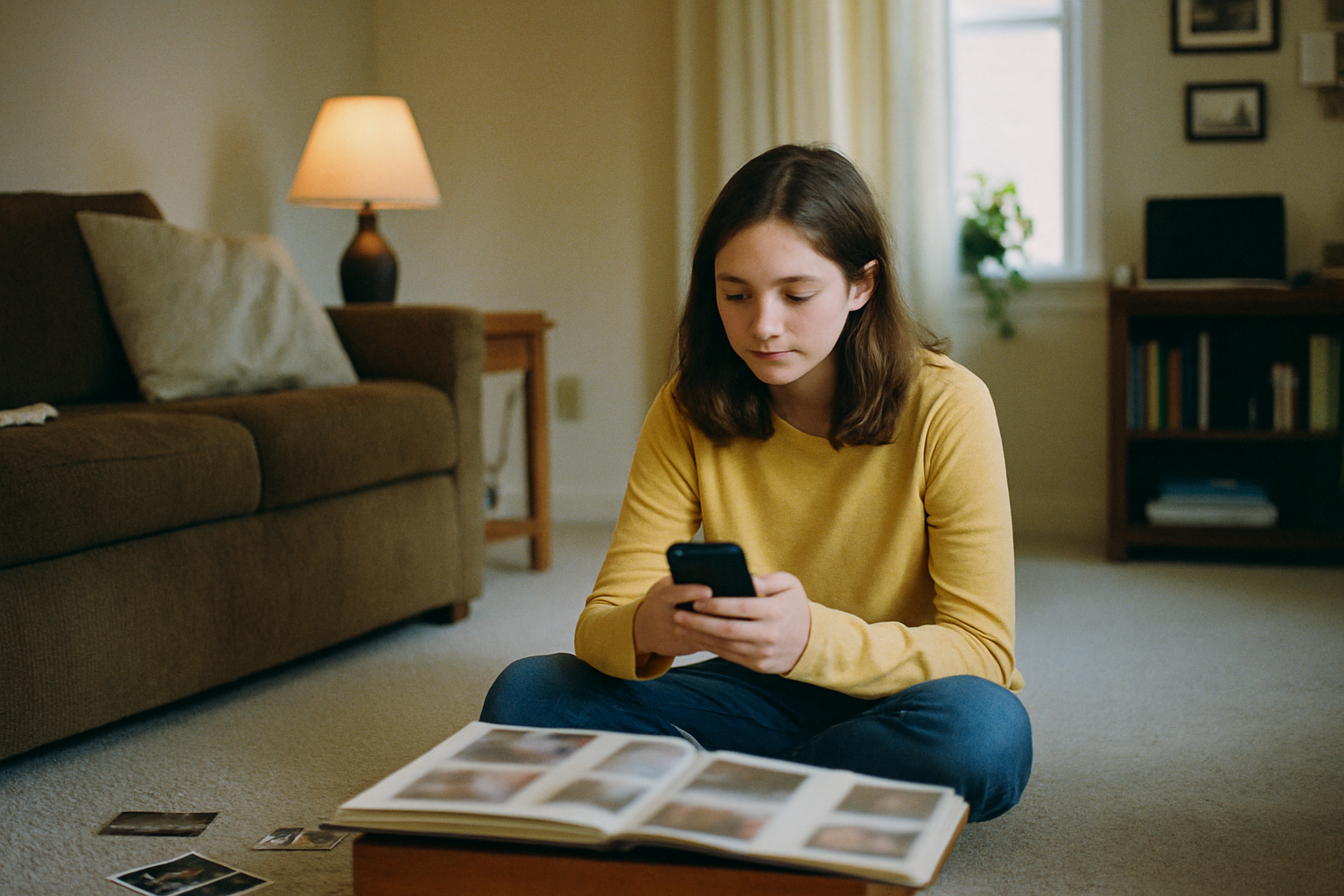
It's a familiar scene: you pick up your phone to check one thing—a text message, the weather—and an hour later, you look up, pulled from a digital trance. The immediate reaction is often a pang of guilt. We’ve all absorbed the narrative that screen time is the enemy of focus, connection, and even cognitive health.
For years, the advice has been simple: unplug, disconnect, reduce your hours. We picture our brains getting softer with every scroll, our memories fading with every tap. This story is so pervasive that any headline challenging it feels like a trick.
But what if the story is more complicated? What if the device in your hand isn't just a distraction machine but also a potential tool for cognitive engagement? A recent study has opened the door to this very question, forcing us to look past the simple metric of hours and minutes and toward a more nuanced understanding of our digital lives.
The short answer
A new study from EMJ found a surprising link between higher self-reported screen time and better cognitive function, challenging the simple belief that all screen time is harmful. This doesn't mean endless scrolling is good for you. Instead, it suggests the quality of our digital engagement is the crucial factor. The findings highlight the difference between passive consumption and active, meaningful tasks—like preserving family memories.
A Nuanced Picture Emerges
The conversation began swirling after a recent headline made its way through science news outlets. According to EMJ, a new study has linked self-reported screen time to better cognition. For those of us accustomed to digital-age doom and gloom, this sounds almost paradoxical. How could an activity so often associated with distraction be linked with positive cognitive outcomes?
The first step is to read past the headline. The study doesn't give us a license to spend our days lost in algorithmic feeds. Instead, it offers a crucial distinction. It highlights a correlation, not a causation. This means that the study observed two things happening together—people who reported more screen time also tended to perform better on certain cognitive tests—but it doesn't prove that one caused the other.
It's possible that people with higher cognitive function are simply more engaged with the world in various ways, including digitally. Or perhaps the type of screen time they engage in is fundamentally different. The study also relies on "self-reported" data, which can be subjective. We're not always the most accurate judges of our own habits.
But even with these caveats, the finding is significant. It cracks open the monolithic idea of "screen time" and forces us to ask a better question: not how much time are we spending, but how are we spending it?
The Quality of Your Clicks
Think about all the ways you can use a screen. You can spend an hour learning a new language on an app, collaborating on a project document, or having a heartfelt video call with a grandparent. You can also spend that same hour mindlessly scrolling through a social media feed, watching an endless stream of 15-second videos.
Both scenarios count as "screen time," but their effect on your brain is profoundly different. This is the difference between active engagement and passive consumption.
Active Digital Engagement
This is when you use technology as a tool for creation, connection, or learning. It requires focus and cognitive effort. Think of activities like editing a family video, transcribing an old family recipe, using a genealogy site to trace your roots, or organizing photos and stories into a cohesive narrative. These are tasks that build skills and strengthen neural pathways, much like the cognitive benefits of storytelling for seniors.
Passive Digital Consumption
This is the default state for much of modern internet use. It's driven by algorithms designed to capture and hold your attention with minimal effort from you. Scrolling through infinite feeds, binge-watching series, or letting autoplay guide you down a video rabbit hole are all forms of passive consumption. While relaxing in small doses, excessive passive use can lead to mental fatigue and a feeling of time lost rather than time spent.
The new study suggests that people with better cognitive performance might be using their devices for more active tasks. Their screen time isn't a void; it's a workshop, a classroom, or a community center. This reframing is especially powerful when we consider the role of technology in our family lives.
From Digital Clutter to Digital Legacy
For most of us, our family's most precious memories now exist as pixels. Decades of photos, videos, and messages are stored on our phones and in the cloud. We have more raw material for our family history than any generation before us. Yet, paradoxically, we often feel disconnected from it. The sheer volume is overwhelming, a digital shoebox filled with thousands of photos that aren't truly preserving memories.
Scrolling through your camera roll is a form of passive consumption. You see a flicker of a memory, but without context, it's just data. The story, the feeling, the voices of the people in the photo remain locked away. This is where the shift to active engagement can transform everything.
Active memory preservation means using your screen time to build something meaningful. It's about turning digital clutter into a curated family legacy.
Adding Context
Instead of just having a photo of your grandfather's first car, you use your time to write down the story he always told about it—the color, the smell, the road trips. That context is what gives the image life.
Recording Voices
You use your phone not just to text, but to record your mom telling a favorite family anecdote in her own voice. That audio becomes a treasure that a simple photograph could never replicate.
Connecting Generations
You actively share these curated stories with family members in a private, focused space, inviting them to add their own memories and perspectives. This fosters connection, not just content consumption.
Intentional Curation
You make conscious choices about which moments truly matter, transforming an overwhelming archive into a beautiful, accessible story of your family. This act of curation is itself a powerful cognitive exercise.
This is the very reason we built Memory Murals. We wanted to create a space that encourages this kind of active, intentional engagement with family history. It’s a tool designed to combat the passive scroll and help you build a living archive that enriches your life and connects your family.
A Mindful Approach to Memory Keeping
Technology presents us with a paradox. Our cameras can be so easy to use that they sometimes prevent us from being present in the moment, a phenomenon some call the photographic paradox. Our phones can connect us to loved ones across the globe or isolate us in a bubble of endless content. The device isn't inherently good or bad; the outcome is determined by our intention.
The recent study on screen time and cognition is not an endpoint, but an invitation. It invites us to stop feeling guilty about the clock and start being more mindful of our actions. It encourages us to ask: Is this activity enriching me, or is it just draining my attention? Am I creating something, or just consuming?
Choosing to actively preserve your family's story is one of the most rewarding ways to use your screen time. It turns a potential distraction into a tool for connection, reflection, and legacy. It's an investment in your family's future, built from the moments of its past.
At Memory Murals, we believe your family's story deserves a quiet, beautiful home, free from the noise and algorithms of social media. It's a private sanctuary where you can actively engage with the memories that matter most. If you're ready to shift your screen time from passive scrolling to active storytelling, we invite you to start building your family's archive today.
The conversation around our digital habits will continue to evolve. But this new research gives us a hopeful path forward. By focusing on quality over quantity, on creation over consumption, we can harness our technology not to escape our lives, but to more deeply understand them—and to preserve the stories that make us who we are.
Get 50 questions to ask your parents — before the stories are gone
The exact prompts families use to draw out the stories nobody ever wrote down. Free, straight to your inbox.
No spam. Unsubscribe anytime.
Frequently asked questions
What did the new study on screen time and cognition find?
A new study published by EMJ found a surprising link between self-reported screen time and better cognitive performance. The research challenges the common assumption that more screen time is inherently negative for cognitive health. It's important to note that this study highlights a correlation, not causation, and focuses on self-reported data. The findings suggest that the *type* of digital engagement might be more important than the total duration, opening up new avenues for understanding our digital habits and brain health.
Does more screen time improve your memory?
Not necessarily. The recent study suggests a correlation between screen time and better cognition, but it doesn't prove that one causes the other. The key takeaway is that active and engaging screen-based activities, like learning a new skill or interacting with family memories, may be different from passive consumption like endless scrolling. The quality and purpose of your screen time likely matter more for cognitive health and memory than just the total number of hours you spend on devices.
What is the difference between active and passive screen time?
Active screen time involves mentally engaging tasks like video calls with family, using an app to learn a language, organizing digital photos, or writing. It's interactive and requires cognitive effort. Passive screen time is about consumption, such as scrolling through social media feeds or binge-watching shows without much thought. Experts believe that active engagement is more likely to have cognitive benefits, while excessive passive consumption is often linked to negative outcomes.
How can I use screen time to help preserve family memories?
You can make screen time a tool for active memory preservation. Instead of just scrolling through old photos, use an app to digitize them and add context, stories, and voice notes. Schedule video calls with relatives to record their life stories. Use digital platforms specifically designed for building a private family archive. This shifts the activity from passive consumption to a meaningful, interactive project that strengthens family bonds and creates a lasting legacy for future generations.
Is social media bad for our memory?
The relationship is complex. While social media can connect us, its design often encourages passive scrolling and can present a distorted version of our past. Some research suggests this can interfere with how we form and recall authentic memories, a concept explored in the "hidden science of digital forgetting." The constant stream of curated content can overwhelm our ability to consolidate deep, personal memories. A private, focused space for family stories offers a healthier alternative.
About the author
Patrick Moore, Founder of Memory Murals
Patrick Moore is the founder of Memory Murals. He built it after realizing how much of his own family's history had quietly slipped away — to help families preserve their stories, voices, and photos while they still can.
Related Stories
Insights
Is Social Media Rewriting Your Childhood? The Hidden Science of "Digital Forgetting"
New research shows sharing photos online sharpens what's in-frame while erasing surrounding context. Here's how to protect the full story behind your memories.
Patrick Moore • February 21, 2026

Insights
The Photographic Paradox: Is Your Camera Stealing Your Memories?
The more we document, the less we may remember. Here's the science behind the photo-taking impairment effect — and how to use photos as cues instead of replacements.
Patrick Moore • February 23, 2026

Insights
Alzheimer's & Memory Loss: New Links to Inflammatory Processes
New research is uncovering a surprising link between inflammation and the brain changes seen in Alzheimer's disease. While science works on treatments, this complex connection highlights the urgency for families to preserve precious memories. Understanding the 'why' behind memory loss can empower us to focus on what matters most: the stories that define a life.
The Memory Murals Team • August 16, 2026
Preserve your family's memories in one private place.
Start free in minutes. No credit card required.