
Is Social Media Rewriting Your Childhood? Digital Forgetting
New research shows sharing photos online sharpens what's in-frame while erasing surrounding context. Here's how to protect the full story behind your memories.
Patrick Moore, Founder • February 21, 2026
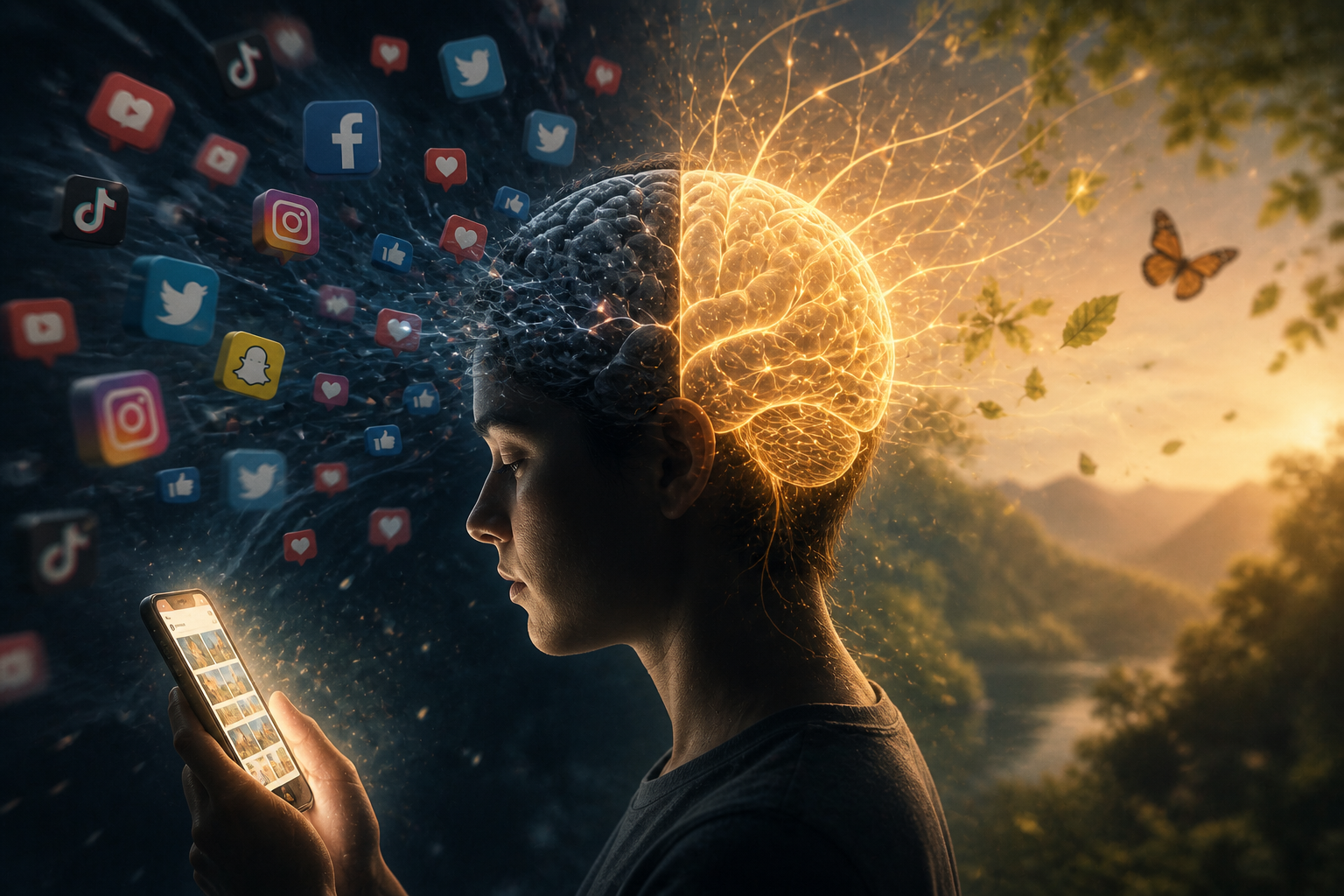
I was scrolling through old Instagram posts the other night -- a vacation photo from years ago, perfectly filtered, great caption. And I realized something unsettling: I don't actually remember that trip. I remember the photo. I remember posting it. But the sounds, the smells, the conversation we had at dinner that night? Gone.
That's not a personal failing. It's your brain doing exactly what it's designed to do -- and social media is making it worse.
The "Sharing Paradox": More Photos, Fewer Memories
We've always treated photographs as backup drives for our brains. Take a picture, preserve the moment. Simple.
Except it's not. Research published in Memory, Mind & Media (Cambridge University Press) in 2025 found something genuinely disturbing. The paper, by Wang, Q., et al., revealed a sharing paradox: when you share a photo online, your recall for details inside the frame gets sharper. The color of the cake, the pattern on someone's shirt, the angle of the sunset -- you'll remember those.
But your memory for everything outside the frame gets worse. The laughter just out of shot, the conversation that led to that smile, the smell of jasmine on the breeze -- those fade. The image you posted to preserve the moment is actually helping you forget it.
Why This Happens
It's not about weak memory. It's about priorities. When you repeatedly engage with a curated version of a memory (the shared photo), your brain tags those specific elements as high-priority. Everything else -- the "background noise" of life -- gets deprioritized and becomes harder to access over time.
Retrieval-Induced Forgetting: Your Brain's Ruthless Editor
The mechanism behind this has a name: Retrieval-Induced Forgetting (RIF). It's actually your brain being efficient, not broken.
Every time you retrieve a memory -- by looking at a posted photo, retelling the same highlight story, or replaying a "frame-worthy" moment in your head -- you strengthen the neural pathway to that specific detail. And to make that pathway even faster, your brain actively suppresses competing details from the same event. It's like a ruthless decluttering process. You keep what you access most and quietly discard what you don't.
This connects to how repeated recall shapes memory architecture, something we've explored in "The Biological Glue: How Your Brain Builds Your Legacy".
The Librarian Analogy
Think of your brain as a library. When you keep asking for the "Sunset Photo" book -- the one that got hundreds of likes -- the librarian moves it to the front desk. But to make room, she starts moving related books into the basement: what you ate that night, the music playing, the conversation you had. Over time, those basement books become nearly impossible to find.
The Digital Version
Every time you revisit a shared photo, you're training your brain to prioritize that image over the actual experience. The more often you look at it, the stronger the connection to the photo becomes, and the weaker the connection to everything that surrounded it. You're pruning the rich tapestry of your past down to its most frequently viewed threads.
This is why, despite having thousands of photos, we struggle to recall the nuances of a day -- the emotions, the conversations, the serendipitous stuff that wasn't "shareable." We wrote about a related angle in "The Photographic Paradox: Is Your Camera Stealing Your Memories?".
Your Internal Highlight Reel
We talk about the "highlight reel" in the context of comparing ourselves to other people online. But the scarier version is the internal highlight reel: when your primary interaction with your own past is through curated, publicly-facing posts, you start reducing your life story to a series of disconnected, two-dimensional snapshots.
I call this Narrative Thinning. Instead of a rich, layered story, your personal history becomes bullet points. You lose the texture, the context, and the "in-between" moments -- the unplanned, unpolished, vulnerable stuff that actually shapes identity and builds resilience.
Fades
Lost Context
Much of the surrounding memory context is weakened by repeated viewing of the same shared photo
Most
Digital Filters
A large share of social media users filter or edit their photos before posting
Millions
Photos Uploaded Daily
Countless photos are shared to social platforms every day, spreading the RIF effect across untold memories
What Gets Lost
The details most vulnerable to RIF are exactly the ones that make your story yours:
Sensory Context
Emotional Complexity
The Unpolished Truth
Without these layers, memories go from immersive experiences to intellectual acknowledgments. You know you were there, but you've lost what it felt like. This erosion contributes directly to what we've called the "Digital Orphan" Crisis -- where our digital footprints fail to capture the full story of our lives.
"Digital Amnesia" in 2026
The problem is getting worse. Data growth driven by AI means storage isn't infinite, and maintaining every digital file costs more every year. DigiKey and Counterpoint Research have documented the growing pressure on storage infrastructure and its economic impact.
So what do we do? We delete "extra" photos, videos, and files to save space. Which performs a digital version of the same pruning our brains are already doing through RIF. We're giving both our biological and digital systems permission to forget the "unimportant" parts of our lives.
But is any moment in your family's history truly unimportant? Is the blurry photo of a child's first step less valuable than a perfectly posed portrait? Is an unedited voice memo of a grandparent's story less critical than a polished video clip?
Deleting these "unimportant" pieces saves space. It also erases chapters. That's Digital Amnesia -- and it's why preserving your authentic story matters more now than it did five years ago. (We explored this further in "Your Legacy: The Private Sanctuary for Your Family's Truth".)
How to Protect Your Legacy
The goal isn't to stop taking photos or quit social media. Photos are useful. The goal is to shift from passive sharing to intentional preserving -- curating your memories for your future self and your family, not for an audience.
Three strategies that actually work:
1. Practice Sensory Anchoring
After taking a photo, pause for five seconds. Note one smell, one sound, and one physical sensation. This pairs the visual with non-visual cues, making the whole event more resilient against RIF.
2. Build a Private B-Roll Archive
Keep a space for photos you'd never post -- blurry candids, messy rooms, raw conversation snippets. These "imperfect" artifacts are often the strongest context cues for deep recall.
3. Narrate the Why, Not Just the What
Instead of "Great day at the beach!", write what you actually felt and why the moment mattered. This tells your brain the entire event is a priority, not just the frame-worthy image.
The Sensory Anchoring Technique
Take the Photo
Capture the moment as you normally would
Pause for 5 Seconds
Stop and deliberately engage your senses
Log Three Senses
Identify one smell, one sound, and one physical sensation from that exact moment
Record the Context
Write a private note pairing those sensory details with the emotional why behind the moment
Beyond the Snapshot
These practices build a richer connection to your past by engaging with context, emotion, and sensory details. For more ways to take control of your family's narrative, read "5 Gentle Ways to Start Your Family Archive".
This is why Memory Murals exists. Your life isn't a highlight reel. It's a messy, beautiful, layered thing, and it deserves a private space where you can preserve all of it -- not just the parts that get likes. Start your free 7-day trial today.
| Feature | Physical | Digital |
|---|---|---|
| Captures surrounding context | ||
| Records sensory and emotional details | ||
| Supports audio and voice memories | ||
| Private by default | ||
| Free from algorithmic manipulation | ||
| Designed for long-term preservation |
Captures surrounding context
- Physical
- Digital
Records sensory and emotional details
- Physical
- Digital
Supports audio and voice memories
- Physical
- Digital
Private by default
- Physical
- Digital
Free from algorithmic manipulation
- Physical
- Digital
Designed for long-term preservation
- Physical
- Digital
Don't Let Your Story Fade to a Filter
Your life isn't a gallery of perfect posts. It's a messy, beautiful, completely unique thing. Social media is fine for staying connected, but it's a terrible steward of your actual history. You and your family deserve a way to preserve the whole story -- the unedited truth that shaped who you are.
Preserve Your Family's Full Story
Memory Murals helps you capture the context, emotion, and voices behind your photos -- in a private space free from algorithms and public pressure. Record guided stories, save audio memories, and build a family archive designed to last. Start your free 7-day trial.
Frequently Asked Questions About Digital Forgetting
How does sharing photos online affect my memory?
It creates a "sharing paradox." Sharing a photo sharpens your recall for details inside the frame but weakens your memory for everything surrounding the event -- the sounds, smells, emotions, and conversations. This is driven by Retrieval-Induced Forgetting (RIF), a process where your brain strengthens frequently accessed details and suppresses competing ones. Research by Wang, Q., et al. (2025) in Memory, Mind & Media documented this effect.
What is Retrieval-Induced Forgetting (RIF)?
It's a natural brain process. Every time you recall a specific detail (like viewing a shared photo), the neural pathway to that detail gets stronger -- but competing details from the same event get actively suppressed. Your brain becomes more efficient at accessing the "target" memory, and other memories from the same moment become harder to reach. Over time, this leads to "narrative thinning" where the rich, emotional layers of your past gradually disappear, leaving just a highlight reel.
How can I protect my memories from "digital forgetting"?
Three things that work: 1) Practice sensory anchoring -- after taking a photo, note a smell, a sound, and a physical sensation to create richer memory traces. 2) Keep a private archive for unpolished, un-shareable photos and videos that provide crucial context. 3) Write about why a moment mattered, not just what happened. And use a dedicated preservation tool like Memory Murals to keep the full story safe.
Is digital storage reliable for long-term memory preservation?
It's getting harder. Storage costs are rising, data volumes are exploding, and most of us are deleting "extra" files to save space -- which performs a digital version of the same pruning our brains already do through RIF. Without intentional archiving and context, digital storage alone can actually contribute to amnesia rather than prevent it. Platforms like Memory Murals address this by providing a space specifically designed for rich, contextualized preservation.
Get 50 questions to ask your parents — before the stories are gone
The exact prompts families use to draw out the stories nobody ever wrote down. Free, straight to your inbox.
No spam. Unsubscribe anytime.
About the author
Patrick Moore, Founder of Memory Murals
Patrick Moore is the founder of Memory Murals. He built it after realizing how much of his own family's history had quietly slipped away — to help families preserve their stories, voices, and photos while they still can.
Related Stories

Insights
The Photographic Paradox: Is Your Camera Stealing Your Memories?
The more we document, the less we may remember. Here's the science behind the photo-taking impairment effect — and how to use photos as cues instead of replacements.
Patrick Moore • February 23, 2026
Pillar Articles
The "Digital Orphan" Crisis: Why 20,000 Photos Can't Replace One True Story
We're raising a generation of digital orphans — children with thousands of images but no context. Here's why family stories matter more than photos.
Patrick Moore • January 20, 2026

Pillar Articles
The Biological Glue: How Your Brain Builds Your Legacy
New research shows memory can be stabilized by physical structures in the brain. Here's what functional amyloids reveal about why some moments last a lifetime.
Patrick Moore • February 22, 2026
Preserve your family's memories in one private place.
Start free in minutes. No credit card required.