Is Legacybox Worth It?
You've seen the ads for Legacybox, the service that promises to easily digitize your shoeboxes of old photos, tapes, and films. But is it the right choice for your irreplaceable family memories? We break down the real costs, turnaround times, quality, and safety concerns to help you decide.
Patrick Moore, Founder • November 9, 2026

In a closet, or a corner of the attic, there’s a box. It’s filled with the textures of a life you know mostly through stories: the slick gloss of 70s photographs, the matte cardboard of slide mounts, the clatter of VHS tapes whose labels have faded to a pale, unreadable yellow.
You want to save them. You know they’re fragile, fading, and trapped in obsolete formats. But the task feels monumental, a mix of technical hurdles and emotional weight you can’t quite find the time to tackle.
Then, an ad appears. A simple, reassuring promise: a box you fill, send away, and receive back transformed into a neat digital library. This is the core appeal of Legacybox and similar mail-in digitizing services. But when the contents of that box are irreplaceable, is it a trusted partner or a risky gamble?
The short answer
Is Legacybox worth it? For those who value convenience above all else and have a mixed-media collection, it can be a simple, if pricey, solution. However, if your priorities are archival-quality scans, cost-effectiveness, the security of your originals, or a quick turnaround, you will likely find better value and peace of mind with a dedicated local scanning service or a thoughtful DIY approach.
The Promise of the All-in-One Box
The business model is built on simplicity. Instead of you figuring out what kind of scanner you need for film negatives or how to convert an audio cassette, they handle the logistics. The process is designed to feel as easy as possible.
The Legacybox Process
Order Your Kit
You choose a box size based on the number of items you plan to digitize (e.g., 10-item, 20-item). They ship you a sturdy box, pre-paid return shipping label, and barcode stickers for every item.
Pack Your Memories
You sort through your collection, applying a unique barcode to each tape, photo album, or film reel you want digitized. This is how they track your originals at their facility.
Ship It Back
Once packed, you drop the box off with their designated shipping partner (currently FedEx). You can follow its journey to their processing facility in Tennessee.
Digitization & Return
Their technicians clean and digitize your media. After the process is complete, they ship your original items back to you, along with your new digital copies on a thumb drive, DVD, or via a cloud download link.
On the surface, it’s a perfect solution for a widespread problem. But the value of the service depends entirely on how they execute on these steps, and whether the results align with your expectations.
Scan Quality: Convenience vs. Control
For many, the goal of digitization is simply to see and share an old photo on a modern screen. For this purpose, Legacybox's quality is generally sufficient. They deliver standard JPEG files from photos and MP4 files from videos.
However, if your goal is true archival preservation, the details matter. Archiving professionals typically scan photos at 600 DPI (dots per inch) or higher and save them in a lossless format like TIFF. This captures more detail and allows for future editing or large-format printing without quality loss. Legacybox provides one-size-fits-all processing, which is efficient for them but limiting for you. You don't get to choose your resolution or file type.
This is the fundamental trade-off: you're exchanging granular control for broad convenience. It's less like hiring a specialist and more like using an assembly line.
Shipping & Safety: The Journey of Your Originals
This is, without a doubt, the biggest source of anxiety for potential customers. Mailing the only existing photo of your great-grandparents is a leap of faith. To their credit, Legacybox has developed a system to mitigate this fear.
Robust Tracking System
Every single item gets its own barcode. You receive email updates as your order moves through their facility, from check-in to scanning to quality control. This provides a welcome sense of transparency.
The Inherent Risk of Mail
No matter how good the tracking is, the package still travels across the country and back. Shipping carriers can and do lose packages. While rare, the consequence of that small risk is the permanent loss of a memory.
Crush-Proof Packaging
They provide a well-designed, sturdy box that protects the contents from the normal bumps and bruises of transit, which is a step above using your own random cardboard box.
No Local Option
Unlike a local shop where you can hand-deliver your precious items and speak to the person who will handle them, the process is entirely remote and impersonal. For many, that face-to-face handoff provides crucial peace of mind.
Turnaround Time: Managing Expectations
If you need your photos digitized for an anniversary tribute next month, a mail-in service is likely not your best option. While marketing materials might suggest a process of a few weeks, user-reported timelines are often much, much longer.
10-12
Weeks
A commonly reported wait time, with some users waiting several months depending on order complexity and seasonal volume.
~80%
Of Media
Is processed in their main facility, but some formats may require specialized handling, potentially extending your wait.
It's essential to view this as a long-term project. Send your box, and then try to put it out of your mind for a season. The constant checking of order status can become a source of stress if your expectations are misaligned with the reality of their processing queue.
The True Cost: Unpacking the Pricing
Legacybox runs promotions so frequently that you should never pay the full list price. Their business model relies on a high perceived value followed by a steep discount.
But even with a 50% off coupon, the costs can add up. The pricing is per-item. One VHS tape is an item. One bag of 25 photos is an item. One reel of film is an item. A modest collection of 10 tapes and 100 photos (4 "items") can easily run into several hundred dollars.
Watch for the Upsells
Your digitized files are returned on the medium you choose—thumb drive, DVD set, or cloud download. Access to the cloud version often costs extra and may only be available for a limited time. Be sure to read the fine print to understand what you're getting and for how long. You'll want to immediately download and back up your files yourself.
When you compare this to the one-time cost of a high-quality photo scanner (around $200) or the per-scan price of a local service, Legacybox is often the most expensive option, especially for large archives consisting of a single media type like photos or slides.
Comparing Your Options
So, what's the right path? It depends on your personal balance of time, money, and peace of mind.
Legacybox
Local Scanning Service
DIY Scanning
For a deeper dive, check out our comparison of the best services to digitize old family photos.
Beyond Digitization: Preserving the Story
Getting your photos and videos into a digital format is a huge, important step. But it’s not the final one. A thumb drive full of generically named files (IMG_2051.jpg, tape_04.mp4) is better than a decaying box in the attic, but it’s still an unorganized pile.
This is where the real work of preservation begins: identifying the people in the photos, capturing the stories behind the videos, and connecting these moments to the larger narrative of your family. A folder of files doesn't tell you that the grainy Super 8 film is the only moving footage of your grandfather as a young man, or that the faded photo is from your parents' first date.
We built Memory Murals for this exact purpose. Digitization is the first step; context is the second. Once you have your digital files—whether from Legacybox, a local service, or your own scanner—you need a private, permanent home for them. A place to label, organize, and, most importantly, preserve the story behind them.
Your family’s stories deserve a safe place
Photos, voice recordings, and the stories behind them — private, ad-free, free to start.
Start preserving memories freeFree plan available • No credit card required
The goal isn't just to convert media. It's to safeguard meaning.
Whether you choose the all-in-one convenience of a mail-in service or the hands-on control of a home scanner, your effort is an act of love. You are carrying these moments forward, ensuring the faces and voices of the people you love are not forgotten.
The right choice is simply the one that gets it done. Once you have those precious files safe on your computer, the next step is giving them a home where they can be shared and understood. You can start building that private family archive today at Memory Murals.
Get 50 questions to ask your parents — before the stories are gone
The exact prompts families use to draw out the stories nobody ever wrote down. Free, straight to your inbox.
No spam. Unsubscribe anytime.
Frequently asked questions
What is the real cost of Legacybox?
The final cost of Legacybox depends on the number and type of items you send, as they charge per item. While they frequently run significant discounts, the total can quickly become several hundred dollars for a medium-sized collection. It's crucial to count your items and calculate the cost based on their current promotional pricing, as the initial 'box' price is just a starting point. Be mindful of potential upsells for digital access or extra copies.
Is it safe to send photos and tapes to Legacybox?
Legacybox provides a crush-proof box and uses a trackable shipping system with FedEx, which includes barcodes for tracking your order throughout their facility. While this system adds a layer of security, sending irreplaceable original media through any mail service always carries an inherent risk of loss or damage. Many users have a seamless experience, but it's a personal comfort level you must consider before shipping your only copies.
How long does Legacybox actually take?
While Legacybox often advertises a turnaround time of several weeks, customer reviews frequently report the process taking several months from the time they ship their box to when they receive their originals and digital copies. The actual duration can vary significantly based on order volume and the types of media being processed. It's wise to expect a longer wait than the initial estimate suggests.
What is the quality of Legacybox scans?
Legacybox provides standard-quality scans suitable for digital viewing and sharing on social media. However, for archival purposes, professional photo restoration, or large prints, the quality may not meet expert standards. They offer a single resolution level without options for higher DPI or specific file formats like TIFF. It's a service geared toward convenience and bulk processing rather than high-fidelity, archival-grade digitization.
Are there better alternatives to Legacybox?
Yes, alternatives exist depending on your priorities. Local scanning services often provide higher quality, faster turnaround, and eliminate shipping risks. For those on a budget with time to invest, a DIY approach using a good quality scanner offers the most control and lowest cost. For preserving the stories behind the media, a private digital archive app is the essential next step after any digitization method.
About the author
Patrick Moore, Founder of Memory Murals
Patrick Moore is the founder of Memory Murals. He built it after realizing how much of his own family's history had quietly slipped away — to help families preserve their stories, voices, and photos while they still can.
Related Stories
Comparisons
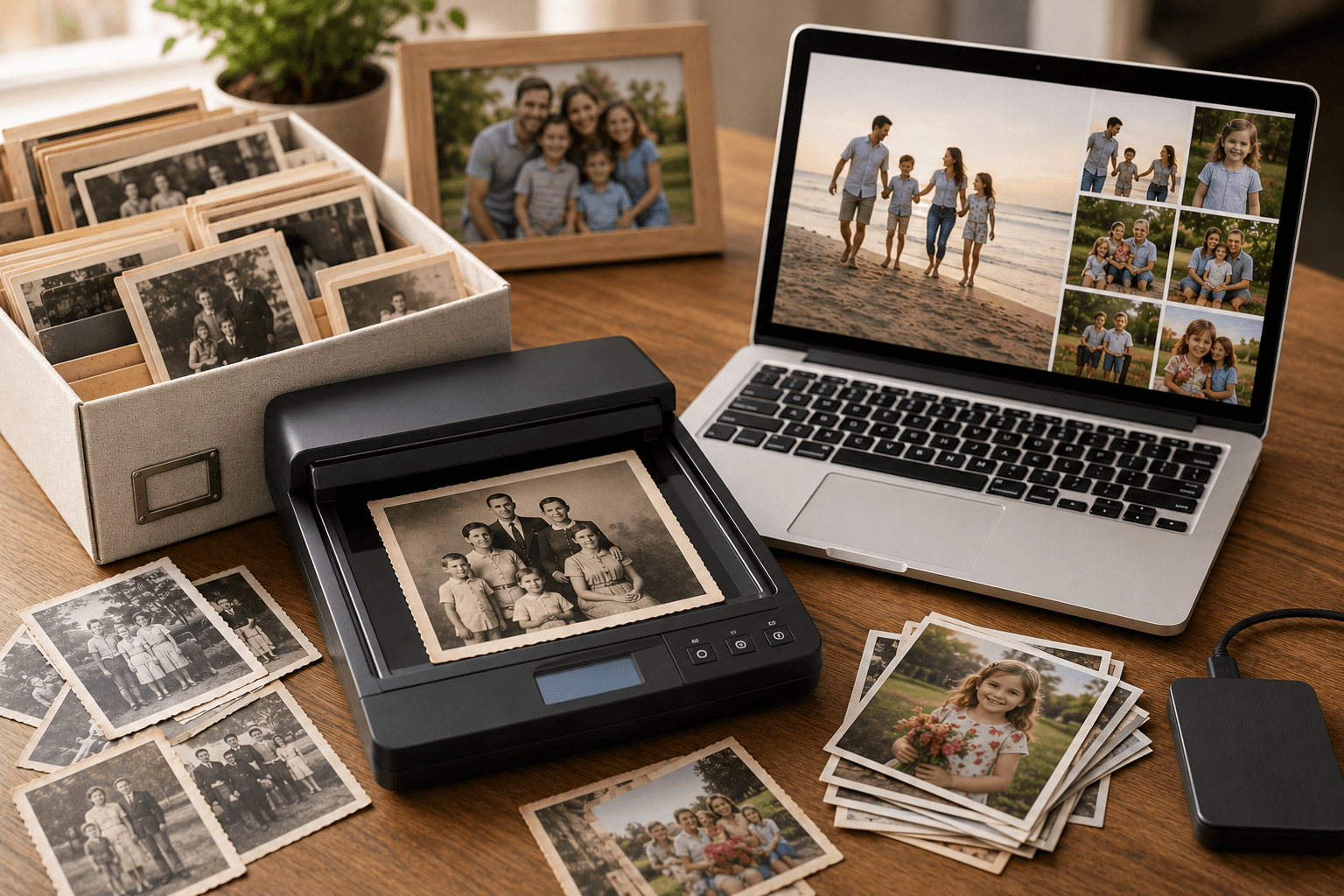
Best Photo Scanning Services for Old Family Photos (2026)
When you have a thousand photos and zero free weekends, paying a service makes sense. But 'per item' isn't 'per photo,' turnaround ranges from a week to three months, and almost nobody tells you what happens to your files. Here's the honest comparison.
Patrick Moore • May 27, 2026
How-To Guides
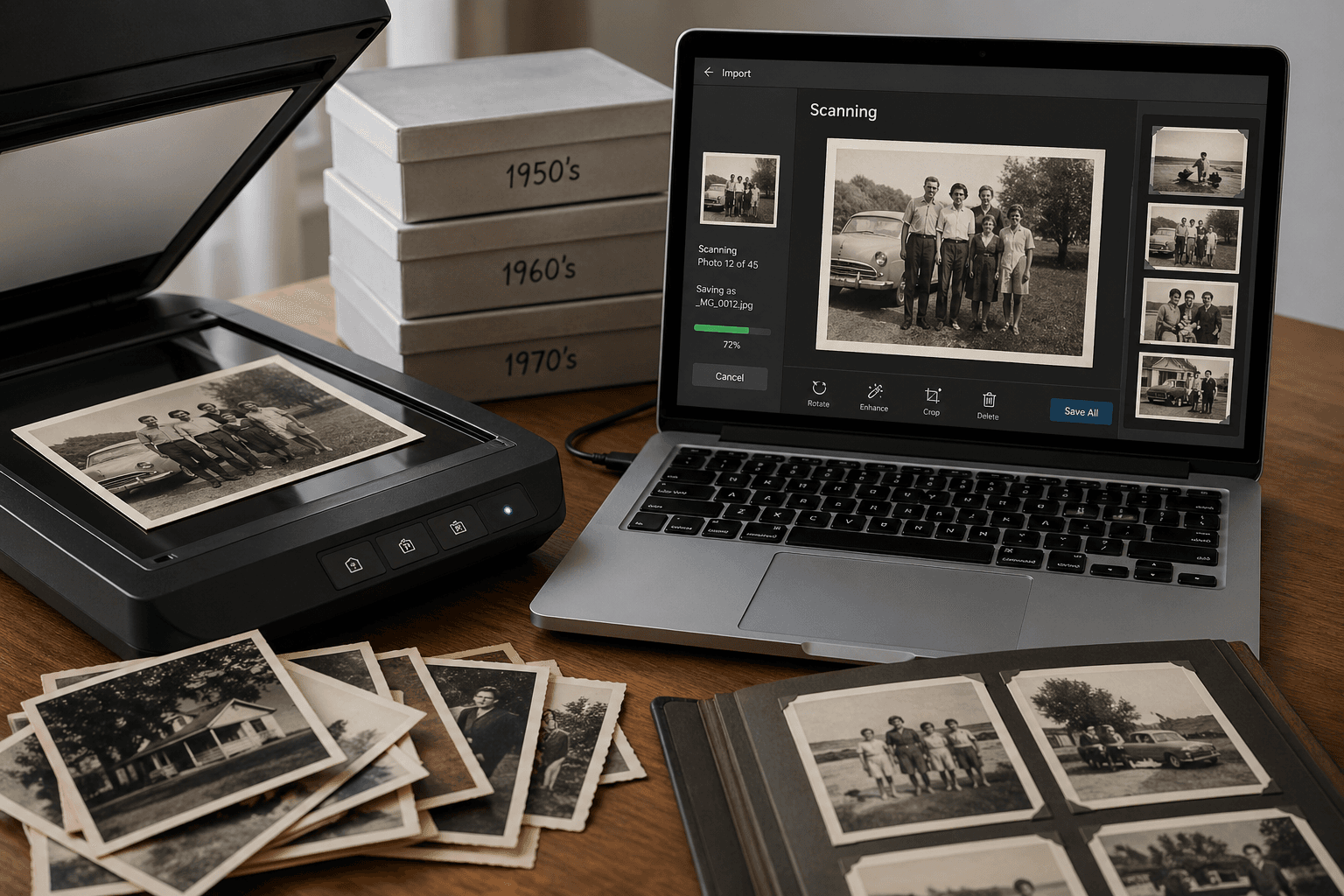
How to Digitize Old Photos at Home in 2026 (No Scanner Required)
A practical, no-fluff guide to turning a shoebox of old family photos into a digital archive — using just your phone, a flatbed scanner, or a mail-in service. Real tradeoffs, no jargon.
Patrick Moore • April 28, 2026

Comparisons
Google Photos Launches AI Video Remix: What it Means for Your Memories
Google Photos recently announced an AI Video Remix tool, promising to automatically create highlight reels from your family videos. But what does this mean for the real stories behind the clips? We explore the pros and cons of AI-generated video and how it compares to a more intentional approach to preserving your family's legacy.
Patrick Moore • July 20, 2026
See the version we built.
Voice-first, multi-contributor, and priced on one page — $12.99/mo, $99.99/yr, or a $7 weekend pass. Free for 7 days.