
Anniversary Tribute Ideas (2026)
1st, 10th, 25th, 50th, 60th — every anniversary calls for a different kind of tribute. Here's the milestone-by-milestone breakdown, plus 10 tribute ideas that work better than a card and a candle. Includes how to honor a couple when one spouse has died.
The Memory Murals Team • May 11, 2026
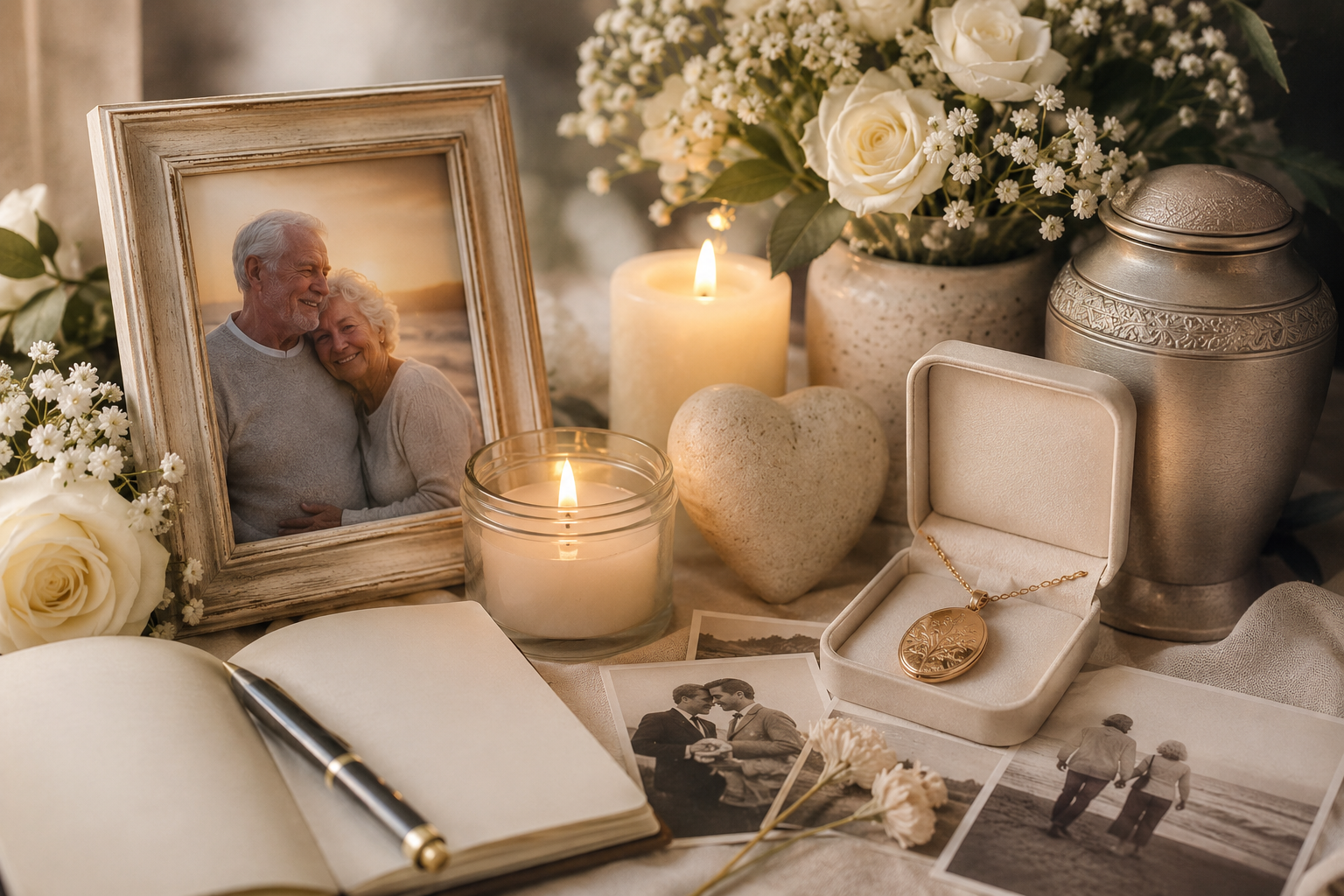
It's your parents' 50th anniversary. Or your grandparents' 60th. Or your aunt and uncle's 25th — the silver anniversary, the one that historically gets a party but that nobody seems quite sure what to actually do for. You can pick up another card and a bouquet, but you're trying to do something that lands a little harder than the standard $15 gift-shop play.
Anniversary tributes are different from birthday tributes in one structural way: they're about a couple, not a person. The tribute has to honor two people together — the relationship, the journey, the version of each of them that the other person has watched become who they are. That's harder than honoring one individual, and it's why most anniversary tributes settle for a card.
This post is the milestone-by-milestone breakdown of what works at each anniversary, plus ten tribute formats that work better than the floral arrangement. Including the tributes that work when one spouse is no longer here.
Disclosure
We built Memory Murals, a voice-first family archive. Several of these tributes involve recording stories or voices — we mention our tool where it fits and otherwise stay out of the way. Most of these work with the phone you already have.
The 30-second answer
The one tribute that works for almost every anniversary from the 10th onward: A recorded "how we met" story from the couple — separately, then together. Saved permanently. Played as part of the celebration.
For 25th and 50th anniversaries: Layer in the children's tribute — short audio or video messages from each kid (and grandkids, if any) saying what they've learned from watching their parents stay together.
For 60th and 70th: Pivot from celebrating the future to honoring the past. The tribute that earns a 60th is about what the marriage built, not what comes next.
When one spouse has died: Honor the marriage anyway. The anniversary doesn't stop existing because one person did.
Not every anniversary deserves the same tribute. Here's what each calls for.
1st anniversary. Tender, optimistic, often quiet. Tributes that work: paper artifacts (the "paper anniversary" tradition is real and good). A handwritten letter from each spouse. A printed memento of the wedding. Tributes to avoid: anything that asks them to prove the marriage. They've been married a year. Let them celebrate it.
5th–10th anniversary. The "early years" anniversaries. Often celebrated quietly. Tributes that work: photos of the marriage so far. A small renewal of vows. Captured moments — the start of a tradition that will repeat at later milestones. Strong reference point: the "how we met" recording works beautifully here because the couple is still close enough to the early days to remember the texture.
15th–20th anniversary. The "deep middle." Often the busiest years of a marriage — careers, kids, mortgages. Tributes that work: anything that gives the couple space to remember they're a couple, not just co-parents. A weekend away. A photo album of just the two of them, with no kids in the frame.
25th anniversary (silver). The first major milestone. Often the moment a family rallies for a tribute. Tributes that work: a children's tribute, a "things we've learned from watching you" video from family and friends, a recreated wedding photo, a vow renewal. Big enough to deserve a party; not so far along that the couple isn't fully alive in the moment.
30th–40th anniversary. Less marked culturally but emotionally weighty. The couple has typically watched kids grow into adults, parents pass, careers peak. Tributes that work: anniversaries that name what they specifically built together, separate from how the world saw it.
50th anniversary (gold). The big one. Often involves extended family, grandchildren, sometimes great-grandchildren. Tributes that work: full multi-generational tributes. Recorded "how we met" stories preserved as family heirlooms. Children's tributes. Letter books from across the marriage. Worth investing real time into.
60th–70th anniversary. Rare and treasured. Most couples don't get to 60. The energy is different — more aware of mortality, more grateful, often quieter. Tributes that work: smaller, more intimate gatherings. The tribute that names what the couple built and taught others. Honoring impact, not future. The 60th anniversary often comes with one spouse in declining health; the tribute has to read the room.
The single most universal anniversary tribute. Works at every milestone from the 10th onward, gets richer with each decade.
The premise: Each spouse records, separately, the story of how they met. Five minutes each. Audio or video. Then — and this is the part that makes it work — record them telling the story together, comparing notes, correcting each other, laughing at the parts where their memories diverge. The total recording runs 15–25 minutes.
Why this works: Couples have told the "how we met" story a thousand times, in fragments, at parties, over the years. They've rarely told it in full, on the record, with both perspectives interleaved. The recording captures something that exists in their relationship but has never been preserved.
The decade rule: This tribute gets better with anniversary distance. At year 10, the story is fresh but partially shared. At year 50, the story has aged into a family legend, each spouse remembers slightly different details, and the recording becomes the definitive version the grandchildren will eventually hear.
Logistics: Quiet room. Phone or audio recorder on the table between them. Ask them to start with "Tell me how you met" and let them go. Don't interrupt. Plan for 30 minutes; the natural conversation will fill it.
Save the recording. Save it well. A voice memo on a phone is fine for capture but not for permanence — move it to a voice-first family archive or similar durable storage. The recording is the artifact; treat it like an heirloom.
The tribute that lands hardest at the major milestones, especially when it's a surprise.
The premise: Each child of the couple (and each grandchild, if you want) records a short message — 60–90 seconds — answering a single specific question. The messages get assembled into a video reel that plays during the anniversary celebration.
Question options that produce good answers:
- "What did you learn about love from watching Mom and Dad together?"
- "What's one thing they did as a couple — not as parents — that you've tried to carry into your own life?"
- "What's a moment between them that you wish you could ask them about?"
- "What's something they don't know you noticed?"
The format constraint that matters: All contributors answer the same question, not different ones. The chorus of perspectives on a single prompt produces a tribute with shape, not a sprawling montage.
At 50th anniversaries: Often grandchildren join. The youngest grandchild might be five and just say "I love Grandma and Grandpa." The oldest is 35 with their own kids. The full age range is the texture of the tribute.
The artifact afterward: Save it. This is the kind of thing the children will treasure when their parents are gone. Don't let it live only on a phone that'll get replaced.
A small, photogenic, often-underused anniversary tribute.
The premise: Recreate one specific photo from the couple's wedding day. Same pose, same outfit (or modern equivalents), same setting if possible. Print both side-by-side. Frame.
Best ages for this: Works at every anniversary from the 10th onward; lands hardest at 25th, 50th, and beyond. The visual contrast — two photos, same pose, decades apart — does the storytelling work without anyone saying anything.
A variant for couples who can travel: Visit the original wedding venue on the anniversary. Take a photo standing in the same spot. The visit is the tribute, the photo is the artifact.
A variant for couples who can't travel: Use the home as the venue. The kitchen they've cooked in for 40 years is itself a meaningful background. The recreation can be at the kitchen table just as well as at the church where they got married.
A tribute that the couple makes for each other, with the family helping set the conditions.
The premise: In the weeks before the anniversary, each spouse separately writes a letter to the other. Not "happy anniversary" — a real letter. Specific. Things they've never said. A memory they treasure. A way the other person has changed them.
The exchange: Both letters are handed over at the anniversary celebration, in a quiet moment. The couple reads them privately — not aloud at the party. This is intimate; let it be intimate.
Why this works at every milestone: Most long marriages have stretches where the daily logistics of life crowd out the conversation that produced the marriage in the first place. The letter is a forcing function for that conversation. Both spouses write things they've forgotten to say.
Audio version: Some couples are more honest in voice than on the page. A 5-minute recorded letter from each spouse, exchanged at the anniversary, works the same way. We're biased toward voice formats — they age better — but the principle holds for either.
The traditional anniversary tribute, with one update.
The traditional version: A photo album of the marriage — wedding, kids, vacations, holidays, milestones. Printed. Bound. Given as a gift.
The 2026 update: Make the album interactive. A photo album where each page has a QR code linking to a 1-2 minute audio recording from someone in the photo — the bride and groom on their wedding day, the child being held at their baptism, the family at the 25th anniversary trip. The album becomes a playable memory.
Honest format note: The QR-coded album is more work than the standard one. Skip it if you're under time pressure. The traditional photo album, well-chosen and well-printed, still works.
Tool note: Our roundup of memory-sharing apps covers options for the recording-and-organizing side of this format if you don't want to assemble it manually.
For couples who don't want more stuff — increasingly common from the 25th anniversary onward.
Formats that work:
- A weekend at a place that's mattered to them. The honeymoon hotel. The cabin they spent 20 summers at. The town where they had their first apartment.
- A meal at the restaurant of their first date (if it's still around) or a restaurant in the city of their first date (if it isn't).
- An activity that's a callback to early in the relationship — a concert by an artist they used to see together, a hike they used to take, a class they used to plan to take "someday."
- A renewal of vows. Small, with immediate family. A line each: what would they say now?
Why this works: Anniversaries are inherently temporal — they're about a relationship across time. A shared experience folds the past of the relationship back into the present of it. The wrapped gift sits on a shelf; the experience becomes a new chapter.
The trip-with-camera framing: Plan the experience around a specific moment to capture — a photo, a recording, a written reflection. The experience is the gift; the captured moment is the artifact that survives it.
The hardest tribute to get right. The wrong version turns the anniversary into a memorial service for the deceased spouse. The right version honors the marriage that existed without erasing the present.
What works:
- The surviving spouse can mark the anniversary alone, with family present but not central. A quiet meal at home with the kids and a recording of the deceased played at some point.
- A recorded interview with the surviving spouse about the marriage. The recording is for the future — for grandchildren, for a family archive — not for performance.
- A photo and a candle. Small. Quiet. The anniversary doesn't stop existing because one person did.
- For very-late-life surviving spouses: a tribute from the children that names what the marriage built — the family, the values, the home — without making the deceased the centerpiece.
What doesn't work:
- A surprise gathering that the surviving spouse hasn't consented to. Anniversaries after a loss are emotionally complex; don't force the energy.
- A tribute that erases the deceased. If the surviving spouse wants to talk about them, let them.
- A tribute that elevates the deceased so far that the surviving spouse feels invisible. The marriage was both of them. Honor both, including the one who's still here.
For the family supporting a surviving spouse on an anniversary: Reach out a few days before. Ask what they want. Some surviving spouses want company. Some want solitude. Some want to mark the day; some want to skip it. Listen and follow their lead.
A variant of the children's tribute, with a specific format that works particularly well at 50th and 60th anniversaries.
The premise: Each child writes a one-page letter to both parents. Not separate letters to Mom and Dad — one letter, addressed to the marriage. The letters are read aloud, one at a time, at the anniversary celebration.
Why this lands: The marriage is the entity being honored. Most family tributes inadvertently honor individuals — Mom, Dad — rather than the partnership between them. The letter addressed to the marriage itself is structurally different. The phrasing forces the writer to think about the couple as a unit.
Reading aloud vs. presenting privately: Public reading lands harder but is emotionally heavier; private presentation is safer for older or more reserved parents. Read your audience. The 30-year-old parent at her own 5th anniversary will tolerate the public version. The 88-year-old grandfather at his 60th may prefer the private one.
One letter or several: Both work. A single letter from the oldest child as a representative speech works at smaller gatherings. Several short letters from each child stack up to a fuller tribute at bigger ones.
A format that honors the couple's impact on other relationships — not just their own.
The premise: In the weeks before the anniversary, you reach out to close friends, siblings, cousins, and other family members and ask: "What's one thing you learned about love or marriage from watching [couple]?" Collect 8–15 specific responses. Compile into a written tribute or a short recorded one. Present at the celebration.
Why this works at long milestones: A 50- or 60-year marriage has been watched by an entire network of people across decades. Those people have picked up things from it without ever telling the couple. The tribute names what they took away. Often the couple has no idea they were teaching anything.
Sourcing tip: Many of the most-moving answers come from people who saw the couple at specific stages — the friend who watched them survive a particular hard year, the niece who lived with them one summer, the colleague who carpooled with one of them for fifteen years. Cast wide. The unexpected sources often produce the best answers.
A tribute that doesn't end with the celebration — it starts something.
The premise: Pick one tradition the couple has had across their marriage (a yearly trip, a Sunday breakfast, a holiday they always host) and pledge to continue it in their honor for as long as it makes sense. The pledge is the tribute. The continuation is the artifact.
Examples that work:
- "We're going to host the Easter dinner at our house from now on, the way you did for 40 years."
- "We're going to take the kids to the cabin you took us to, every summer, for as long as we can."
- "We're going to keep up your weekly Sunday call to Aunt Marcie."
Why this works: Long marriages produce traditions that nobody else thinks of as load-bearing until they end. Pledging to continue one signals that the marriage produced something that didn't depend solely on the couple — that the next generation will carry forward what the couple built.
Format: A short written note, given to the couple at the anniversary. The act of continuing it is the part that matters. The note is the announcement.
A few patterns to skip.
The gift that ignores the couple's actual interests. Anniversary gift "rules" by year (paper, cotton, silver, gold) are folklore, not commandments. Skip them if they push you toward something the couple doesn't actually want.
The slideshow that's just kids and grandkids. The marriage existed before the kids. Photos from just the couple — the dating photos, the early-married photos, the trip without children — should be in any anniversary tribute. The kids are part of the story; they're not the whole story.
The roast. Wedding-style roasts work because the couple is just starting out and can take it. Anniversary roasts often fall flat because the couple has heard the bits for decades and the energy of teasing belongs to a different stage of the relationship.
The "your love inspires us all" generic tribute. Specific or skip. Tributes that say "you two are amazing" without naming why are background noise. One specific thing — beats — beats ten general ones.
The party that drags on when one spouse is in poor health. Read the room. A 90-minute anniversary lunch may be the right length for an 80-year-old couple at their 60th, even if "the kids wanted to do more." Match the energy to the honorees, not to the family's appetite for celebration.
The 'how we met' recording
Audio of each spouse separately, then together comparing notes. Gets richer with anniversary distance. The 50th-anniversary version is the family legend in their own voices.
The children's tribute video for 25/50
Single shared question, 60-second answers from each child and grandchild, edited into a 5-10 minute reel. Almost always makes the couple cry.
The recreated wedding photo
Same pose, decades apart. The visual contrast does the work. Low effort, high artifact value.
The letter to the marriage itself
Each child writes a one-page letter addressed to the couple as a unit, not to Mom or Dad separately. Structurally different — and lands differently.
A tradition pledge instead of a gift
Pledging to continue a tradition the couple built signals that what they made has roots beyond them.
The slideshow that's only kids and grandkids
The marriage existed before the kids. Include photos of just the couple — dating, early-married, child-free trips. The kids are part of the story, not the whole story.
The generic 'your love inspires us' tribute
Specific or skip. One named moment beats ten general compliments.
Anniversary 'gift rule' shopping (paper, silver, gold)
Folklore, not commandments. Skip if they push toward something the couple doesn't actually want.
The drawn-out party for couples in late-stage health
Match the celebration to the honorees' energy, not the family's appetite. A 90-minute lunch can be the right length.
The honest verdict
The anniversary tributes that get felt are the ones that honor the marriage itself as the entity being celebrated — not just the two individuals who happen to be in it. A recorded "how we met" story preserved as a family heirloom; a children's tribute where each contributor answers the same specific question about the couple; a tradition pledged forward instead of a wrapped gift. These tributes name what the couple built together, which is something neither spouse fully sees while it's being built. The card and the bouquet are the floor. The recording, the letter, and the named impact are the ceiling. For surviving spouses on an anniversary after a partner's death: mark the day, honor the marriage, and follow the surviving spouse's lead on how present or quiet the tribute should be.
If you want a place to keep the recordings, letters, and photos so they don't end up scattered across phones and shoeboxes, give Memory Murals a try — we built it for the kind of multi-generational family archive that an anniversary deserves. And the companion post on wedding tributes covers the formats that work earlier in a couple's story, while the retirement tribute roundup handles the late-life career milestone that often falls in the same season as a big anniversary. If you're trying to evaluate tools for the recordings themselves, our honest review of Memorygram and Memory Murals compares the two main approaches to long-term archive ownership.
What's a meaningful 50th anniversary tribute for parents?
The format that lands hardest is a multi-layered tribute: a children's video where each child (and grandchild) answers the same specific question about the couple ("what did you learn about love from watching them?"); a recorded "how we met" story from the couple themselves; a recreated wedding photo. Save all three permanently as family artifacts. The 50th is the milestone where investing real time pays off — the recording becomes the kind of thing your kids' kids will play in 40 years.
What do you do for a 25th anniversary?
The silver anniversary is the first major milestone, and it deserves more than a card. Tributes that work: a children's tribute (the kids are usually in their teens or 20s and can produce thoughtful answers), a vow renewal with just immediate family present, a recreated wedding photo, a "things we've learned" tribute from siblings and close friends. Don't over-invest if the couple is private — a single well-chosen tribute beats five half-hearted ones.
How do you honor a couple on their wedding anniversary when one spouse has died?
Mark the day, honor the marriage, follow the surviving spouse's lead. Some surviving spouses want company on anniversaries after a loss; some want solitude. Reach out a few days before and ask what they want. Tributes that work when invited: a recorded interview with the surviving spouse about the marriage (an artifact for the family archive); a small dinner with children and grandchildren; a photo and a candle. What to avoid: surprises, public emotional displays, tributes that erase the surviving spouse from the story.
What's a unique anniversary gift idea besides flowers?
A recorded "how we met" story from the couple, preserved as a family artifact. It costs zero dollars to produce (a phone records audio fine) and becomes the most valuable anniversary tribute in the family archive within a few decades. For older couples especially, the recording is the kind of thing nobody thinks to make until it's too late. Pair with a small physical gift if the recipient expects one, but the recording is the part that lasts.
How do you write a meaningful anniversary tribute?
One specific moment, described concretely. Not "you've inspired us all" — "I still remember the time Dad stayed up making your birthday cake from scratch when the bakery cancelled, and you laughed at how lopsided it turned out." Specificity does the work. Address the tribute to the marriage, not to Mom and Dad separately — the partnership is the entity being celebrated. Keep it under 400 words written or 90 seconds spoken. The short, specific tribute lands harder than the long, general one.
Related Stories
Wedding Tribute Ideas That Last Beyond the Slideshow (2026)
The wedding slideshow has become the default tribute, and most of them get watched once. Here are 11 wedding tribute ideas that last longer — honoring parents, grandparents, and people who couldn't be there. Plus an honest take on what works and what feels forced.
The Memory Murals Team • May 11, 2026

Retirement Tribute Ideas: Meaningful Ways to Honor a Career (2026)
The retirement watch is dead. Here are 10 tributes that actually honor a career — the kind that capture decades of work, the people it shaped, and the version of the person nobody outside the office got to know. Plus what to skip.
The Memory Murals Team • May 11, 2026

Voice Recording Books for Grandparents: What Actually Works (and What Feels Gimmicky)
A voice recording book can turn a grandparent's storytelling into something your kids will actually hear someday. But there's a wide gap between the gimmicky ones and the ones that really work. Here's what to look for.
The Memory Murals Team • April 14, 2026