AI and Genealogy: Bringing Family Records to Life
AI is no longer just science fiction; it's a powerful new partner for anyone exploring their family tree. From automatically colorizing black-and-white photos to deciphering faded handwriting on census records, artificial intelligence is revolutionizing genealogy. Discover how these new tools are making family history more accessible and vivid than ever before.
Patrick Moore, Founder • August 22, 2026

Picture a shoebox of old family photos. In one, a stern-looking woman in a high-collared dress stares back from a faded, sepia-toned world. She’s your great-great-grandmother, but she feels like a character from a history book, distant and unknowable. In another, a handwritten census record from 1910 lists her husband's occupation, but the looping cursive is so dense and the ink so faded it’s nearly impossible to read.
For generations, this has been the work of the family historian: squinting, guessing, and piecing together a fragmented story from brittle paper and ghostly images. It’s a labor of love, but one that often hits dead ends. What if you could see that photo in color? What if you could read that document as clearly as an email?
This isn't a future fantasy. It’s happening right now. Artificial intelligence is quietly transforming the world of genealogy, acting as a powerful new lens through which we can view our past. It’s not about replacing the human touch of discovery, but augmenting it, breaking down old barriers and bringing our ancestors’ worlds to life in ways we never thought possible.
The short answer
Artificial intelligence is changing genealogy by automating complex and time-consuming tasks. AI-powered tools can now decipher faded, historical handwriting on documents like census records, making them searchable. They can also restore, colorize, and enhance old, damaged photographs, bringing faces from the past into stunning clarity. Furthermore, AI analyzes massive datasets to uncover hidden connections and suggest potential ancestors, acting as a powerful assistant that makes family history research faster, more accessible, and more visually compelling than ever before.
Deciphering the Past: AI and Historical Documents
One of the biggest hurdles in genealogy has always been the records themselves. Before typewriters became common, every official document—from ship manifests and military records to birth certificates and census forms—was written by hand. Over a century, ink fades, paper yellows, and handwriting styles that were once common become alien to the modern eye.
This is where a technology called Handwriting Recognition Technology (HRT), powered by AI, is making a monumental impact. By training algorithms on millions of historical documents, companies are creating AI that can read and transcribe even the most challenging script with remarkable accuracy.
This does more than just save time. It unlocks information that was effectively lost. A name misspelled by a census taker or an ancestor who signed with an 'X' might have been a dead end. Now, AI can cross-reference records, understand phonetic spellings, and piece together clues from surrounding data to suggest a match. It turns a static image of a document into a dynamic, searchable piece of data.
How AI Transcribes a Historical Document
Digitization
A high-resolution scan or photograph of the original document is created, capturing every detail of the ink and paper.
Pattern Analysis
The AI analyzes the image, identifying the patterns of handwriting—the loops, strokes, and spacing—that form letters and words.
Transcription
Drawing on its training, the AI converts the identified patterns into digital text, creating a machine-readable version of the document.
Indexing and Searching
The transcribed text is indexed, allowing researchers to instantly search for names, dates, and places across millions of records.
Bringing Faces to Life: AI-Powered Photo Enhancement
While documents provide the facts of our ancestors' lives, photographs provide the soul. They are our most direct connection to the people we never met. AI is making this connection more profound than ever.
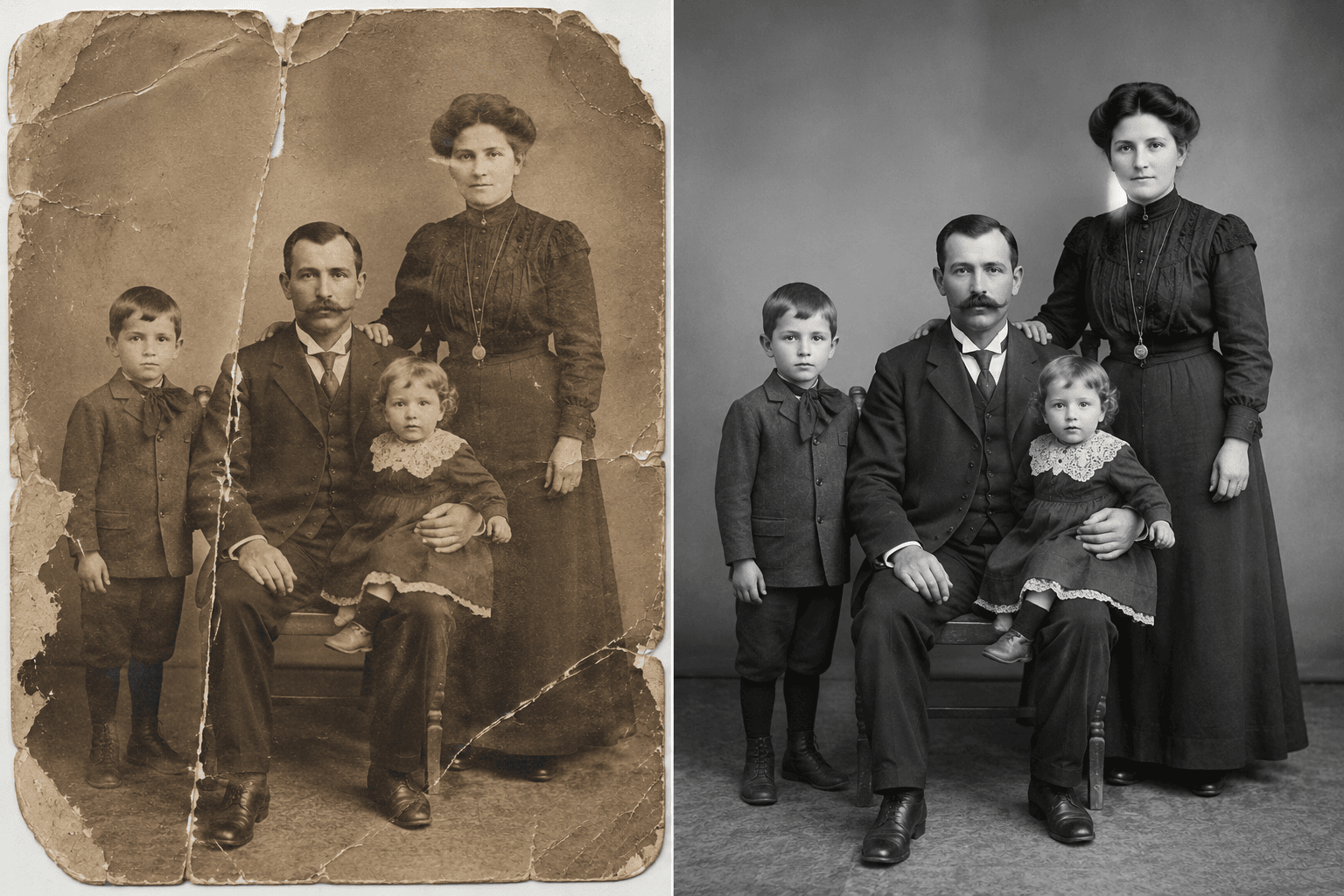
You've likely seen the results on social media: a black-and-white portrait of Abraham Lincoln suddenly in full, realistic color. The same technology is now available to everyone. AI can restore old photos with AI, repairing cracks, tears, and water damage. It can sharpen blurry images, revealing details in a face or a piece of clothing that were previously invisible.
Beyond colorization and repair, AI-powered facial recognition is helping to solve one of the most common family mysteries: the box of unlabeled family photos. By uploading a known photo of an ancestor, these systems can scan entire collections and identify that same person at different ages or in group shots, finally putting names to faces.
Of course, this technology requires a thoughtful approach.
More Relatable History
Seeing an ancestor in color can be a powerful experience. It bridges the gap of time, making them feel less like a historical artifact and more like a real person you could have known. It helps us connect emotionally to our own history.
An Artistic Interpretation
It's important to remember that AI colorization is an educated guess. The AI doesn't know the color of your great-grandmother's dress; it makes a logical choice based on the data it was trained on. The result is a beautiful interpretation, not a historical fact.
Uncovering Hidden Connections
Perhaps the most powerful application of AI in genealogy is its ability to work at a scale no human could ever manage. A dedicated researcher might spend a lifetime poring over records. An AI can analyze billions of them in seconds.
This is leading to breakthroughs in what's known as record matching. Instead of just looking for an exact name and date, AI can understand context. It knows that "Wm." and "William" are the same name, that a person might appear in a census record in Ohio and a military record in Virginia a few years later, and that a town's name might have changed over time. It can weigh the probability of a match based on dozens of data points.
This allows AI to suggest potential family connections that would be almost impossible to find manually. It might spot a pattern of migration from a specific village in Italy to a particular neighborhood in Chicago, connecting your family to a broader community. Or it might find a marriage record for a previously unknown sibling by matching the names of the parents. It's like having a team of a thousand research assistants working for you around the clock.
Your New Research Assistant
With all this power, it's easy to think AI might make the genealogist obsolete. But the opposite is true. AI is the ultimate assistant, handling the heavy lifting of data processing so that you can focus on the most human part of the work: analysis, storytelling, and verification.
AI makes mistakes. It can misread a name or suggest a connection that turns out to be a coincidence. The role of the family historian is more important than ever: to critically evaluate the clues AI provides, to seek out original source documents, and to weave the data points into a true and meaningful narrative.
This also highlights the crucial difference between public genealogy platforms and a private family archive. Platforms like Ancestry use your data to power their discovery engines, which is incredibly useful for research. But the goal of research is different from the goal of preservation. A family archive is about context and story, not just data.
A Word of Caution on Privacy
When you use online AI tools, especially free ones, it's vital to consider your privacy. Many services use the photos and data you upload to further train their AI models. Your great-grandmother's portrait could become part of a dataset sold to other companies. For something as personal as family history, it's essential to choose platforms that respect your ownership and privacy. At Memory Murals, we believe your family's history belongs to you, period. Our platform is a private sanctuary, not a data source for AI training.
AI is opening a new, exhilarating chapter in the age-old quest to understand where we come from. It's dusting off forgotten records, adding color to black-and-white worlds, and helping us see the faces of our ancestors with new eyes. It collapses the distance between their time and ours.
The work of discovering these stories is one part of the journey. The other is to preserve them. Once you've used these incredible tools to bring your history to life, the next step is to gather those enhanced photos, transcribed letters, and uncovered stories in a safe, permanent home. At Memory Murals, we've built a private space for just that purpose. You can start your own family archive today and ensure these stories are cherished for generations to come.
Ultimately, the goal isn't just to build a bigger family tree. It's to understand the lives lived, the challenges overcome, and the legacy passed down. And thanks to these new tools, that legacy has never felt more alive.
Get 50 questions to ask your parents — before the stories are gone
The exact prompts families use to draw out the stories nobody ever wrote down. Free, straight to your inbox.
No spam. Unsubscribe anytime.
Frequently asked questions
What is AI genealogy?
AI genealogy refers to the use of artificial intelligence technologies to assist in family history research. This includes using AI to transcribe old handwritten documents, restore and colorize old photos, analyze vast datasets to find connections between ancestors, and even identify unknown people in photographs. It acts as a powerful assistant for genealogists, automating tedious tasks and uncovering insights that might be missed by human researchers alone. It makes family history more accessible and engaging for everyone.
How does AI help with old photos?
AI can dramatically improve old family photos. It can automatically repair damage like cracks, tears, and water spots. AI algorithms can also colorize black-and-white images, offering a realistic interpretation of what the scene might have looked like. Furthermore, it can sharpen blurry faces and increase the overall resolution of a low-quality scan, making it possible to see your ancestors' faces with surprising clarity. These tools make historical photos feel more immediate and emotionally resonant.
Can AI read old handwriting?
Yes, increasingly sophisticated AI can read old handwriting from historical documents. This technology, often called Handwriting Recognition Technology (HRT), is trained on thousands of examples of historical cursive and script. It can transcribe census records, ship manifests, letters, and other documents that were previously difficult to decipher. This turns unsearchable images into searchable text, making it much easier to find ancestors whose names may have been recorded with varied spellings or in looping, archaic script.
Is using AI for genealogy accurate?
AI is a powerful tool, but its accuracy depends on the task. For photo restoration, the results are an artistic interpretation, not a perfect historical record. For document transcription and record matching, AI is highly accurate but not infallible. It can misinterpret a letter or suggest an incorrect family connection. It's crucial for researchers to treat AI-generated information as a clue or a starting point, always verifying its findings against the original source documents to ensure accuracy in their family tree.
What are the privacy risks of using AI for family history?
When you upload family photos or data to some online AI services, you may be granting them a license to use your information to train their models. This is a significant privacy concern for many. It's essential to read the terms of service for any tool you use. For sensitive family memories, using a private, secure platform designed for family archiving is a safer alternative, ensuring your history isn't used for commercial AI training and remains under your control.
About the author
Patrick Moore, Founder of Memory Murals
Patrick Moore is the founder of Memory Murals. He built it after realizing how much of his own family's history had quietly slipped away — to help families preserve their stories, voices, and photos while they still can.
Related Stories

Pillar Articles
Family History Preservation Services vs. Genealogy Platforms: Which Actually Protects Your Old Documents?
Ancestry and MyHeritage help you research a family tree. Legacybox and EverPresent digitize your originals. Neither one preserves the story behind the documents. Here's how the three categories actually differ — and how to pick for securing old family papers.
Patrick Moore • July 1, 2026
How-To Guides
How to Restore Old Photos With AI (Free + Paid Walkthrough, 2026)
A four-step walkthrough for restoring old family photos with AI in 2026 — including the free path (Remini, Hotpot, Magic Memory) and the preservation-grade paid path (Memory Murals). The shortest possible workflow from shoebox to restored archive.
Patrick Moore • May 20, 2026
Comparisons
Ancestry.com Adds 570,000 Quebec Obituaries: A New Chapter for Family History
A massive new collection of 570,000 Quebec obituaries has just been added to Ancestry.com, opening new doors for anyone with Canadian roots. We explore what this means for your family history search and how it highlights the difference between collecting data and preserving the stories behind the names.
Patrick Moore • October 3, 2026
Preserve your family's memories in one private place.
Start free in minutes. No credit card required.