What Is a Digital Legacy?
Your passwords will expire. Your photos will scatter. Your stories will fade. A digital legacy is the intentional act of deciding what survives — and most people never start.
The Memory Murals Team • April 4, 2026
When someone says "legacy," your brain probably goes to one of two places: a rich person's estate, or a plaque on a building. Something grand. Something for other people.
But a legacy isn't about money or monuments. It's about what you leave behind that makes someone say, forty years from now, "Let me tell you about my grandmother."
And increasingly, that legacy is digital.
A digital legacy is everything you leave behind online
At the simplest level, your digital legacy is the sum of your digital life after you're gone. Your email account. Your photos. Your social media profiles. Your texts. Your cloud storage. Your playlists. Your search history (yes, that too).
But that's the accidental version — the digital footprint you leave just by existing in 2026. It's scattered, unorganized, partially locked behind passwords nobody has, and mixed in with junk you'd never want anyone to see.
The intentional version is different. An intentional digital legacy is what you choose to preserve, organize, and pass down. It's the difference between leaving a messy desk and leaving a letter.
Two types of digital legacy
Accidental: whatever happens to your accounts, photos, and data after you're gone. Often lost, locked, or scattered.
Intentional: what you deliberately preserve, organize, and share with your family while you're still here to tell the story.
Why this matters more than you think
Here's the math that nobody does:
Your phone has 5,000 photos. Your partner's phone has 4,000. Your parents have another 2,000 on an old iPad. Your sister has videos from holidays. Your uncle has the only copy of your grandmother's voice on a cassette tape he converted to MP3 in 2018 and saved somewhere on a laptop that died in 2023.
Add it up. Your family's visual and audio history is spread across 8+ devices, 4+ cloud accounts, and at least one dead hard drive. Nobody has a complete picture. Nobody has the stories attached to the images. And nobody has a plan for what happens to any of it.
Now do this thought experiment: imagine you suddenly couldn't access any of your accounts. How much of your family's history would your children be able to find?
Most
No Plan
adults have no digital estate or legacy plan whatsoever
Thousands
Photos Per Phone
sit on the average smartphone — almost none with context or story attached
The five layers of a digital legacy
Most guides about digital legacy focus on passwords and account access. That matters, but it's the least interesting part. Here's the full picture:
1. Stories and voices
This is the most valuable and most fragile layer. The story your dad tells about meeting your mom. The way your grandmother laughs. The phrase your grandfather always says when he's proud of you.
These exist inside one person's memory, and when that person can't access them anymore, they're gone. Not lost — gone. No hard drive recovery will bring back a story that was never recorded.
If you do nothing else for your digital legacy, record the voices. A two-minute voice memo of your mother telling a story is worth more than a thousand photos without context.
2. Photos with context
A photo of a family dinner is nice. A photo of a family dinner with a note that says "This was the night Dad told us he was retiring. Mom cried. We all pretended not to notice" — that's a legacy.
The context is what transforms a photo from a visual record into a story. Who's in it. When it happened. Why it mattered. What you can't see in the frame.
Most photo libraries have the image and nothing else. The context lives in your head — and it fades faster than you'd think. By the time your kids ask "who's that person next to Grandma in the blue shirt?" you might not remember.
3. Documents and records
Birth certificates. Marriage licenses. Immigration papers. Military service records. The handwritten recipe card your great-aunt wrote in 1962. The letter your grandfather sent home from overseas.
These aren't sentimental — they're historical. They connect your family to dates, places, and events that become context for everything else.
4. Values and wisdom
This is what the estate planning world calls an "ethical will" — a non-legal document that passes down your values, beliefs, life lessons, and hopes for the next generation. Not what you own, but what you believe.
"Here's what I learned the hard way." "Here's what I hope you remember about me." "Here's what I wish someone had told me at your age."
Most families never create anything like this. The values get transmitted informally — or they don't get transmitted at all.
5. Access and logistics
Passwords, account lists, subscription details, where the important files are. This is the least emotional layer but the most urgent — because if nobody can access your accounts, layers 1-4 might as well not exist.
Starting a digital legacy takes 15 minutes
You don't need a lawyer, a financial planner, or a weekend retreat. You need 15 minutes and a decision about where things will live.
Step 1: Pick one place
Not seven apps, not a combination of Google Drive and iCloud and a physical hard drive. One place where the important things go. A place your family knows about and can access.
This is what digital legacy platforms are built for — a single, private, organized archive that your family can access across generations. Memory Murals was built specifically for this: photos, voice recordings, stories, and family connections in one searchable, private timeline.
Step 2: Record one story
Not ten. One. Pick the story you tell most often — the one your kids have heard a dozen times. Record it. Your voice, your words, your pauses. The recording doesn't need to be perfect. It needs to exist.
That one recording is now the most valuable digital asset you own. Everything after that is bonus.
Step 3: Add context to five photos
Open your camera roll. Find five photos that matter — not the best ones, the meaningful ones. For each one, add a note: who's in it, when it was, and one sentence about why it matters. That's it.
You just turned five meaningless image files into five family artifacts.
Step 4: Tell one person where it is
A digital legacy nobody can find is the same as no legacy at all. Tell your partner, your child, your sibling — someone — where you're keeping this. Give them access.
Start now — it's free
Memory Murals gives you a private space to save voice recordings, photos, and stories in one family timeline. Tag family members, add dates, and search by person or decade. Your family can view and contribute from any device. Free 7-day trial, no credit card.
The things people wish they'd saved
When we talk to families who've lost someone, the regrets are almost never about money or property. They're about:
- "I wish I had a recording of her voice"
- "I wish I'd asked him about his childhood"
- "I wish I knew the story behind that photo"
- "I wish I'd written down the recipe before she forgot it"
- "I wish I knew what he was like as a young man"
Every one of these is a digital legacy failure — not because the technology didn't exist, but because nobody started. The stories were there. The person was willing. Someone just needed to press record.
Digital legacy vs. digital estate
These terms get confused. They're different:
Digital estate = your accounts, passwords, subscriptions, financial assets. Who gets access to your email, your crypto, your social media profiles. This is a legal/logistical concern.
Digital legacy = your stories, photos, voice recordings, values, and family history. What you want your grandchildren to know about you, not what you want them to have.
Both matter. But the estate can be sorted after you're gone (with a good estate plan). The legacy cannot. The stories die with the person.
For the tactical follow-on — what specific steps to take so a digital legacy actually holds up across decades, not just lives somewhere today — see our walkthrough on building a permanent digital legacy that lasts.
Why most people never start
It's not laziness. It's one of three things:
It feels morbid. Thinking about what you leave behind means thinking about not being here. That's uncomfortable. But a digital legacy isn't a death project — it's a life project. You're not preparing to leave. You're preserving what matters while you're still here to tell the story right.
It feels overwhelming. Thousands of photos, decades of memories, where do you even start? The answer: with one story. Not with "digitize everything." With one two-minute recording. Then another one next week. The legacy builds itself.
It feels like something for later. It always feels like there's time. But memory fades gradually, not suddenly. The details slip before you notice they're slipping. The best time to record your mother's story about her first job was ten years ago. The second best time is today.
Your digital legacy starts with one decision
Not a big decision. A small one.
Decide that something you carry — one story, one voice, one photo with a sentence of context — is worth preserving. Decide that your grandchildren deserve to hear it in your own words, not reconstructed from guesses.
Then open your phone, hit record, and talk for two minutes.
That's a digital legacy. Everything else is details.
Get 50 questions to ask your parents — before the stories are gone
The exact prompts families use to draw out the stories nobody ever wrote down. Free, straight to your inbox.
No spam. Unsubscribe anytime.
Frequently asked questions
What is a digital legacy?
A digital legacy is the collection of stories, voices, photos, and personal context you leave behind for the people who'll outlive you. It's not your accounts, passwords, or financial assets — that's a digital estate. Digital legacy is what you want your grandchildren to know about you: what you sounded like, what your kitchen smelled like, what you believed, what you survived. The estate can be sorted after you're gone. The legacy cannot — the stories die with the person if nobody captured them.
What's the difference between a digital legacy and a digital estate?
A digital estate is the legal and logistical concern: who gets access to your email, your crypto wallet, your social media accounts, your subscriptions. A digital legacy is the personal-history concern: the stories, the voice recordings, the photos with context, the family history that only you know. Both matter. Estates are usually handled by a will and an executor. Legacies have to be built while you're still alive to tell the story right — there's no estate plan that resurrects an unrecorded story.
How do I start building a digital legacy?
Start with one two-minute voice recording. Pick one story from your own life or one you've heard from a parent or grandparent, open the voice memo app on your phone, and record yourself telling it. That's it — you've started. The mistake almost everyone makes is trying to start with "digitize everything." Don't. Start with one story, then another one next week, then another. The legacy builds itself.
What should be included in a digital legacy?
The pieces that disappear fastest if nobody captures them: voices, the stories behind photos, family recipes, the dates and details of milestone events, the values you want passed forward. Photos themselves are usually fine — most families have thousands. The missing piece is almost always the context: who's in the photo, what was happening, why it mattered. A digital legacy is mostly the context layer that makes the photos worth keeping.
Why is preserving a digital legacy important?
Because the regrets of bereaved families are almost never about money or property — they're about "I wish I had a recording of her voice" or "I wish I'd asked him about his childhood." A digital legacy is the work of pre-empting those regrets while it's still possible. Memory fades gradually, not suddenly. The details slip before anyone notices they're slipping. The best time to capture a story is while the person is still here to tell it right.
Related Stories
Insights
What Happens to Your Family Photos When You Die?
When someone dies, their iCloud, Google Photos, and social media don't transfer to family. One woman spent years fighting Apple for her husband's wedding photos. Here's what actually happens to your digital memories — and how to make sure your family never loses them.
Patrick Moore • April 8, 2026
Insights
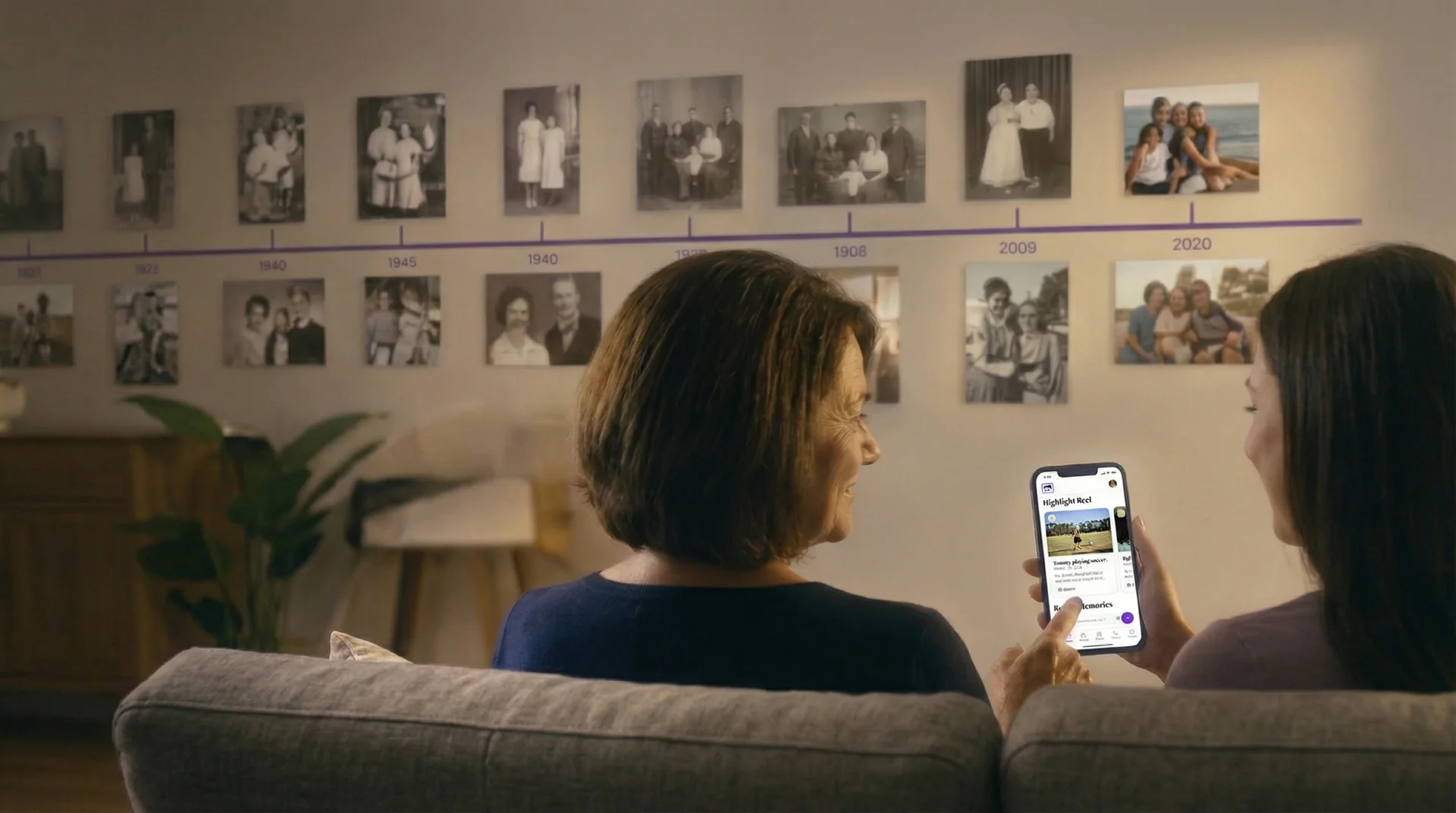
The Stories You'll Never Hear Again: Why Every Unrecorded Day Is a Permanent Loss
Your family is losing stories every single day. Not to tragedy or disaster, but to the quiet, ordinary passage of time. Here's why the window is closing faster than you think.
The Memory Murals Team • March 29, 2026

Insights
The Battle for Photo Privacy: When Anti-AI Apps Get Scraped
A recent news story highlights a troubling reality: even apps designed to protect your photos from AI can be vulnerable. This post explores the ongoing battle for digital privacy, what it means for your family's memories, and how to choose a truly secure home for your most precious moments.
Patrick Moore • August 15, 2026
Preserve your family's memories in one private place.
Start free in minutes. No credit card required.