
Record Your Kid Before College — The Year You Won't Get Back
The version of your kid who lives in your house ends in August. Not in a dramatic way — they'll come home for breaks, sit at the same table, sleep in the same bed. But the day-to-day person, the one who walks through the kitchen at midnight saying nothing, is closing up shop. Here's how to record them before they go.
The Memory Murals Team • May 16, 2026

In October, you'll vacuum their bedroom. The room will be neat — neater than it ever was when they lived in it — and that's what will get you. The bed is made because nobody slept in it. The desk is clear because nobody dumped a backpack on it. The closet has space in it for the first time in years because the half-broken hangers are gone.
You'll sit on the bed and try to remember what it sounded like when they came home from school. Not the words — the sound. The thunk of the door. The "I'm home" that wasn't really to anybody. The grunt that meant Mom-I-don't-want-to-talk-yet. The laugh when something on their phone caught them off guard halfway up the stairs.
You'll realize, sitting there, that you don't have any of it recorded. You have a thousand photographs of milestones. You have approximately zero recordings of the ordinary Tuesday version of your child. And the ordinary Tuesday version is the one that just left the house permanently — not the milestone version, who's coming home for Thanksgiving.
This post is about getting the ordinary Tuesday version on tape before August. Not by sitting your kid down for an interview. Not by making it weird. By capturing the casual sounds of the last summer they live with you, while it's happening, with almost no effort.
The window is shorter than you think
If your kid is graduating high school in May or June, the actual capture window is roughly mid-May through mid-August. After that they're packing. After packing they're gone. Don't put this off until July thinking you have months — July is the month they're already half checked out, mentally living in the dorm room they haven't seen yet. The best time to record is now. The second best time is this weekend.
The specific sounds you're about to lose
Most parents bracing for an empty nest expect to miss the obvious stuff: the goodnight, the family dinners, the seeing-them-every-day rhythm. Those losses are real but they're not the surprising ones. The surprising losses are acoustic.
Here's what parents who've already shipped one kid to college consistently report missing — and almost none of them have any of it preserved:
The casual 'hey'
Their laugh from another room
The way they say your name when they need something small
The thinking-out-loud noises
The reason parents don't capture this stuff isn't that it's hard. It's that it's invisible until it's gone. Nobody thinks to record the background noise of their own house. The brain marks ordinary sounds as not-worth-attention. The kid is doing what they always do; the parent is doing what they always do; the sounds are background; the camera is off.
The fix is to record exactly the kind of audio your brain is telling you isn't worth recording. The sounds that feel pointless to capture right now are precisely the ones that will be priceless by Thanksgiving.
What to record in the last eight weeks at home
You don't need to interview your kid. You don't need to sit them down. You don't even need them to know you're recording most of the time — though there's nothing wrong with telling them. The point is to capture the texture of their daily presence, not produce a documentary about it.
The plan below is eight weekly captures. Each takes under five minutes of active effort. By the end of the summer you have a sound portrait of the version of your kid who lives with you, frozen at the exact age they left.
Eight weeks, eight casual captures
Week 1 — A cooking/kitchen recording
Record the audio of any moment when you're both in the kitchen together. Don't direct the conversation. Just hit Voice Memos on your phone, set it on the counter, and let it run for ten minutes. You'll get the radio playing, the spatula sounds, the casual back-and-forth, and probably one good story unprompted. Trim to the best four or five minutes later.
Week 2 — A car-drive recording
The car is the highest-yield environment for hearing your kid talk. No eye contact, hands occupied, nowhere else to be. Record a 15–30 minute drive — the airport, the grocery store, the gas station run. They'll talk more in a car than at any kitchen table. Save the recording; don't review it. The point is the sound, not the content.
Week 3 — Their phone voice
Record yourself on a normal phone call with them — five minutes, no agenda. Most modern phones make this easy (iPhone has built-in call recording on iOS 18+; on Android, the Google Phone app has it built in on most newer devices, and there's always the speakerphone-into-a-second-phone workaround). Their phone voice is different from their in-person voice and the contrast becomes more obvious every year you don't have a sample of either.
Week 4 — A specific story prompt
One direct ask, casually delivered: "Tell me about the day of [specific memory only they have access to] — what do you actually remember?" The summer camp incident. The first job. The eighth-grade trip. Pick something they can describe in 3–5 minutes that you only know the parent-side of. Record their version.
Week 5 — A 'thirty seconds about a friend' recording
Pick one of their close friends from this year and ask them to describe that friend in a minute. Why they're funny, what the friend is good at, the inside joke. You'll get a portrait of someone you don't really know plus a sense of who your kid is when they're with that person — which is who they're going to be more of after September.
Week 6 — A walking recording
Walk with them somewhere — the dog, the block, an errand. Phone in pocket, recording. Walking conversations have a different rhythm than sitting conversations; less performance, more silence between sentences. The silences are part of the recording. Don't trim them out.
Week 7 — The advice question (the only formal one)
One sit-down, ten minutes, one question: "What do you think you're going to miss about being here that you haven't thought about yet?" They'll resist the formality. Sit through the resistance. The answer they give in minute eight is the one worth having on tape.
Week 8 — A 'we packed today' voice note
The night you pack the car for move-in, hand them your phone and ask them to record a sixty-second voice note. No prompt — just whatever they want to say to future-them. They'll roll their eyes. They'll do it anyway. Future-them, at 30, listens to this clip more than any other.
What if you only have a month
You can compress this to four weeks by halving it: kitchen-or-car (week 1), phone voice (week 2), one story prompt (week 3), walking + packing voice note (week 4). The half-version still gives you about an hour of usable audio across four very different contexts. An hour of audio is more than most parents have of their grown children combined.
How to record without your teenager freezing up
The fastest way to ruin this whole project is to announce it. The second-fastest way is to point a camera at them. The third-fastest is to ask them to "do it for posterity" — which is a sentence guaranteed to elicit an immediate "nope" from anyone under twenty.
What works instead is incidental capture. You're not making a documentary. You're not building a yearbook. You're putting a phone on a counter and letting it run while life keeps happening. The teenager isn't performing because they don't know to perform. The recording is a byproduct, not the event.
What kills the recording
Sitting them down. Asking them to "say something." Pointing a camera at them. Making it formal. Telling them why you're doing it. The phrase "for when you're older." Anything that turns the moment into an event they have to react to.
What keeps the recording natural
Phone resting face-down on the counter. Voice Memos running silently. No announcement. No "smile for the camera." The recording starts before the conversation does and continues after it ends. They never notice; you never have to ask permission for something that was always going to happen anyway.
There is a question about consent worth taking seriously. Recording a minor without explicit consent in a household where reasonable expectations of privacy exist is, in most US states, legally fine — but ethically you should plan to tell them, at some point, that the recordings exist. The right move is usually to tell them after, not before. "I have a folder of voice memos of you from the summer. I'm going to keep them. You can listen any time, and we'll never share them outside the family." Almost no kid objects after the fact. Almost every kid would have refused beforehand. The asymmetry is the point.
What to tell them when they ask
If your teenager does notice the phone on the counter and asks what you're doing, the honest answer that doesn't make it weird is: "I just want to remember what summer sounded like before you leave. I'm not going to do anything with it. I just want it." Most kids accept that immediately. The ones who don't accept it will at least pretend not to, and the recording keeps running.
The piece this connects to
This summer is the inbound recording project — what you capture, quietly, of the version of them that's about to disappear. There's a separate outbound project that happens around the same time: the video message that the rest of the family records for the senior as a graduation gift.
The two projects pair perfectly because the audience for each is different. The inbound recordings (this post) are for you, and eventually for them in their thirties when they want to remember what their own teenage voice sounded like. The outbound recordings — covered in our full playbook for the graduation video message every senior actually re-watches at 35 — are for them, and eventually for their kids when they want to hear what their grandparents sounded like at the moment their parent left home.
Running both in the same summer is the highest-leverage six weeks of family recording most parents will ever do. The inbound project preserves who your kid was. The outbound project preserves who their family was when they left. After August, the cast and the kid both change.
Where to put all this audio so it survives
A folder of voice memos on your phone is better than no recording at all. It's not the final answer.
Voice memos on a single phone are vulnerable to the same things every phone is vulnerable to: lost device, full storage, accidental delete by a kid who borrows the phone for a TikTok, an iCloud full warning that prompts somebody to "clean up old files." We've watched families lose irreplaceable audio to all four of those scenarios. The recording you spent eight weeks making deserves better infrastructure than the same camera roll as your screenshots.
What "survives" actually looks like:
Multiple copies in multiple places
Labels, dates, and one-line context
Recording_2026-07-12.m4a is functionally anonymous in fifteen years. Rename it. Add the kid's name, the rough age, what the conversation was about in one sentence. The labeling step is the difference between "a file" and "a memory you can find."Searchable and shareable later
Voice transcription so the words are findable
This is honestly where Memory Murals exists — it was built for exactly this use case. Each recording becomes its own entry on a private family timeline. Audio gets transcribed automatically. The archive is shared with family members you invite, and the recordings are searchable by the words spoken in them. The senior gets access on their phone too, so when they want to hear themselves at seventeen, they can pull it up from a dorm room in another state. Start a free family archive →
One thing worth saying clearly: the medium matters less than the fact that the recording exists somewhere durable. If you don't want to use a dedicated tool, at minimum, get the audio into a cloud-backed folder shared with another adult in your family and rename the files with dates and one-line context. The goal isn't sophistication. It's findable in 2040.
A closing beat
In October you'll vacuum the empty room. That part's already booked. The question isn't whether the room empties; the question is whether you have anything to play in your kitchen when it does.
The summer is the recording session. The phone in your pocket is the studio. The teenager doing teenager things in the next room is the performance. Hit record. Don't tell them why. Save the file. Label the file. Back it up.
The version of your kid who lives in your house ends in August. The version of you who can still hear them does not have to.
Build a private family archive that captures their voice now — and stays accessible to them for the rest of their life. Try Memory Murals free →
Related Stories
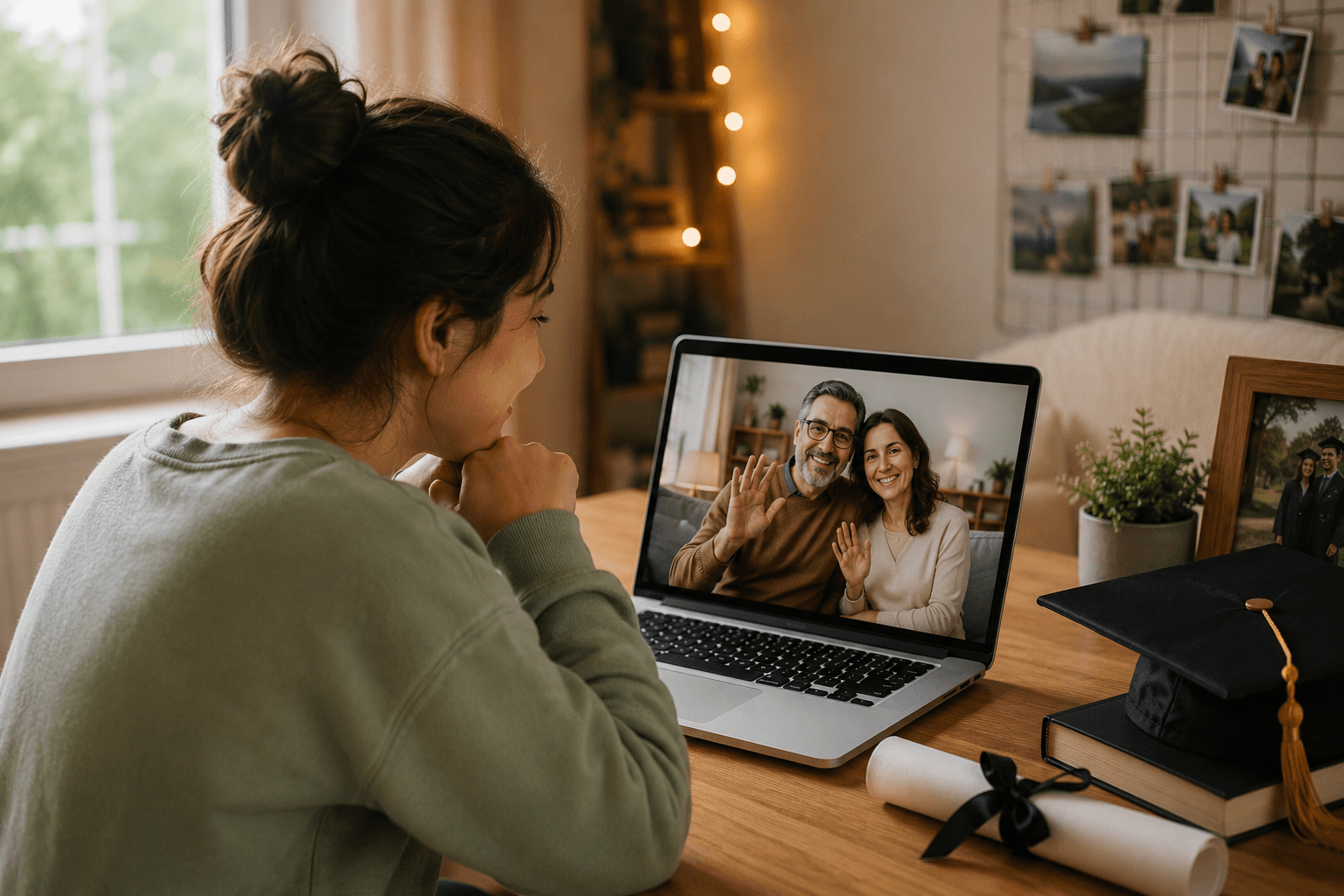
The Graduation Gift Every Senior Says They'll 'Watch Later' — And Actually Watches At 35
Most graduation gifts get a polite thank-you and disappear into a drawer. The one your grandkid replays at 35 — broke, alone in a new city, or holding their own first baby — is the one with their family's voices on it. Here's how to build it.
The Memory Murals Team • May 16, 2026

Baby Milestones You'll Forget If You Don't Write Them Down
You'll remember the first steps. You won't remember the exact day they figured out how to clap. Here's why the small milestones matter most — and how to make sure they don't disappear.
The Memory Murals Team • April 17, 2026
How to Save a Deceased Loved One's Voicemail Before It's Gone Forever
Your phone carrier is counting down to the day your loved one's last voicemail disappears forever. Most families don't know this until it's too late. Here's exactly how to save it — on iPhone and Android — before the clock runs out.
The Memory Murals Team • April 19, 2026