
Ask Mom About Her Mom This Mother's Day
Most Mother's Day posts ask you to record your mom. This one asks something different: spend Sunday asking her about her mother. She is, for most of us, the last living person who really knew her. When she goes, the only stories left of your grandmother go with her.
Patrick Moore, Founder • May 8, 2026

Last Mother's Day, on a whim, I asked my mom what her own mother smelled like.
She paused for so long I thought I'd offended her. She looked out the window. She picked up her coffee cup, didn't drink from it, put it down again. Then she said, "Lavender soap and burnt toast. Always burnt toast. She'd put it down to get the butter and forget. God, I haven't thought about that in fifty years."
That sentence is on a recording now. Eleven seconds long. It's the only audio anywhere on Earth of someone describing my grandmother's kitchen — and my grandmother died in 1994, before I was old enough to remember her.
This is what nobody tells you about Mother's Day: there's a quieter, stranger gift you can give your mom this Sunday that is also, accidentally, the most important thing you can do for your grandkids. You can spend thirty minutes asking your mother about her mother. Because she is, for almost all of us, the last living person who actually knew her. When she's gone, your grandmother dies a second time — and that one is permanent.
This is one specific application of the broader method we wrote up in our complete family interview guide. The recording technique, the question patterns, the archival side — all of it transfers to this Sunday's conversation.
The whole post in one line
This Sunday, ask your mom about her mother. Eight questions, recorder on, thirty minutes. You'll capture the only autobiography your grandmother will ever leave behind — and you'll give your mom something she rarely gets to do: be a daughter again, out loud, in front of someone who's listening.
The camera turned one generation back
There are already plenty of guides on how to interview your mom — including our own list of 25 questions to ask your mom before it's too late and the annual Mother's Day Memory Ritual. They're all built around the same idea: your mom is the subject. Get her on tape. Save her voice while you can.
This post is asking you to do something different on Sunday. Not record your mom as the subject — record your mom as the keeper. The subject is your grandmother.
The frame is one generation back, and the urgency is sharper than people realize. For many people reading this, the grandmother on their mother's side is already gone. The rest will likely be there within a decade. After that, the only person on Earth who can answer "what did Grandma's hands feel like when you were six" is the woman sitting across the brunch table. When she's gone, that answer is gone with her — and there is no archive on the planet that can recover it.
Most
Never asked
Most people never sit down to ask their parents about their grandparents before it's too late
11 sec
Worth a lifetime
is all it took to capture my grandmother's kitchen — fifty years after the fact
That "never asked" truth is the one that sticks with me. We tend to think of family memory as something that just exists — passed down through stories at holidays, the way salt gets passed down a table. But the reality is clearer than the feeling. Most families lose their grandmother's actual voice, smell, gestures, and rhythms within a single generation of her death. Not because anyone failed to love her. Because nobody thought to ask the one person who still had her on the inside.
Eight questions to ask Mom about her mom this Sunday
These are the eight I'd give you if you only had thirty minutes. Don't try to do all of them. Pick three or four. Let her drift between them. The good stuff is always in the drift.
1. "What did your mom smell like?"
Why it matters: Smell is the most direct line to memory the brain has — it bypasses the part of the brain that translates everything into words and goes straight to feeling. When you ask this, you're not asking your mom to describe her mother. You're asking her to be a child again for a few seconds, sitting close enough to her own mother to know her by smell. Whatever comes out of her mouth in the next ten seconds is the most honest snapshot of your grandmother that exists anywhere.
2. "What did her hands feel like?"
Why it matters: Hands are how a child first knows their mother — before language, before names, before they even know they have a separate body. Were Grandma's hands soft or calloused? Always cold? Did she have a ring she fidgeted with? Knuckles that cracked when she laundered things? Your mom's answer is, in the most literal way, how your grandmother held her — and it's a generational echo of how she held you.
3. "What's the song she used to sing?"
Why it matters: Music encodes who someone was when they were happy. Most mothers had a song they hummed without realizing — at the sink, in the car, putting laundry away. If your mom can name it, even hum a few bars, you've captured the soundtrack your grandmother's brain played when nobody was watching. That's a more intimate portrait than any photograph.
4. "What's one thing she said constantly that drove you crazy as a kid?"
Why it matters: Every mother has a catchphrase — the rhythmic line they used a thousand times that the kids rolled their eyes at. "Close the door, you're letting the cold in." "Did you call your sister?" "I'll be ready in five minutes." Capturing your grandmother's catchphrase is the audio version of a fingerprint. It's also, weirdly, the thing your mom is most likely to laugh about — and her laugh telling you about it is half the gift.
5. "What did she love that nobody else knew about?"
Why it matters: Most mothers have a private self — the version that exists when the kids are asleep and the house is quiet. The novel under the bed. The ham radio in the basement. The TV show she pretended not to watch. Asking your mom what her mom loved in secret is asking her to introduce you to a woman you were never allowed to meet.
6. "What did the two of you fight about?"
Why it matters: Conflict reveals values. Saints don't make for good biographies — real people do. What your grandmother fought with your mom about is what your grandmother believed mattered. Was it boys? Money? Independence? Religion? Whatever it was, you'll learn more about who she actually was from one fight than from a hundred sanitized stories.
7. "What did she look like the last time you saw her?"
Why it matters: This is the hardest question on the list, and it is the most important. The last visual is the one that haunts everyone, and almost nobody talks about it. Whether your grandmother died young or in a nursing home or in the middle of a Wednesday, your mom carries the image of her final face. Recording the description of that face — even as your mom cries, especially as your mom cries — is the most honoring thing you will ever do for either of them.
8. "What would she want her great-grandchildren to know about her?"
Why it matters: This is the question that turns the recording into an inheritance. Your mom isn't answering for herself anymore — she's answering as her own mother. For thirty seconds, your grandmother gets to address children she never met. There is no other way to give your kids that voice. There is no other technology that does this. There is only your mom, on Sunday, with the recorder on.
The 30-minute setup
Most people who read a post like this nod, close the tab, and remember it on Monday. Here's how to make it harder to forget.
Bring a photo of Grandma
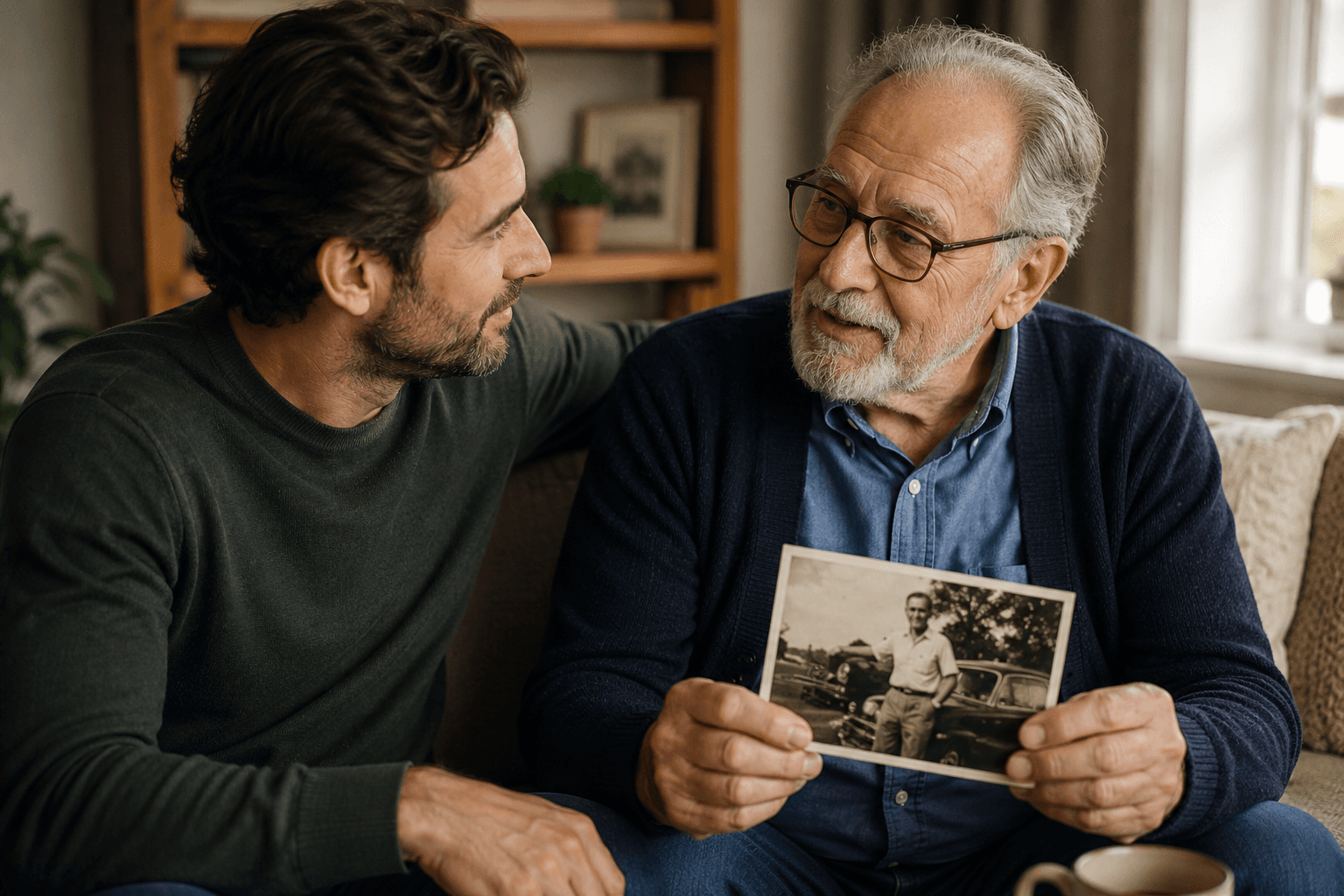
The single best thing you can do is print or pull up a photo of your grandmother before you start. Anything — a wedding photo, a Polaroid from a holiday, a bad school photo of her at twelve. Faces unlock memories nothing else can. Your mom will look at the photo, and the moment her eyes track over a specific feature — Grandma's eyebrows, the cardigan she always wore, the tilt of her head — the answers start. Without the photo, the conversation often stays at the surface. With it, you usually can't keep up with what comes out.
Pick three questions, not eight
The list above is a menu, not a worksheet. Pick the three you'd most regret never knowing the answer to and stop there. The conversation will spill into the others on its own — your mom will start with smell and end up at a story about a Saturday morning in 1968 that has nothing to do with smell at all. That's the recording you actually want. Forty minutes of drift beats two hours of interview every time.
Hit record at the start, not 'when something good comes up'
Most people wait until they hear the first profound thing before turning on the recorder. By then it's too late. Hit record before you ask question one. The first ninety seconds are always awkward, and you can trim them later. After that, your mom forgets the phone is on, and you'll get the version of her that doesn't perform. That's the version you want.
Voice memos work fine if — and this is a real if — you commit to moving the file out of your phone the same day. Memory Murals was built specifically for keeping recordings like this somewhere your kids will actually be able to find them in 40 years. Either way, save it twice. A file on one device isn't preserved; it's waiting to be lost.
What if your grandmother is still alive — or your mom is gone?
If your grandmother is still here, record both of them — separately, then together. The crossover stories are the gold. If your mom is gone, the questions still work, you just ask them of your aunts, uncles, godparents, or anyone else who knew her well. Don't wait. Every year of delay halves the answers.
Why this is also a gift to her
There's a thing nobody warns you about: most mothers, after a certain age, almost never get asked about their own mothers. Their friends knew her, so they don't ask. Their kids never met her, so it doesn't come up. Their grandkids only know her as a name on a wall. So your mom is the only one carrying this entire person around inside her, and most weeks of the year, nobody opens that door.
When you ask her these questions on Sunday, you're not just gathering facts. You're letting her be a daughter again, out loud, in front of someone who is paying attention. For thirty minutes she gets to live in her own mother's kitchen with company. That is, by itself, a Mother's Day gift — and it's one most people never think to give.
The recording is the bonus.
This Sunday, sit with her. Bring the photo. Hit record. Ask three questions. The flowers will be brown by Tuesday. The brunch will be forgotten by next weekend. The eleven seconds where she says "lavender soap and burnt toast" will outlive everyone in the room.
When Father's Day comes around in June, do the mirror version with your dad — the eight questions to ask dad about his dad. Same idea, one generation back on his side. The grandparents you never met live, for now, only inside the parents you still can.
Get 50 questions to ask your parents — before the stories are gone
The exact prompts families use to draw out the stories nobody ever wrote down. Free, straight to your inbox.
No spam. Unsubscribe anytime.
About the author
Patrick Moore, Founder of Memory Murals
Patrick Moore is the founder of Memory Murals. He built it after realizing how much of his own family's history had quietly slipped away — to help families preserve their stories, voices, and photos while they still can.
Related Stories

Lists & Roundups
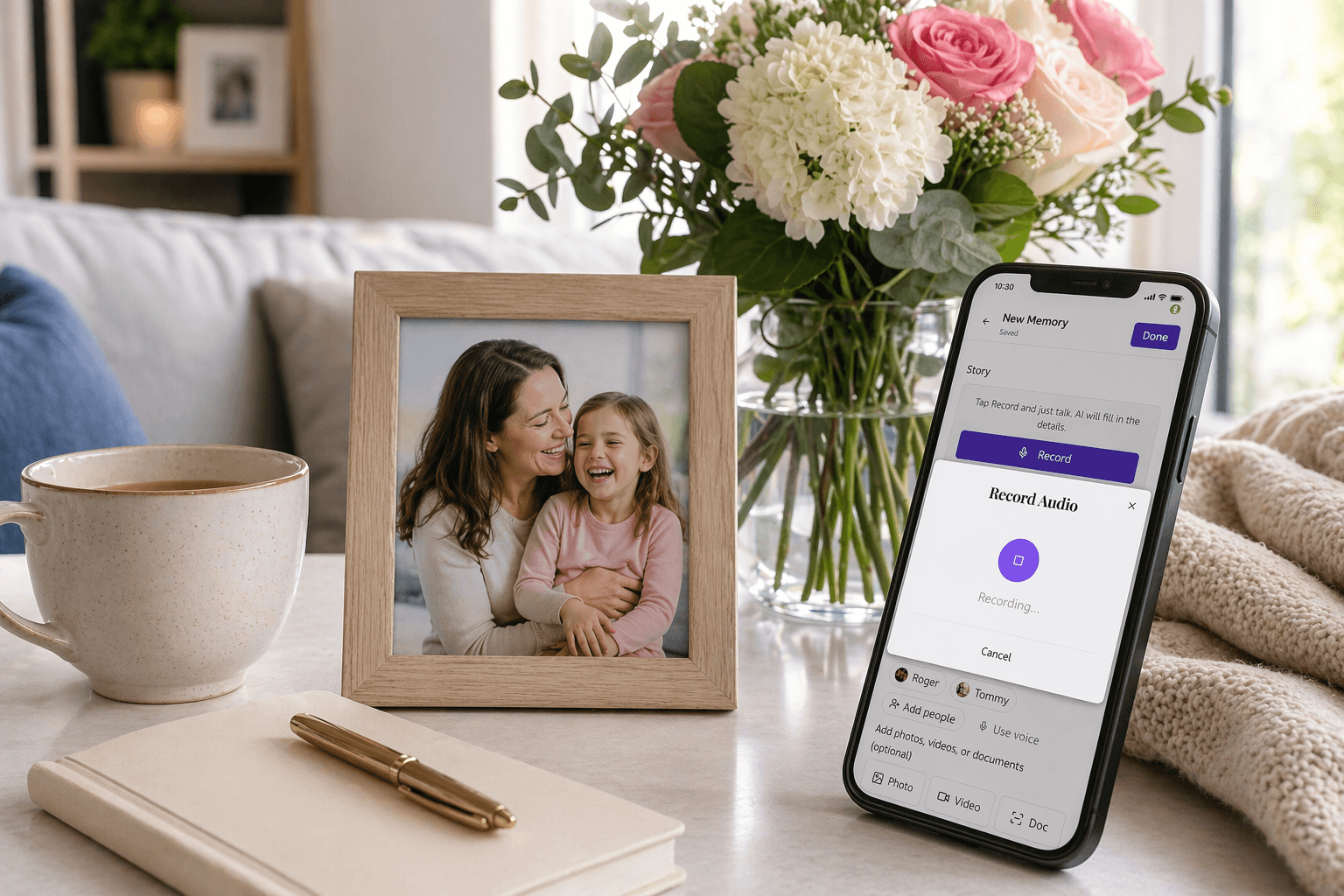
25 Questions to Ask Your Mom Before It's Too Late (And Why Each One Matters)
Most of us think we know our mothers. But between the school pickups and the phone calls, there's an entire life you've never asked about. These 25 questions will change that.
Patrick Moore • March 31, 2026
How-To Guides
The Mother's Day Memory Ritual: A 30-Minute Annual Tradition That Outlasts Every Other Gift
Flowers wilt by Tuesday. Brunch is forgotten by the next weekend. But a 30-minute recording of your mom's voice, saved every Mother's Day for the rest of her life, becomes the only family heirloom that gets more valuable with time.
Patrick Moore • April 2, 2026
How-To Guides
Your Dad Is the Last Person Who Remembers Your Grandfather. Ask Him This Sunday.
Most Father's Day posts ask you to record your dad. This one asks something different: spend Sunday asking him about his father. He is, for most of us, the last living person who really knew the man your kids will only ever see in a frame. When he goes, the only stories left of your grandfather go with him.
Patrick Moore • May 15, 2026
Now give it somewhere to live.
The file you just saved outlasts nothing on its own. Put it where your family can still find it in thirty years.