
The Mother's Day Memory Ritual
Flowers wilt by Tuesday. Brunch is forgotten by the next weekend. But a 30-minute recording of your mom's voice, saved every Mother's Day for the rest of her life, becomes the only family heirloom that gets more valuable with time.
Patrick Moore, Founder • April 2, 2026
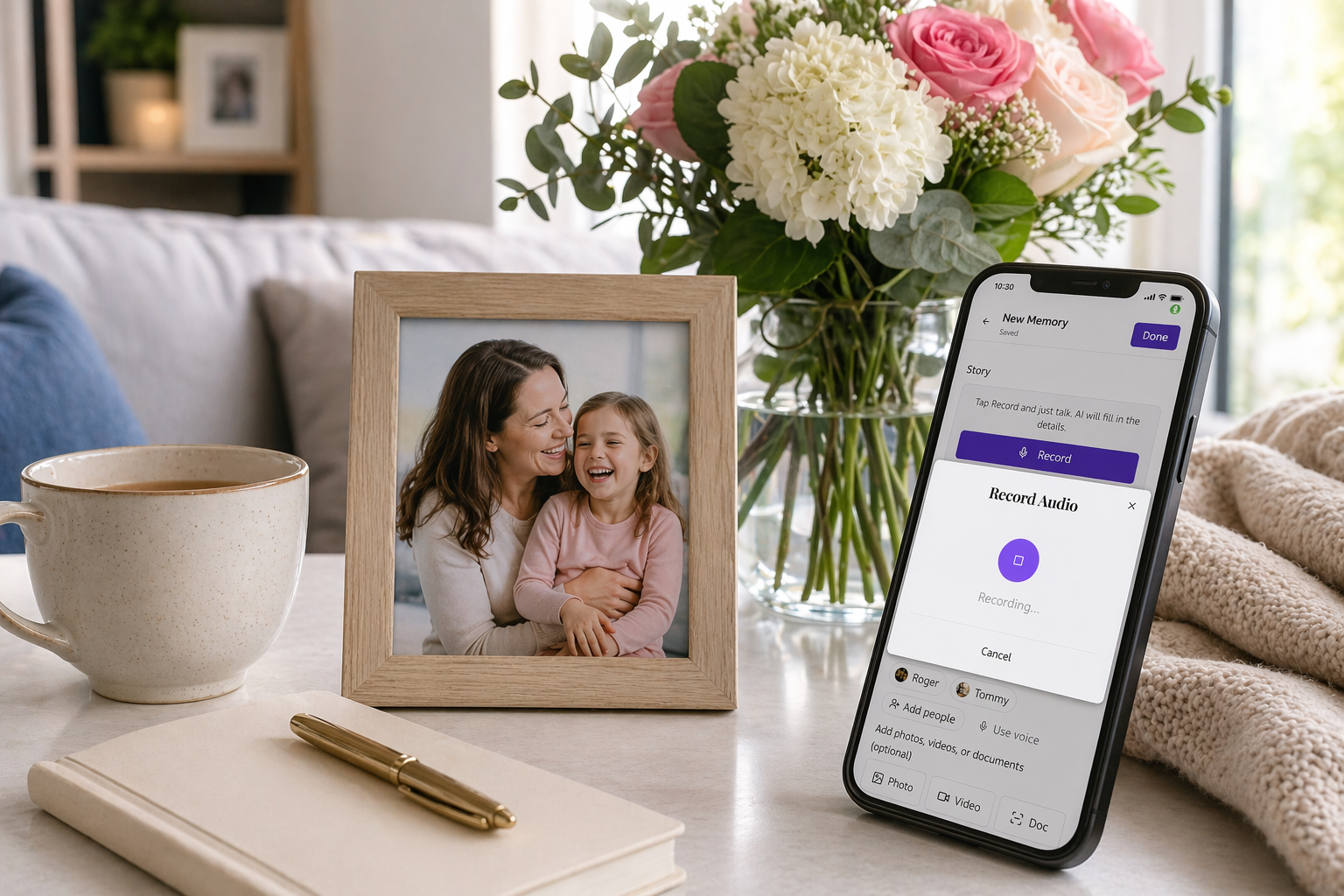
The best Mother's Day I ever had cost me nothing but thirty minutes and an open Voice Memos app.
We were at her kitchen table. She was halfway through a cup of coffee that had gone cold twice already because she kept getting up to point at things in the photos I'd brought over. She was seventy-one. I'd just asked her what her mother's kitchen smelled like when she was seven years old.
She thought about it for a long second. Then she said, "Bacon fat and that terrible floor cleaner. God, I haven't thought about that floor cleaner in fifty years."
That sentence is on a recording now. It's nine seconds long. And I can tell you — without exaggeration — that I'd give every physical gift I've ever given her back just to keep those nine seconds.
This is what nobody puts on a Mother's Day gift guide. The best gift isn't something you buy. It's something you do, and it only works if you do it every single year.
The whole post in one line
Every Mother's Day, sit with your mom for 30 minutes. Ask her two questions. Record it. Save it somewhere your family can find it in thirty years. Do that every year until you can't anymore. That's it. That's the ritual.
The gifts that decay vs. the ones that compound
Most Mother's Day gifts are on a decay curve. The flowers peak on Sunday afternoon. The brunch peaks at the entree. The spa gift card peaks the moment you hand it over and declines every week it sits unused in her wallet.
Memory is the only gift that moves the other direction.
A recording of your mom at 58, telling the story of how she met your dad, is more valuable at 68. It's more valuable still at 78. And if she's gone at 83, that same nine-minute file becomes the thing your kids will play for her great-grandchildren in 2065.
47%
Biggest Regret
of Americans regret not recording or documenting a conversation with a loved one who has since died
0
Moms Who Said
'I wish my kids had spent less time asking me about my life'
In a 2022 YouGov survey of 6,090 U.S. adults, 47% said they regret not recording or documenting a conversation with a loved one who has since died.
That 47% number is the one that haunts me. Because those people didn't fail to care. They cared deeply. They just thought there would be more time. There always seems to be more time — right up until the afternoon there isn't.
A ritual fixes the "more time" problem. Rituals are what you do when you don't trust yourself to remember to do it. That's the whole point of pinning this to Mother's Day — the holiday does the reminding for you. Every May, you get the same nudge: it's been a year, sit down with her again.
(If you're still working out the rest of Mother's Day — the things this ritual doesn't replace, like the actual gift you're handing her — our Mother's Day gift ideas for the mom who has everything covers what compounds versus what just fills a shelf.)
Two conversations, one afternoon, every year
The ritual has two halves. Both go in the archive. Both take about fifteen minutes. You can split them across the day or do them back to back. It's not that precious.
Half 1: Interview your kids about Mom
Sit your kids down before Mom comes over and ask five simple questions about her. Voice memo on. Five minutes.
Things like:
- What does Mom do that makes you laugh?
- What's her best food?
- What's the best thing about her?
- What does she always say?
- What do you love about her?
Their voices at 4, 7, 11, 16 — changing every year, saying wildly different things — turn into the single funniest, most devastating gift your mom will ever receive. When she's 80, a recording of your 5-year-old calling her "the best snuggler" is worth more than any diamond.
Half 2: Interview Mom about Mom
When you're with her, ask her two real questions. Not "how was your week." Real ones — things about her childhood, her twenties, the version of herself before she was anyone's mother.
One new question each year. That's it.
By year ten you have twenty deep memories of who she actually is, in her own voice. By year twenty you have forty. By the time she's gone, you have the only autobiography she'll ever leave — the real one, not the polished one.
The reason both halves matter is that they capture the two directions the relationship actually runs. One is how your kids see her. The other is who she is outside of being seen as Mom. Most families never record either. A few record one. Almost nobody records both. Over ten years of this, you end up with something no store and no service can sell you.
If you don't have kids — or your kids are grown
The ritual still works. Swap "interview the kids" for "interview yourself." Once a year on Mother's Day, record a one-minute voice memo to your mom — things you noticed about her that year, things you want her to know, a specific thing she said in April that stuck with you. It's weird the first time. By year three it's the thing you look forward to most. When she's gone, those annual voice memos become a letter you already wrote, year by year, without knowing it.
Five questions for the kids. Two questions for Mom. One list you keep forever.
Most printable Mother's Day questionnaires ask kids things like "What's Mom's favorite color?" That's fine for a first-grade art project. It's not what you want if you're building an archive.
You want questions whose answers change in interesting ways year over year. Questions that are specific enough to force a real answer but open enough to catch the weirdness of a six-year-old's brain.
For the kids (ask the same five, every year)
These are the five that give you the most mileage across a decade of answers.
- "What does Mom do that makes you laugh the hardest?" — kids answer this completely differently at 5, 10, and 15. The evolution is the gift.
- "What's something Mom always says?" — you're going to hear phrases come out of your mom's mouth that you didn't even notice until your kid quoted them.
- "What's Mom really good at?" — the answer in kindergarten will be "she ties my shoes." The answer at 12 will be "she listens." Save both.
- "What's one thing you love about Mom that you don't think anyone else knows?" — this is the one that catches them off guard and produces the stuff you'll cry watching back.
- "If you had a superpower, what would you want Mom's superpower to be?" — kids' answers to this one are stranger and more revealing than you'd believe.
For Mom (ask two new ones each year)
The full list of 25 good ones lives in our guide to questions to ask your mom before it's too late — don't burn through them all in year one. Pick two. Let the answers breathe. Come back next year.
For a focused 30-minute alternative once you've worked through the basics — eight specific questions aimed not at your mom but at her own mother (the grandmother whose voice rarely shows up in family archives because nobody asked) — see ask Mom about her mom this Sunday.
For your first ritual, I'd start with these two. They're the best openers we've found.
Year One — Question A
"What's your earliest memory?" Sounds simple. It isn't. You're asking her to go back to a version of herself that predates photographs, predates your existence, predates almost everyone else in her life. Whatever she says first — that's the seed of every other story you'll ever pull from her.
Year One — Question B
"What's a small moment from your life you think about more than you probably should?" This is the one that stops her mid-sentence. The answer is never dramatic. It's a Tuesday afternoon when she was twenty-three. A look someone gave her. A song on the radio in a specific car. And it will be the most human thing she's ever said to you.
The trick with the second question isn't the question itself. It's the silence after. She will pause. She will try to deflect. Sit with it. Count to ten in your head if you have to. The deflection is usually followed by the real answer.
How to actually pull this off this Sunday
Most people who read a post like this nod along, close the tab, and forget by Friday. Let's make it harder to forget.
The Mother's Day Memory Ritual — first year
This week: pick your tool
You need exactly one thing: a place to record audio and keep it for thirty years. Your phone's voice memo app works if — and this is a real if — you commit to moving the file somewhere else immediately. Memory Murals was built specifically for this. So were a few others. The tool matters less than the fact that you picked one and will use it every year. (Avoid text threads and camera rolls. Those are where memories go to get buried.)
Saturday: interview the kids
Before the Mother's Day stuff kicks off, pull each kid aside for three minutes. Ask the five questions above. Hit record. Don't over-produce it — background noise is fine, a crying baby is fine, a kid who won't sit still is fine. The realness is the point. Save each year as its own file so future-you can hear the voices change.
Sunday: interview Mom
After brunch, after the cards, when the pace naturally slows — that's your window. Say, "Mom, can I ask you a couple of questions and record them? I want to save your voice answering these, not just my memory of you answering them." She will say yes. She may pretend to protest. She will say yes. Ask your two questions. Let her talk. Don't interrupt. Don't edit.
Sunday night: save it twice
Two copies, two places. One in your archive, one somewhere else (email it to yourself, AirDrop to a laptop, upload to a shared family drive). Files die when they live in only one spot. This is the same logic from saving a deceased loved one's voicemail — a file on one device isn't preserved, it's just waiting to be lost.
Next April: put a calendar reminder on 2027-04-25
Two weeks before Mother's Day next year. That's your cue to prep. Same ritual, new questions. In year two you already have a baseline. In year five you have a small archive. In year fifteen you have the only real record of your mother as a person.
That's the whole thing. Five steps. The first four take an afternoon. The fifth takes eight seconds on your phone right now.
The medium matters more than you think
Most families default to video for stuff like this, and I understand the impulse. Video feels more complete. You get facial expressions. You get the setting. You get the visual record of what she looked like that year.
But video has a weird side effect that nobody warns you about: people perform for video. They straighten up. They fix their hair. They answer in the voice they think is being recorded. They self-edit.
Audio-only recording is different. Something about the absence of a camera lens makes people forget they're being recorded within about ninety seconds. They start talking the way they actually talk. Tangents. Sighs. The throat-clearing thing they always do. The pause before the real answer.
The 'half-listening' effect
Audio also gets played more often. A 10-minute video is a commitment — you have to sit down and watch it. A 10-minute audio file plays in the car, while cooking, while folding laundry. Families actually revisit audio. Video archives tend to get saved and never opened again. If the goal is to let your mom's voice become part of your everyday life again after she's gone, audio wins.
To be fair to video: if you're capturing something visual — the way she rolls out dough, the expression on her face when she tells a specific story, your 4-year-old dancing while answering questions — use video. Both can coexist. But if you're forced to pick one, audio is the one that gets listened to, and listened to again, and eventually learned by heart.
There's a reason the sound of a loved one's voice is the memory that brings them back most vividly. Photographs freeze a moment. Voices contain motion. They carry the whole person.
The urgency is real, but it's not what you think
I want to be honest about something, because most posts on this topic either dodge it or lean too hard on it.
The urgency isn't that your mom is going to die tomorrow. Statistically, she probably isn't. The urgency is that she's quietly becoming a different version of herself every year, and if you don't capture any of those versions, they just... go. Not dramatically. Not with warning. She'll still be there. The 63-year-old version of her will just be gone.
Ten years from now, you will not remember what she sounded like this May. You'll remember the general idea of how she sounded. You'll remember phrases. You won't remember the actual timbre, the specific rhythm, the way she said your name when she was distracted versus when she was paying attention. Your brain doesn't store audio fidelity that long.
This is also true, by the way, of you. Your kids will not remember what you sounded like at 38 unless someone recorded it. The ritual is quietly doing two things at once: preserving her, and preserving the family-of-this-year for a family-of-twenty-years-from-now that doesn't exist yet.
Honest verdict
If you can only do one new thing this Mother's Day, pick this one. The flowers, the card, the brunch — keep all of them. They're not wrong. But add thirty minutes with a phone on the table and two real questions. In five years you won't remember what restaurant you went to in 2026. You will absolutely remember the answer she gave on the recording.
The archive problem (and why "my camera roll" isn't an answer)
Here's where most well-intentioned families lose the plot. They record the audio. They nod to themselves about how meaningful it is. And then they save it in one of the three worst places to save a thirty-year memory: a text thread, a camera roll, or a Google Drive folder nobody remembers the name of.
Thirty years is a long time for a file. Phones change. Carriers change. Cloud services get bought, renamed, sunset, migrated badly, or silently delete "inactive" content after eighteen months. Text threads get pruned when you run out of iCloud storage. Camera rolls turn into 80,000-photo graveyards where nothing is findable.
A real archive has three things that a camera roll doesn't:
Context
Every recording has a date, a person tagged, a one-line note about what was happening that day. Ten years from now you'll know exactly which year you recorded the "earliest memory" answer and who was in the room.
Durability
Built to outlive devices. Not tied to a phone that'll break in 2029 or a cloud service that might fold. If your whole house burns down, the archive is still there.
Family access
Your sister, your dad, your kids when they grow up — they can all reach the recordings without asking you for the password. That's what turns a private file into a family heirloom.
We built Memory Murals specifically around this problem — private by default, built for voice, designed to be used for decades and navigated by people who weren't the one who made the recording. But the key phrase in that sentence is specifically around this problem. Any tool that solves those three needs will work. The worst choice isn't picking the "wrong" app. The worst choice is not picking one at all, leaving the audio to rot in a Voice Memos folder, and discovering five years later that half of it is gone and the other half is uncatalogued.
What the ritual looks like after a decade
People sometimes ask what the long-form version of this looks like. Here's a rough shape of what families who've done this for years tell us.
Year one: awkward. Everyone feels a little weird about being recorded. Kids giggle. Mom self-consciously fixes her hair. You get usable audio anyway.
Year three: everyone stops fixing their hair. Mom starts bringing things up before you ask. "Did I ever tell you about the time —" is now her opening line. The archive has about ninety minutes of audio.
Year seven: your oldest kid is suddenly a teenager and refuses to do it, then does it anyway, and gives the most devastating honest answer of the decade. Mom has told you the hard version of stories you only knew the soft version of. The archive has four hours.
Year twelve: you lose someone. Maybe not Mom. Maybe a grandparent, an aunt, someone whose voice is in year four of the archive. You play that file for the first time in eight years. You cry. Then your kids ask to hear their younger selves. Then everyone cries. Then you feel grateful in a way no physical gift has ever made you feel.
Year twenty: the archive is the most valuable thing your family owns.
That's the arc. It's not dramatic in any single year. It's the compound interest of small Sundays. The meaningfulness lives in the accumulation, not in any individual recording.
A closing beat
Buy the flowers. Make the brunch reservation. Get the card, sign your name, mean the words.
But also: put your phone on the kitchen table. Press record. Ask her what her mother's kitchen smelled like when she was seven. And then listen.
In thirty years, when everything else from this Mother's Day is gone — the flowers long wilted, the card in a box somewhere, the brunch receipt thrown away — that nine seconds of answer will still be there. Playing in the car. Playing while your kids cook her recipe. Playing on the Mother's Day where she's not there to answer anything new.
That's the only gift that actually lasts. And it only costs you thirty minutes and the willingness to ask.
Ready to start the ritual this Sunday? Try Memory Murals free → — private family archive, built for voice, designed to hold the thirty-year version of this tradition. No credit card required. No feed. No ads. Just a place that's built to still be there when she isn't.
Get 50 questions to ask your parents — before the stories are gone
The exact prompts families use to draw out the stories nobody ever wrote down. Free, straight to your inbox.
No spam. Unsubscribe anytime.
About the author
Patrick Moore, Founder of Memory Murals
Patrick Moore is the founder of Memory Murals. He built it after realizing how much of his own family's history had quietly slipped away — to help families preserve their stories, voices, and photos while they still can.
Related Stories
Lists & Roundups
25 Questions to Ask Your Mom Before It's Too Late (And Why Each One Matters)
Most of us think we know our mothers. But between the school pickups and the phone calls, there's an entire life you've never asked about. These 25 questions will change that.
Patrick Moore • March 31, 2026
How-To Guides
How to Save a Deceased Loved One's Voicemail Before It's Gone Forever
Your phone carrier is counting down to the day your loved one's last voicemail disappears forever. Most families don't know this until it's too late. Here's exactly how to save it — on iPhone and Android — before the clock runs out.
The Memory Murals Team • April 19, 2026

How-To Guides
Your Mom Is the Last Person Who Remembers Your Grandmother. Ask Her This Sunday.
Most Mother's Day posts ask you to record your mom. This one asks something different: spend Sunday asking her about her mother. She is, for most of us, the last living person who really knew her. When she goes, the only stories left of your grandmother go with her.
Patrick Moore • May 8, 2026
Now give it somewhere to live.
The file you just saved outlasts nothing on its own. Put it where your family can still find it in thirty years.