
Getting Kids Involved in Family Storytelling
Tired of getting one-word answers when you try to connect your kids with their grandparents' stories? I was too. Forget formal interviews. Here are some fun, game-like activities that turn memory-keeping into an adventure kids will ask to go on again.
Patrick Moore, Founder • June 21, 2026
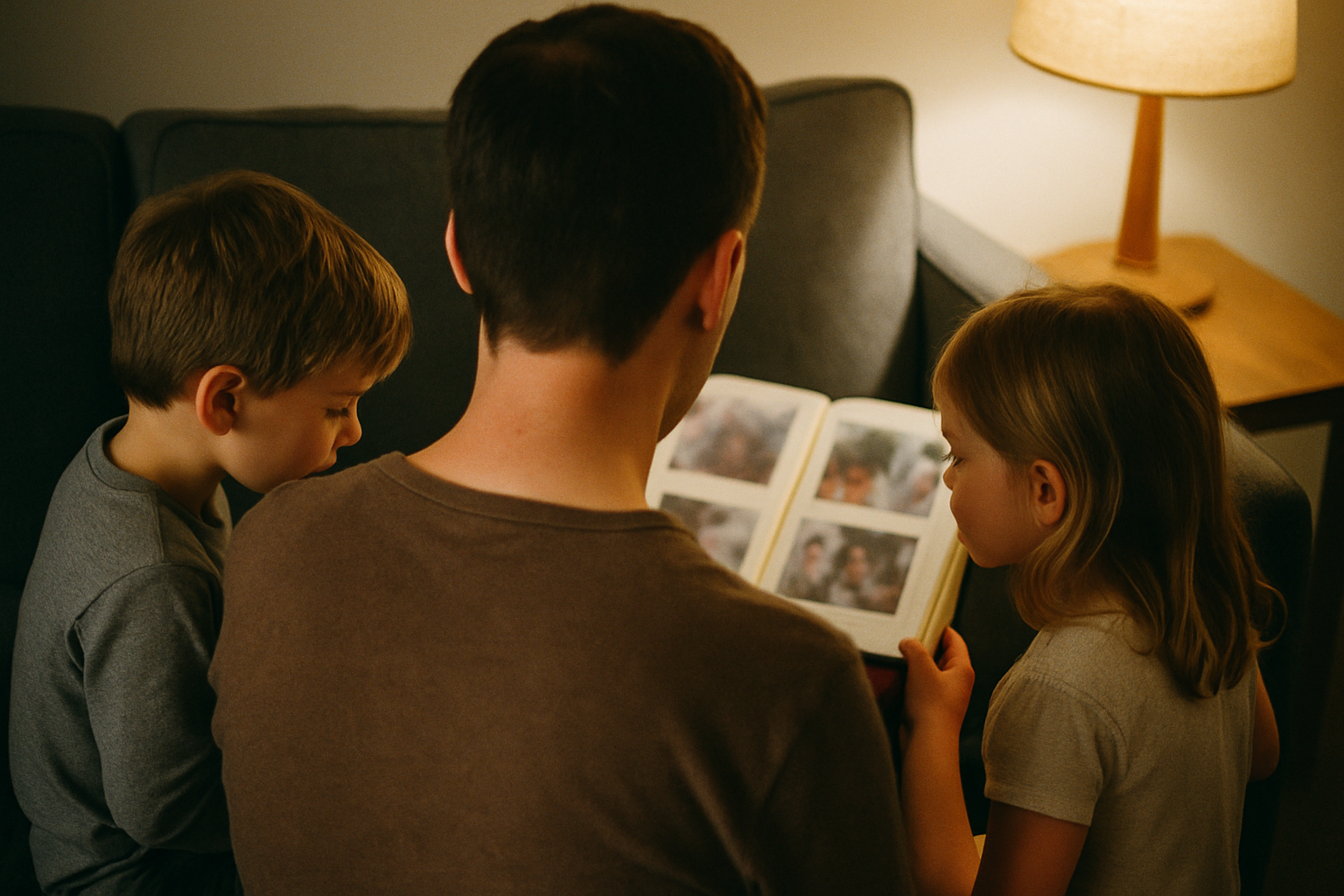
My eight-year-old, Leo, was rummaging in his grandma’s kitchen junk drawer—a place of immense archaeological significance—when he pulled out a weird-looking metal contraption. It was a hand-cranked egg beater. I was about to launch into a little speech about how things were different 'back in the day,' but Leo beat me to it.
"Grandma," he asked, his eyes wide, "was this for whipping alien brains?"
My mom laughed, a real, deep belly laugh. And for the next ten minutes, she didn't talk about the Great Depression or World War II. She told Leo about the time she tried to 'help' her own mother make a birthday cake and ended up redecorating the entire kitchen ceiling with chocolate batter, propelled by that very egg beater.
Leo was captivated. Not by a grand, historical narrative, but by a small, silly, human story. He saw his grandma not as an old person, but as a kid, just like him. That was the moment I realized I had been approaching this all wrong. Getting kids involved in their family's story isn't about sitting them down for a formal interview; it's about finding the alien-brain-whipper in the junk drawer.
The short answer
To get kids involved in family storytelling, transform it from an interview into a game. Use props like old photos, objects, or maps as starting points. Ask 'wondering' questions instead of direct ones, and let their curiosity lead the conversation. Focus on short, fun activities like a photo scavenger hunt or recording a two-minute story about a single recipe. The goal is connection and fun, not a comprehensive biography.
Turn Detectives into Storytellers
Kids are natural detectives. They want to explore, touch, and figure things out. A formal Q&A session can feel like homework, but a mission to uncover a story feels like an adventure. The key is to reframe the activity from 'asking questions' to 'finding clues.'
Instead of a long list of prompts, try picking just one thing—a single photograph, a piece of jewelry, a report card, a tool from the garage. This gives them a tangible starting point. My son’s discovery of the egg beater worked because it was real, physical, and mysterious. It begged the question, What is this for?
Once you have your 'clue,' the goal is to unlock its story. This approach is one of the most gentle ways to start a family archive because it’s low-pressure and focuses on a single, manageable memory. It’s less intimidating for both the child and the grandparent.
Here are a few 'missions' you can try:
Photo Scavenger Hunt
Give your child an old family photo and have them find three things in the picture that don't exist anymore or look very different today. It could be a car, a hairstyle, or a type of telephone. Then, they can ask the story behind those items.
Artifact 'Interviews'
Let your child choose one object from a box of old keepsakes. Their job is to 'interview' the object, with the grandparent providing the voice. Questions could be: "Where did you come from?" "What was your most important job?" "What's the biggest secret you know?"
Recipe Stories
Cook a family recipe together. While you measure and mix, have your child record Grandma or Grandpa telling the story of that dish. Who taught them to make it? What holidays is it for? Was there ever a time it went horribly wrong (like the chocolate batter incident)?
Soundtrack of a Life
Ask a grandparent what song they danced to at their wedding, or what was popular when they were in high school. Play the song and ask them what memories it brings back. You can even have your child create a playlist of their grandparent's life.
Little Historians (Ages 6–9)
For younger kids, activities should be sensory, short, and playful. Their attention spans are shorter, and their connection to the past is more concrete. They need to see, touch, and do.
One of our favorite activities is creating a 'Then & Now' map. It’s a fantastic way to make the past feel real and located in a physical space they can understand. It's one of those perfect rainy day activities with no supplies needed beyond a piece of paper and some imagination.
How to Create a 'Then & Now' Map
Draw the Present
On a large piece of paper, have your child draw a simple map of their grandparent's current street or neighborhood. They can include their house, a park, a corner store, etc.
Ask About the Past
Now, ask the grandparent what was different when they were a child. Was that park a field? Was the grocery store a movie theater? Was their best friend's house where the new apartment building is?
Add the 'Ghost' Layer
Using a different colored pen or pencil, have your child add the 'ghosts' of the past to the map. They can draw the old movie theater right on top of the grocery store, or sketch in the creek that used to run through the field.
Record the Stories
As you draw, use your phone to record the little stories that come up. You're not just creating a map; you're creating a geography of memories. Snap a picture of the finished map and save it with the audio.
Middle School Genealogists (Ages 10–13)
Older kids can handle more complex projects and are often digitally savvy. You can channel their screen time into something meaningful by making them the family's official documentarian.
Instead of just recording audio, they can shoot and edit a short video interview. The key is to keep it focused. Don't try to film a whole life story. Pick a single topic, like "Grandpa's First Car" or "The Story of How Grandma and Grandpa Met."
Keep the Tech Simple
Your child doesn't need a professional film studio. A smartphone is more than enough. They can use free, intuitive apps like CapCut or iMovie to trim clips, add titles, and even include old photos. The goal is a two-to-three-minute mini-documentary, not a feature film.
This age group is also great at research. They can take the lead on building a digital family tree, scanning old photos, or even researching the history of an ancestor's hometown online. Giving them ownership of a specific project makes them feel like a valued contributor to the family's legacy.
What You Already Have is Enough
You don't need expensive equipment to start. The best tool is the one you have with you, which is almost always your smartphone. It can capture high-quality audio, video, and photos, and it's something everyone is already comfortable with.
It's tempting to think you need a special microphone and a fancy camera. You don't. The best recordings are usually the ones captured spontaneously on a phone, because the moment felt right. If you want a few simple tips on how to get the best quality, our guide on how to record grandparents' stories has some easy, practical advice that doesn't require buying anything new.
The most important 'tool' is your curiosity and your willingness to let the child lead. If they're more interested in the story of the dog than the story of the war, follow their lead. Any story shared is a win.
From Fun Activity to Lasting Archive
These activities are wonderful in the moment, but their true power is unlocked when they are preserved. The little audio clip about the recipe, the photo of the 'Then & Now' map, the two-minute video about Grandpa's first car—these are the building blocks of your family's legacy.
The challenge is that these precious snippets often end up scattered across devices, lost in a camera roll, or forgotten in a text thread. A fun afternoon of storytelling can easily become a digital ghost if it doesn't have a permanent, safe home. That's how you can truly help kids know their grandparents on a deeper level, long after the moment has passed.
A Dedicated Archive
A private, secure platform keeps everything in one place, organized and accessible to the whole family. It ensures stories are preserved with context and can be enjoyed for generations. It turns fleeting moments into a lasting legacy.
Just Your Phone's Camera Roll
While easy to capture, it's hard to organize, share, and preserve memories this way. Phones are lost, files are corrupted, and context is forgotten. Photos and videos get buried under thousands of screenshots and memes, making them nearly impossible to find later.
This is, of course, why we built Memory Murals. We wanted a single, beautiful sanctuary for our family's most important stories—the big ones and the small ones. It's a place where Leo's recording about the egg beater can live right alongside his great-grandfather's official military records. When you're ready to give these moments the permanent home they deserve, you can start your family's private archive here.
It’s not about performing for the future. It's about creating a space where the warmth of these interactions can be felt years from now. When your kids are grown, they won't just have facts about their grandparents; they'll have their voices, their laughter, and the story of that time they covered the kitchen in chocolate batter.
Get 50 questions to ask your parents — before the stories are gone
The exact prompts families use to draw out the stories nobody ever wrote down. Free, straight to your inbox.
No spam. Unsubscribe anytime.
Frequently asked questions
What are some fun family storytelling activities for kids?
Turn it into a game! Try a 'photo scavenger hunt' where kids find items in old photos. Do 'artifact interviews' where they ask a grandparent questions about a single object, like a war medal or a strange kitchen tool. You can also map out a grandparent's childhood neighborhood together or cook a family recipe while recording the stories behind it. The key is to make it interactive and led by their curiosity, not a formal Q&A session.
How do I get my child interested in family history?
Connect family history to their own life and interests. Instead of starting with names and dates, start with stories of adventure, mischief, or school days. Use tangible props like old toys, report cards, or clothing. Frame it as a detective mission to solve a mystery, like 'Who is this person in the photo?' or 'What was life like when Grandma was my age?' Keep sessions short and fun, focusing on connection over data collection.
What are good storytelling prompts for kids and grandparents?
Instead of generic questions, use specific, sensory prompts. For an object, ask: 'What does this feel/smell like? What sound does it make? What’s the first memory that pops into your head when you hold it?' For a photo, ask: 'What happened right before this picture was taken? What’s something you can see here that we can’t see anymore?' Focus on 'I wonder...' questions that invite imagination rather than just facts.
Why is it important for kids to know their family stories?
Knowing family stories gives children a strong sense of identity and belonging. It helps them understand where they come from and builds resilience by showing them how previous generations overcame challenges. These narratives provide a 'scaffolding' for their own life, connecting them to something bigger than themselves. It also fosters empathy and strengthens the bond between generations, creating a shared family culture that can be passed down.
What's the best age to start family storytelling with kids?
You can start at any age, but elementary school (around ages 6-9) is a great time to begin with simple, tangible activities. At this stage, children are naturally curious and can grasp the concept of 'then and now.' For middle schoolers (ages 10-13), you can introduce more complex projects like creating video interviews or exploring a family tree. The key is to adapt the activity to their developmental stage and attention span.
About the author
Patrick Moore, Founder of Memory Murals
Patrick Moore is the founder of Memory Murals. He built it after realizing how much of his own family's history had quietly slipped away — to help families preserve their stories, voices, and photos while they still can.
Related Stories
Pillar Articles
Ensure Your Kids Truly Know Their Grandparents, Before It's Too Late
It's easy for the connection between kids and grandparents to remain surface-level. This post explores practical, heartfelt ways to bridge that generational gap, ensuring your children build a deep, lasting bond and inherit the family stories that define them.
Patrick Moore • June 12, 2026
How-To Guides
You Have the Questions. Here's How to Actually Record the Answers.
Every article gives you a list of questions to ask your grandparents. Almost none of them tell you what to do next. Here's the part nobody writes: how to actually capture the answers so they outlive the conversation.
Patrick Moore • April 11, 2026
How-To Guides
How to Organize Family Videos: A Step-by-Step Guide to Digital Archiving
Overwhelmed by decades of home movies on phones, tapes, and hard drives? This guide provides a clear, step-by-step process to gather, digitize, and organize your family videos. Learn how to create a lasting digital archive that's easy to navigate, safe from loss, and ready to be enjoyed.
Patrick Moore • September 21, 2026
Now give it somewhere to live.
The file you just saved outlasts nothing on its own. Put it where your family can still find it in thirty years.