
How to Interview Your Parents About Their Life
Most of us mean to ask. We don't. Then we lose the chance. Here's an honest, parent-neutral guide to interviewing your mom or dad — what actually works, what doesn't, and where the recording lives for the next twenty years.
Patrick Moore, Founder • May 13, 2026

Most of us mean to ask. We don't.
There's a Sunday phone call we're going to make. A holiday visit where we're going to bring it up. A long drive where we're finally going to ask the question we've been carrying around for years. Then the Sunday gets busy. The holiday turns into logistics. The drive happens and we talk about the weather instead.
This is the post about how to actually do it. Not someday — this month. Not a perfect cinematic interview — a real one, with a parent who deflects, in a kitchen or a truck or a phone call, captured well enough that twenty years from now you'll still have it. (If you need the why first — why a parent's voice is the thing that matters most, more than the stories themselves — that's a separate piece. This one assumes you already believe it.)
We've written longer playbooks for the mom-specific version and the dad-specific version — they're different in important ways, and we'll point you to the right one below. This piece is the universal frame: the part that's true regardless of which parent you're recording, the part nobody wrote down because everybody assumed you already knew it.
If you want the even broader frame that covers parents, grandparents, veterans, and the recording method end-to-end, see our complete family life stories interview guide — this post is the parent-specific spoke of that master guide.
The single thing this whole post argues
Don't call it an "interview." Don't aim a microphone at them. Don't sit them down across a table with a list of questions. Get the recording running before the conversation starts, anchor it to something they were already doing, and stop trying to extract a story — let one happen. Everything below is supporting detail.
Why Parent Interviews Fail — the Universal Pattern
Mom and dad deflect differently, but the underlying pattern is the same one. Three things almost every parent does when you try to record them.
First, they deflect. Some version of "oh, nobody wants to hear about that." Mom waves it off with humor. Dad shortens his answers to eleven words. The shape is different — the move is the same: any question that points at them gets routed somewhere else.
Second, they perform. The moment a recorder visibly appears, the voice changes. Sentences get tidier. Pauses disappear. The version of your parent that comes out of a sit-down interview isn't the version of them you actually know — it's a public-facing version, composed in their head before they speak. The recording is technically successful and emotionally hollow.
Third, they wait for the wrong moment. You ask at Thanksgiving with twelve people in the kitchen. You ask in the doctor's waiting room. You ask on the phone while they're driving. Wrong moment, every time. The good answers come in quiet, low-stakes settings with no audience — and most family interactions don't provide one by default.
None of this is unique to your parent. We've heard versions of all three deflections from hundreds of families. The pattern is generational and predictable. If you don't plan around it, you'll lose the recording before you start it — and you'll join the families who realized too late how much they wish they'd asked. That's a piece we wrote separately, about the stories you will never hear again.
Pick the Playbook: Kitchen Table or Truck
Here's the part most "questions to ask your parents" posts miss entirely.
You don't run the same interview for mom and dad. The kitchen table works for one of them and fails for the other. The truck works for one of them and feels weird for the other. Pretending the format doesn't matter is the most common reason these interviews go nowhere.
Mom: sit beside her, not across
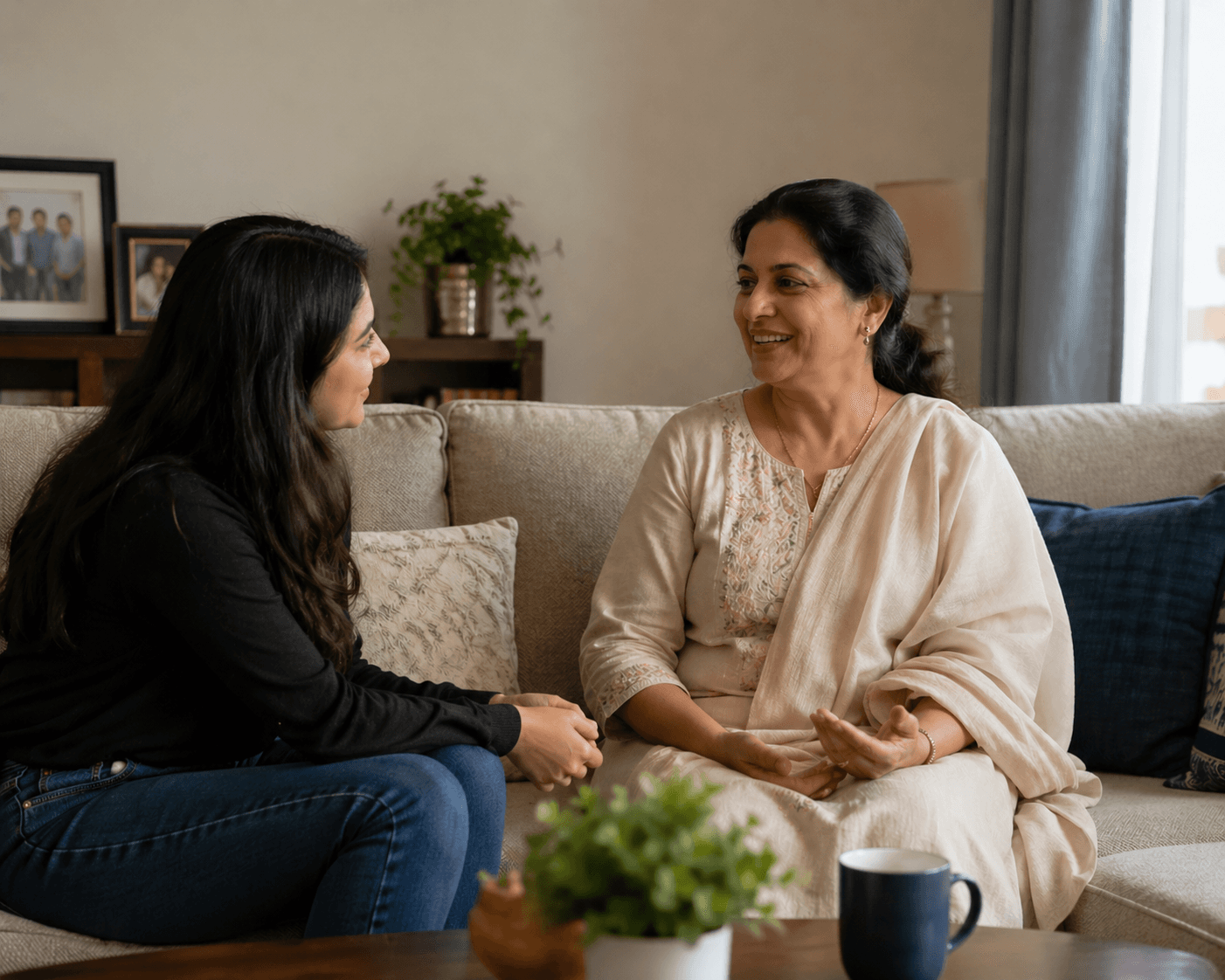
Most moms talk best at a kitchen table with something for their hands to do — a cup of tea, a photo album, half-snapped beans. The recording is invisible (phone face-down). You're at the corner of the table, not across from her — side-by-side feels like collaboration, face-to-face feels like an audition. The full playbook is in our interview your mom guide — kitchen-table setup, the script that breaks the deflection, the five pivots when she says "oh, nobody wants to hear about that."
Dad: get in the truck, not the dining room
Most dads don't open up across a table. They talk sideways — in motion, while doing something else. The fix is to skip the sit-down entirely. Phone face-up on the dash, Voice Memos running, drive to the hardware store. Shoulder-to-shoulder, not eye-to-eye. The full playbook with 30 ranked questions and the six-step setup is in our interview your dad guide.
If you're not sure which playbook fits your parent, the rough test is this: would they rather talk at a table or while doing something else? If they're a beside-you-at-the-counter person, kitchen table. If they're a let's-just-walk-and-talk person, truck or workbench. Plenty of moms are truck people. Plenty of dads are kitchen-table people. The gender on the playbook is a starting heuristic, not a rule — go with whatever shape your parent already does the rest of their thinking in.
Three Techniques That Work for Both Parents
Past the kitchen-vs-truck choice, there's a small set of moves that work regardless of which playbook you're running. If you only remember three things, remember these.
1. Start with a sensory anchor, not a question
"Tell me about your childhood" is too big. They don't know where to start, so they default to a stiff summary. Start with a smell, a sound, or an object instead. "What did your kitchen smell like in the morning when your mom was making breakfast?" gets you a 4-5 minute story. "What was your first car?" gets you a 4-5 minute story. Sensory anchors bypass the part of the brain that filters memories for "interestingness" and go straight to specifics. The meaning shows up on its own, embedded in the details.
2. Use 'and then what happened' as your only follow-up
When they give you a one-line answer and stop, the instinct is to ask a new question. Don't. Most one-line answers are the first sentence of a real story — they just need permission to keep going. "And then what happened?" is permission. Say it quietly, don't make eye contact, and wait. Three or four uses of that phrase per conversation will produce more usable audio than any clever follow-up you could prepare in advance.
3. Don't fill the silences
This is the technique nobody teaches you and the one that separates a thin recording from a real one. When they stop talking, you stop too. Count to fifteen in your head before speaking. Don't make eye contact during the count. Look at the photo, the road, your tea. The silence isn't the end of the story — it's almost always the middle of one, the part where they're deciding whether to tell you the harder thing. Fill the silence and they take the polite exit. Sit with it and you get the part you came for.
If you want a deeper question bank to draw from once the conversation is open, the 50 questions to ask your grandparents before it's too late list works equally well for parents — print four or five, fold them in your pocket, glance at them only if the conversation slows. Never read them off a sheet. The piece of paper turns the conversation back into an audition. (Not sure which gaps to fill first? Our two-minute how well do you know your family's story quiz will show you which questions you can't answer yet.)
What If Both Parents Are in the Room?
Here's a situation almost no interview guide covers, and it comes up constantly: you visit your parents and both of them are home, and you want to record stories, and there's no clear way to do it without one of them taking over.
Don't try to interview them together. Couples interview each other in their answers — mom defers to dad's better memory, dad defers to mom's better storytelling, and the result is a recording where neither of them ever fully shows up. Separate them.
The trick is to manufacture a reason. "Dad, can you grab those old photos from the garage while I help mom with the dishes?" buys you twenty minutes alone with one parent. "Mom, the kids want to see what's in your old jewelry box upstairs" buys you twenty minutes alone with the other. You don't need both interviews in one visit — you need each parent in their own setting, with their own playbook, without the other one quietly editing their answers.
If you only get one of them alone this visit, that's fine. Run that one well. Plan the other for the next visit. Two thirty-minute solo recordings beat one ninety-minute interview where they're both performing for each other.
After the Recording — The Part Most People Skip
Most families hit stop, hug, eat lunch, and never touch the file again. The recording sits on a phone for three years, gets backed up to iCloud, and quietly becomes inaccessible after the next phone change. The interview was the easy part. Preserving it is where things go wrong.
Within an hour: rename the file with their name and the date
"Mom interview — May 13, 2026" beats whatever Voice Memos auto-generated. Future-you, ten years from now, will need that label to find it.
Within a day: save it to two places
Email it to yourself. Drop it in Google Drive or iCloud Files. One copy isn't a backup — two is. Phones get lost. Accounts get locked. The file is irreplaceable; treat it that way.
Within a week: write down three quotes you want to remember
Listen back. Pick the three sentences that hit you hardest and write them somewhere you'll see them. The recording captures everything; the three quotes are what you'll want when you're missing them.
Within a month: share it with one sibling — not all of them
Siblings have different memories of the same parent. The brother who never noticed how much grandpa drank will hear a story that lands differently than the sister who lived through it. Share the file with one sibling and ask them what stood out — you'll get the next round of questions for free.
This is where a single phone Voice Memos folder stops being enough. Voicemails get deleted when the carrier rolls over storage. Phone backups don't include the casual recordings you didn't tag. The point isn't that everyone needs a fancy archive — it's that somewhere intentional needs to be the home for this file, because the default location is "lost in five years."
When to Actually Do This
This whole playbook runs any Sunday. You don't need a special occasion. The easiest version, though, is a holiday visit when you're already there for other reasons — the activation energy is lower because the trip is already happening.
Mother's Day, Father's Day, a birthday weekend, the Thursday before Christmas when the house is quiet — all of them work. The week you fly home for a wedding works. The Saturday morning of any visit works. What matters isn't picking the perfect occasion; it's picking an occasion and committing to thirty real minutes inside it.
The one rule: don't try to run this on the holiday itself. Christmas Day, your mother's birthday, the family gathering — too many people, too much performance pressure. Run the interview the day before or the morning after. When the house is quieter and the energy is lower, parents are more present. That's when the real audio happens.
The 20-Year Question
Here's the part of this conversation almost nobody asks: where will this recording live in 2046?
Walk the actual options. iCloud or Google Photos — locked to one person's account, gone if that account ever closes. An external hard drive — drives degrade and fail, and a recording you copied to a drive eleven years ago is sitting on something that's already past its rated lifespan. The Voice Memos app on the phone you'll replace twice between now and then. A family Dropbox folder nobody opens.
The right long-term home has four properties: you own it, multiple family members can access it without depending on one person's login, it organizes recordings by who — not just when — and it stays accessible across decades. The voice of your father in 2046 should be findable in three taps, not buried in a chronological backwater of someone's iPhone backup.
This is the part Memory Murals is built for. Voice recordings live alongside the photos, the written stories, and every milestone in between — all tagged by person, so the future versions of you and your kids can find every recording your mother ever appeared in across decades, without anyone having to remember a date.
The recording you make this month is the part of your parent that lasts. Make it once. Make it well. Then put it somewhere that will still be there.
If you only do one thing this month
Pick the parent you've been meaning to ask. Pick the playbook — kitchen table or truck (see the section above for which fits which). Pick the day. Run thirty real minutes. Save the file in two places before bed. That's the whole technique — and one recording you actually make this Sunday is worth more than ten you intend to make next year.
Frequently Asked Questions
Q: My parent is in their fifties and perfectly healthy — why now? Because the version of them at fifty-five isn't the version you'll have at seventy. The cadence, the laugh, the way they tell a story right now — all of it drifts even with perfect health. Record this year, then again next year, then every year after. Annual recordings stack into something irreplaceable over a decade.
Q: They refuse outright. What do I do? Don't interview them. Sit beside them, or get in the truck, and ask about an old photo or their first car. Don't make it about recording. Most "refusals" are refusals to perform, not refusals to share. Once they're telling you about the photo or the car, the audio is already happening — and you can mention the recorder after the fact rather than asking permission upfront.
Q: Should I edit the recording before I save it? No. Don't edit your parent's voice. The pauses, the "oh, you know what I just remembered," the way they trail off mid-sentence — those are the parts you'll want most in twenty years. Save the raw file. If you want a polished clip for a slideshow someday, edit a copy.
Q: What if they get emotional and I feel like I should stop? Don't stop unless they ask you to. The emotion is the recording. The most precious moments of your parent's voice will be the ones where they're not in performance mode — and that almost always means a little vulnerable. Stay with them. Pass the tissues. Keep recording.
Q: How long should the first session be? Aim for 60-90 minutes the first time, expect 30-45 minutes of really usable audio. After the first time, you'll know their energy curve and you can run shorter sessions more often. Don't aim for perfect — aim for some.
Q: My parents are divorced. Do I need to do two separate recordings? Yes — and probably in two different sessions. Each parent has their own version of the family history, and trying to reconcile the two versions into one combined narrative produces a thin recording of both. Two separate sessions, in their own homes, on their own terms, will capture far more than one carefully neutral combined one.
Q: What if I live across the country and can't visit? The phone-call variant works. Tell them you're recording — don't surprise them — and call them on a weekday evening when they're already kicking around the house. Free apps record both sides of a call. Mac users can use QuickTime for FaceTime audio. The audio is fine. The connection is what matters.
Get 50 questions to ask your parents — before the stories are gone
The exact prompts families use to draw out the stories nobody ever wrote down. Free, straight to your inbox.
No spam. Unsubscribe anytime.
About the author
Patrick Moore, Founder of Memory Murals
Patrick Moore is the founder of Memory Murals. He built it after realizing how much of his own family's history had quietly slipped away — to help families preserve their stories, voices, and photos while they still can.
Related Stories

Insights
The Sound of Home: Why a Loved One's Voice is the Ultimate Time Machine
We obsess over HD video but overlook our most powerful connection: the human voice. Here's why recording your family's voices might be the most important thing you ever do.
Patrick Moore • January 20, 2026
How-To Guides
How to Interview Your Mom (Even If She Won't Talk About Herself)
Most moms deflect when you ask them to 'tell their story.' Here's how to set up the kitchen-table interview, the script that breaks the deflection, the five pivots when she says 'oh, nobody wants to hear about that,' and the three questions to ask if you only get twenty minutes.
Patrick Moore • April 30, 2026

How-To Guides
How to Interview Your Dad (Even If He's Not a Talker): A Gentle Guide to Recording His Stories
Most dads don't open up across a kitchen table. They talk sideways — in the truck, in the garage, walking the dog. Here's how to record him anyway: why he deflects, why audio is the medium that finally works, and 30 questions ranked from 'first car' to 'your father.'
Patrick Moore • May 5, 2026
Now give it somewhere to live.
The file you just saved outlasts nothing on its own. Put it where your family can still find it in thirty years.