
How to Interview Your Mom
Most moms deflect when you ask them to 'tell their story.' Here's how to set up the kitchen-table interview, the script that breaks the deflection, the five pivots when she says 'oh, nobody wants to hear about that,' and the three questions to ask if you only get twenty minutes.
Patrick Moore, Founder • April 30, 2026
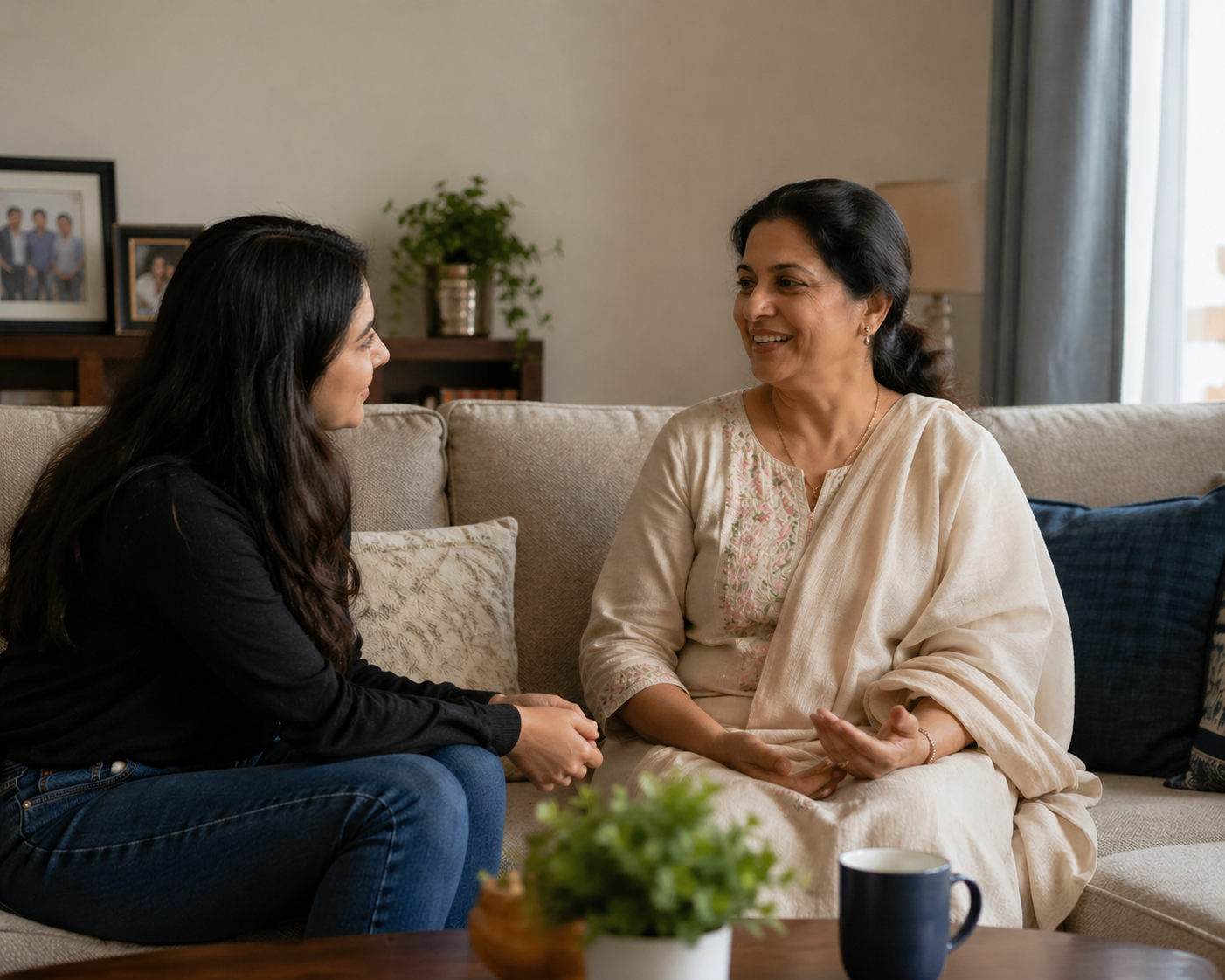
The first time you ask her, she'll laugh and wave you off.
"Oh, honey, nobody wants to hear about all that."
Then she'll change the subject. She'll ask if you want more coffee. She'll tell you about the neighbor's new puppy. She'll do the thing she's been doing for forty years — the thing where any question that points at her ends up redirected back to you, or to someone else, or to anything that isn't her own life.
This isn't because she has nothing to say. Your mom has enormous amounts to say. She has stories she's never told anyone — about her childhood, her first heartbreak, the year she nearly didn't graduate, the night your dad proposed, the postpartum depression nobody named at the time, the friendship that quietly ended in 1987 and still aches sometimes. She has all of it. What she doesn't have is permission to take up that much space in a conversation.
Your job, if you want to interview her, isn't to extract a story. It's to give her permission. This post is about how to do that — practically, in your kitchen, on a Sunday afternoon, without making it weird.
This piece is the mom-specific companion to our broader how to interview your parents guide. The universal frame — when to use which playbook, how to handle both parents in the same house, what to do with the recording afterward — lives there. The kitchen-table specifics live here. If you want the all-relationships master, our complete recording method for family life stories is the level above both.
The frame that changes everything
Don't call it an "interview." Don't say "I want to record you." Don't pull out a tripod. The word interview makes her feel like she's auditioning for a documentary. Call it "I just want to ask you about something" and put your phone on the table face-down. That sentence and that phone position are the entire game. Everything else in this post is detail.
The Kitchen-Table Interview That Worked When Nothing Else Did
The first version of this — the one you've probably already tried — is the structured sit-down. You picked a Sunday. You wrote out a list of questions. You said "Mom, I want to record some stories for the kids," and you set up your phone with the recording app open and the timer visible, and she sat down across from you with her hands folded and a slightly stiff smile, and the answers came out in the same stiff way the smile did. Three sentences each. Polite. Performance-y. Not her.
The kitchen-table version is different in three specific ways.
First, you're not across from her — you're beside her, or at the corner of the table. Side-by-side seating works better for the same reason couples therapists use it: face-to-face feels like opposition; side-by-side feels like collaboration. People who sit at the corner of a table tell deeper stories than people who sit across.
Second, the recording is invisible. Phone face-down. Voice Memos open before she walks in. You don't say "let me hit record." You don't say "this is going to be saved forever." She knows it's recording — most moms aren't dumb — but the moment you stop performing the recording, she stops performing the answers.
Third, there's something for her hands to do. A cup of tea. A half-snapped beans bowl. A photo album on the table between you. Hands-busy, brain-loose. The single best mom-interview technique anyone has ever taught us is put a photo album between you and let her tell you who's in each picture. The photo album does the work. You're just listening.
That's the kitchen-table interview. Not a sit-down. A sit-beside.
Why Moms Deflect — and the Script That Breaks the Deflection
There are five things almost every mom says when you first try to interview her. We've heard all of them, hundreds of times. Each one has a counter that works.
What she might say: 'Oh honey, nobody wants to hear about that'
This is the most common deflection. It's not modesty — it's a lifetime of being trained that her stories are less important than someone else's. Counter: "Mom, my kids are going to be your age someday. They're going to want to know what you were like when you were my age. I'm not collecting this for me. I'm collecting it for them." Watch her face when you say grandkids. Something opens.
What shuts her down: 'Just start whenever you're ready'
Open prompts paralyze her. "Tell me about your childhood" is too big. She doesn't know where to start, so she defaults to a stiff summary. Use specific anchors instead. "What did your bedroom look like when you were ten?" gets a better answer than "Tell me about growing up."
What she might say: 'I don't remember anything interesting'
She remembers everything. The word "interesting" is the problem — it's making her gatekeep her own memories against an imagined audience. Counter: "Forget interesting. Just tell me what your kitchen smelled like in the morning when your mom was making breakfast." She'll smile. The smell question always works.
What shuts her down: 'I'm just going to record this real quick'
Announcing the recording cues the performance. Hands fold. Voice changes. Don't announce it. Open Voice Memos before she comes in, set the phone face-down on the table, hit record, and start the conversation as if you weren't recording at all. (Tell her later — it's the right thing to do — but don't make the recording the event.)
What she might say: 'Why are you asking me all this?'
She's checking whether you're worried about her health. Be honest, briefly. "I'm not. I just realized I don't know enough of these stories yet, and I want to." Then immediately ask the next question — don't sit in the moment. The honesty disarms her; the next question gives her somewhere to land.
The script for breaking the deflection isn't fancy. It's the four sentences above, plus patience, plus a willingness to ask the same question three different ways before giving up on it.
Setting Up the Room, the Recorder, and the First Question
If you have an hour and a half this Sunday, here's the setup that works.
1. Pick the quietest room in the house
Not the living room (TV, kids, dog). Not the kitchen if dishes are running. The dining table is usually best — natural light, a hard surface for the phone, no echo. Close the windows if there's traffic. Put the dog out.
2. Time it for mid-morning, after breakfast
Most parents are sharpest between 10 a.m. and noon. Avoid right after a meal (drowsy) and after 4 p.m. (especially important if she's older — see our companion guide on recording your parent's voice before dementia takes it). A glass of water within reach, because she'll talk longer than you both expect.
3. Phone face-down between you
Voice Memos on iPhone or Recorder on Android. Tap record before she sits down, screen down. Don't put the phone in front of her — put it equidistant. The phone is a third presence; treat it like one.
4. Open with something physical, not a question
Hand her an old photo. "I found this in the box in the garage — who's the woman next to Grandma?" The first three minutes of useful audio almost always come from a photo prompt, not a question prompt.
For the question list itself, you don't need to write your own — we already published the 25 questions to ask your mom before it's too late. Print four or five, keep them face-down next to your tea, glance at them only if the conversation slows. Never read them off a sheet at her — that turns the conversation back into a performance.
5 Conversation Pivots When She Says "Oh, Nobody Wants to Hear About That"
The deflection isn't a brick wall. It's a door. Here are five pivots that get you through.
1. Replace 'tell me' with 'walk me through'
"Walk me through what a Sunday in your house looked like when you were eight." Walking-through is procedural — she gets to describe a sequence rather than perform a story. The story comes out anyway, embedded in the sequence.
2. Ask for sensory details first, meaning second
"What did the house smell like when your dad got home from work?" gets you closer to her father than "What was your relationship with your dad like?" ever will. Smell, sound, taste, weather — start there. The meaning will arrive on its own.
3. Use the 'and then what happened' trick
When she gives you a one-line answer and stops, don't ask a new question. Just say, softly, "And then what happened?" Most one-line answers are the first sentence of a real story — she just needs permission to keep going. "And then what happened?" is permission.
4. Bring the question back through someone else
If she deflects on her own life, ask about a relative she loved. "What was Grandma like when nobody was watching?" gets her talking about herself by accident — because Grandma raised her, so describing Grandma describes her childhood. There's also a longer playbook for this in our piece on how to get your loved ones to share stories.
5. When the conversation flatlines, change rooms
Forty-five minutes in, energy will dip. Don't push through. Stand up, refill her water, say "Show me where you found those photos." Walking unlocks new memories. Some of the best material we've ever heard came from a kitchen-to-garage walk, not from the table.
What to Do With the Silences (Don't Fill Them)
This is the technique nobody tells you about, and it's the single most important one in this whole post: when she stops talking, you stop too.
The instinct is to fill the silence. To say "Oh wow, that's amazing" or "And then what happened?" or any of the polite affirmations we make when someone's been talking for a while. Don't. The silence isn't the end of the story. It's almost always the middle of one — the part where she's deciding whether to tell you the next, harder thing. If you fill it, she takes the polite exit and moves on. If you let it sit for ten or fifteen seconds, she'll often quietly say something like "…you know, there's something I never told you about that…" — and that's the part you came for.
Practice this. Count to fifteen in your head before you speak. Don't make eye contact during the count. Look at the photo, the table, your tea. Give her the room. The recording will catch it. Future-you will be very glad.
After the Recording: The Part Most People Skip
Most families hit stop, hug, eat lunch, and never touch the file again. The recording sits on a phone for three years, gets backed up to iCloud, and quietly becomes inaccessible after the next phone change. Don't let that happen.
Within an hour: rename the file with her name and the date
"Mom interview — April 30, 2026" beats whatever Voice Memos auto-generated. Future-you, ten years from now, will need that label.
Within a day: save it to two places
Email it to yourself. Drop it in Google Drive or iCloud Files. One copy isn't a backup — two is. Phones get lost. Accounts get locked. The file is irreplaceable; treat it that way.
Within a week: write down three quotes you want to remember
Listen back. Pick the three sentences that hit you hardest and write them in a notes app or a notebook. The recording captures everything; the three quotes are what you'll want when you're missing her.
Make it annual
Once you've done it once, you have a template. Same Sunday next year. Same kitchen table. Same opening photo. The compounding effect over a decade is unbelievable — and a one-page playbook for that exact ritual lives in our Mother's Day memory ritual post.
If You Only Get 20 Minutes, Ask These Three Questions
Sometimes you get the whole afternoon. Sometimes you get the twenty minutes between dinner and the kids' bedtime, and that has to be enough. If that's all you have, ask these three. They consistently produce more useful audio per minute than any other questions we've heard.
1. 'What's a smell that takes you straight back to childhood?'
Smell is the memory sense — it activates parts of the brain that words alone don't reach. The answer almost always opens into a 4-5 minute story she didn't know she was about to tell. Don't ask it as a multi-part question; just ask the smell, then sit back.
2. 'What's something you wish you'd told your mom while she was still here?'
This is the heaviest question on the list. Use it gently. It produces some of the most meaningful audio you will ever hear of your mother's voice. If she gets emotional, don't apologize — just stay with her. The emotion is the recording.
3. 'What's the best advice anyone ever gave you about being a parent?'
This one ends the session warmly. It lets her speak directly to her grandchildren without naming them. Twenty years from now, your kid is going to play this clip on their wedding day or in the hospital room with their first newborn. Promise.
If you only do one thing this Sunday
Sit beside her at the table. Phone face-down. Bring a photo. Ask the smell question. Stay quiet between her answers. Save the file in two places before you go to bed. That's the whole technique — and twenty minutes of it is more valuable than any gift you could buy this Mother's Day. Memory Murals takes care of the saving and organizing for you, automatically — but even if you never use us, please do the recording. Future-you will thank you.
Frequently Asked Questions
Q: My mom is 50, not 80 — does this still apply? Yes. Don't wait until "later." The version of her you have now — the cadence, the laugh, the way she tells her stories at this age — will be different in twenty years even if she's perfectly healthy. The right time to record is now.
Q: She refuses outright. What do I do? Don't interview her. Sit beside her. Ask about an old photo. Don't make it about recording. Most "refusals" are refusals to perform, not refusals to share. Once she's telling you about the photo, the audio is happening — and you can ask permission to keep it after the fact rather than asking permission upfront.
Q: Should I edit the recording before I save it? No. Don't edit her voice. The pauses, the "oh, you know what I just remembered," the way she trails off mid-sentence — those are the parts you'll want most in twenty years. Save the raw file. If you want a polished clip for a slideshow someday, edit a copy.
Q: What if she gets emotional and I feel like I should stop? Don't stop unless she asks you to. The emotion is the recording. The most precious moments of your mother's voice will be the ones where she's not in performance mode — and that almost always means she's a little vulnerable. Stay with her. Pass the tissues. Keep recording.
Q: How long should the recording be? Aim for 60-90 minutes the first time, knowing you'll only get 30-45 of usable audio. After the first time, you'll know her energy curve. The second session can be shorter and tighter. Don't aim for perfect — aim for some.
Q: Does this same playbook work for my dad? Mostly no — and that's the post we just published. Dads tend to clam up at the kitchen table the same way moms deflect, but the fix is different: dads talk in motion, not over tea. If you're trying to record your father, read how to interview your dad (even if he's not a talker) instead. Same goal, different setup — record him in the truck, not at the table.
Get 50 questions to ask your parents — before the stories are gone
The exact prompts families use to draw out the stories nobody ever wrote down. Free, straight to your inbox.
No spam. Unsubscribe anytime.
About the author
Patrick Moore, Founder of Memory Murals
Patrick Moore is the founder of Memory Murals. He built it after realizing how much of his own family's history had quietly slipped away — to help families preserve their stories, voices, and photos while they still can.
Related Stories

Lists & Roundups
25 Questions to Ask Your Mom Before It's Too Late (And Why Each One Matters)
Most of us think we know our mothers. But between the school pickups and the phone calls, there's an entire life you've never asked about. These 25 questions will change that.
Patrick Moore • March 31, 2026

Insights
Mother's Day With a Mom Who Has Dementia: 9 Gentle Ideas That Actually Work
Practical, gentle ideas for celebrating Mother's Day when your mom has dementia — what works in memory care, what to record while you still can, and what to do when she doesn't recognize you.
The Memory Murals Team • April 30, 2026

How-To Guides
How to Interview Your Parents About Their Life (Without It Feeling Like an Interrogation)
Most of us mean to ask. We don't. Then we lose the chance. Here's an honest, parent-neutral guide to interviewing your mom or dad — what actually works, what doesn't, and where the recording lives for the next twenty years.
Patrick Moore • May 13, 2026
Now give it somewhere to live.
The file you just saved outlasts nothing on its own. Put it where your family can still find it in thirty years.