
Protecting Seniors from Financial Scams
A quick, urgent phone call. A grandchild in trouble, needing money now. These scams prey on love and fear, costing seniors billions. Learn the top 5 financial scams targeting older adults and the simple, effective steps your family can take to protect them—and their precious memories—from harm.
Patrick Moore, Founder • August 4, 2026

The phone rings on a Tuesday afternoon. Your mom answers, and the voice on the other end is panicked, choked with tears. "Grandma? It's me. I'm in trouble. There was an accident, and I'm in jail. I need you to send bail money, but please, please don't tell Mom and Dad. They'll be so angry."
Her heart lurches. Her first instinct, her only instinct, is to help. She’d do anything for her grandchild. This is the moment a scammer is waiting for—the one where love and fear override logic.
This scenario, known as the "grandparent scam," is just one of many sophisticated and cruel schemes designed to exploit the trust and resources of older adults. Protecting our parents and grandparents in their later years has become about more than just their physical health; it's about safeguarding their financial well-being and their peace of mind.
These conversations can be difficult. No one wants to make their parent feel incapable or untrusted. But framing it as a team effort—a way for the family to look out for each other in a complex digital world—can make all the difference.
The short answer
The top five financial scams targeting seniors are the Grandparent Scam, Tech Support Scams, Government Impersonation (IRS/SSA), Romance Scams, and Lottery/Sweepstakes fraud. The most effective way to avoid them is to establish a simple rule: never send money, gift cards, or personal information in response to an unexpected phone call, email, or text. Always stop, take a breath, and independently verify the person and the situation by using a known phone number or contacting a trusted family member. Scammers rely on urgency; a moment's pause is your best defense.
Why Scammers Focus on Seniors
It can feel baffling and infuriating that criminals specifically target older adults, but their reasons are cold and calculated. Seniors often have accumulated a lifetime of savings, own their homes, and have good credit, making them attractive targets.
Beyond the financial assets, scammers prey on disposition. Many seniors were raised to be polite and trusting, making it harder for them to hang up on a persistent caller. They may also be less familiar with the latest digital red flags, like spoofed phone numbers or phishing emails that look identical to official communications.
Furthermore, loneliness can be a significant factor. A friendly voice on the phone can be a welcome connection, one that criminals are all too willing to fake and exploit. And sadly, many seniors are reluctant to report that they've been scammed due to embarrassment or fear that their family will think they can no longer manage their own affairs. This underreporting only emboldens the criminals.
1. The Grandparent Scam
As described in the opening, this scam uses emotional manipulation to create a false sense of emergency. Scammers will often gather details from social media—like a grandchild's name or recent travel—to make the story more believable. They may even use AI voice-cloning technology to mimic a loved one's voice for a few critical seconds.
How to Avoid It: The key is verification. Create a family password or a simple question only the real grandchild would know (e.g., "What was the name of your first pet?"). Most importantly, hang up and call the grandchild or their parents directly on phone numbers you know are real. No matter how convincing or urgent the plea, one verification call can stop the scam in its tracks.
2. The Tech Support Scam
A frightening pop-up message suddenly takes over your dad's computer screen, flashing warnings of a virus or security breach. It provides a phone number to call for immediate help. When he calls, a "technician" convinces him to grant remote access to his computer. The scammer then pokes around, claims to find numerous problems, and charges hundreds of dollars for fake repairs, often while installing malware to steal personal information in the background.
How to Avoid It: Remind your loved ones that legitimate companies like Microsoft, Apple, or Google will never use pop-up warnings to solicit a phone call. Instruct them to simply shut down the computer. If the pop-up persists after restarting, have a trusted family member or a local, vetted technician take a look. Never, ever grant remote computer access to someone who contacts you unexpectedly.
3. Government Impersonation Scams
A caller claims to be from the IRS, stating that your parent owes back taxes and will be arrested if they don't pay immediately. Or they'll pretend to be from the Social Security Administration, claiming their Social Security number has been suspended due to criminal activity. The tactic is always intimidation, and the demand is for immediate payment via an untraceable method like wire transfers, cryptocurrency, or, most commonly, gift cards.
How to Avoid It: This one is simple. Government agencies do not operate this way. They will never call to demand immediate payment or threaten arrest. They initiate contact through official mail. And they will never ask for payment in gift cards. The moment someone claiming to be from the government demands you go to Target and buy Apple gift cards, you know it's a scam. Hang up.
4. The Romance Scam
This is a long-con that preys on loneliness. A scammer creates a fake, highly appealing online profile on a dating site or social media platform. They spend weeks or even months building a deep emotional connection and gaining their victim's trust. Just as the relationship seems to be getting serious, a sudden "emergency" strikes—a medical crisis, a business deal gone wrong, or a problem with travel to finally meet in person. They ask for money, promising to pay it back as soon as the crisis is over. But the crises never end.
How to Avoid It: Be cautious of online relationships that progress very quickly emotionally but are always delayed when it comes to meeting in person. Perform a reverse image search of their profile pictures to see if the photos have been stolen from someone else's profile. Most importantly, never send money to someone you have not met in person, regardless of how compelling their story is.
5. Lottery and Sweepstakes Scams
An email, letter, or phone call brings exciting news: "You've won millions in a foreign lottery!" The only catch is that to receive the winnings, you must first pay a fee to cover "taxes," "insurance," or "shipping costs." The scammers will continue to invent new fees to drain as much money as possible from the victim, but the prize money never materializes because it never existed.
How to Avoid It: You cannot win a contest you did not enter. And in any legitimate lottery or sweepstakes, you never have to pay a fee to receive your winnings. Any request for a pre-payment is a guaranteed sign of a scam.
What to Do if You Suspect a Scam
Stop & Breathe
Scammers create a sense of urgency to prevent you from thinking clearly. The most powerful thing you can do is pause. Do not act immediately. Hang up the phone or walk away from the computer.
Verify Independently
Call the person, company, or agency directly using a phone number or website you know is legitimate, not one provided by the potential scammer. Talk to a trusted friend or family member about what happened.
Report It
Even if you didn't lose any money, report the attempt. File a complaint with the Federal Trade Commission (FTC) at ReportFraud.ftc.gov. Reporting helps authorities identify trends and shut down these operations, protecting others in the process.
The Other Asset Worth Protecting: Their Memories
The same digital vulnerabilities that expose seniors to financial fraud can also put their most precious, non-financial assets at risk: their life stories, family photos, and personal information. Scammers use data they find online to make their attacks more convincing. A public Facebook post about a grandchild's vacation can become fodder for a grandparent scam.
When family memories are scattered across insecure email threads, public social media profiles, and old, un-updated devices, they are vulnerable. A single phishing email could give a criminal access to an entire email account filled with personal correspondence and photos. A change in a social media platform's privacy policy could expose decades of family pictures to data mining. This is a core part of understanding what is a digital legacy—it's everything you leave behind online, and it needs to be protected.
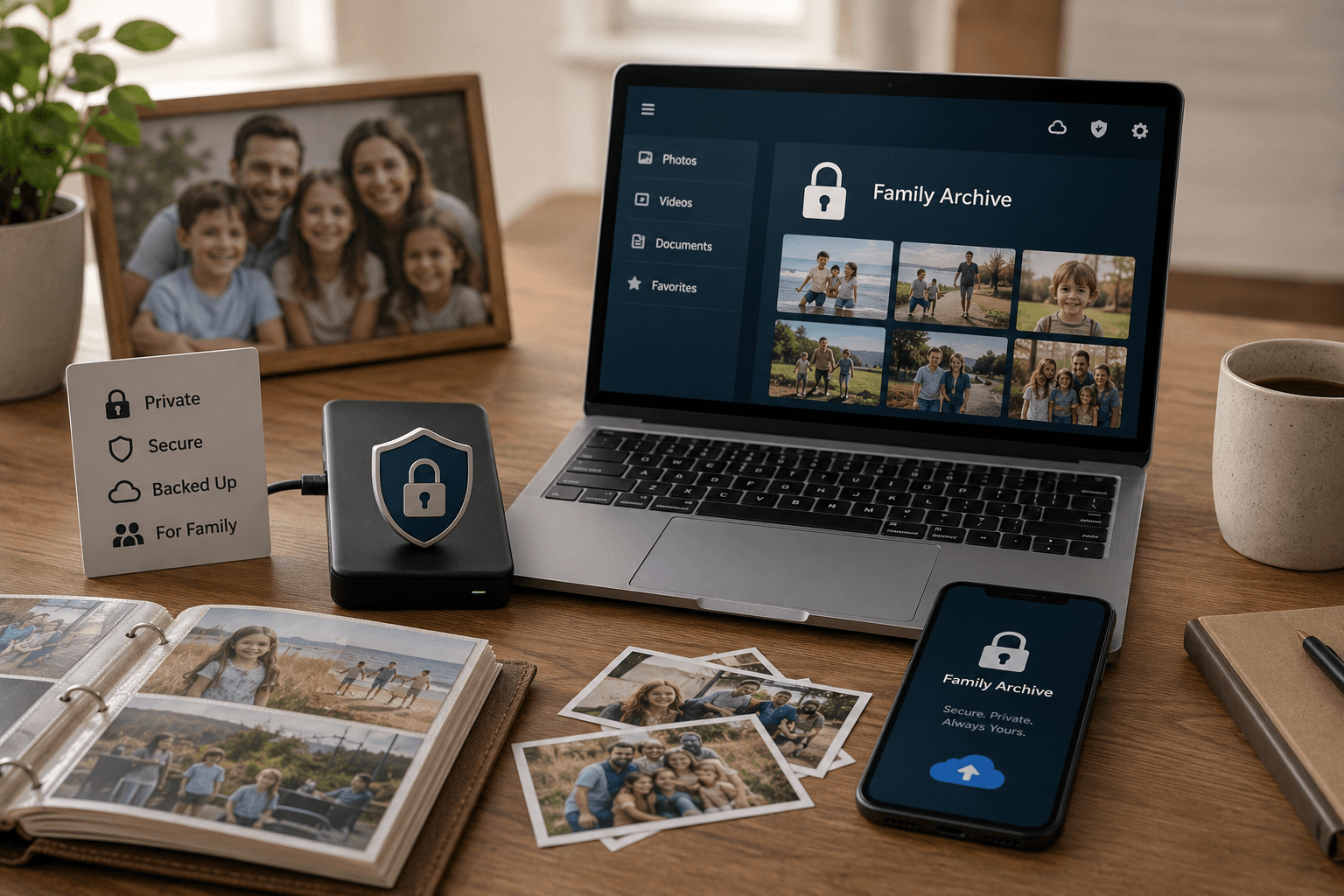
This is why we believe that a private, secure family archive is an essential tool for modern families. It's not just about organization; it's about security and peace of mind.
A Secure Space for What Matters Most
When you use a platform like Memory Murals, you are creating a digital sanctuary. Unlike social media, we are not in the business of selling your data. Our purpose is to protect your family's story. All your data is encrypted in transit (TLS) and at rest (AES-256). You control who has access, ensuring that your parents' stories and photos are shared only with the people they trust. It's a simple, effective way to create a private, secure family archive and reduce your family's exposure to online threats.
Protecting our parents as they age is a profound act of love. It involves having difficult but necessary conversations about their finances and their safety. It means setting up systems that empower them to stay connected without being exposed.
By creating a dedicated space for these stories, you're not just organizing photos; you're building a digital home that is safe from the storms of the outside world. It's a place where their legacy can be celebrated and preserved, securely, for generations to come. You can start building that safe space today for your family, a place founded on the one thing scammers can never touch: genuine connection.
Get 50 questions to ask your parents — before the stories are gone
The exact prompts families use to draw out the stories nobody ever wrote down. Free, straight to your inbox.
No spam. Unsubscribe anytime.
Frequently asked questions
What is the most common financial scam targeting seniors?
The 'Grandparent Scam' is one of the most common and cruel. A scammer calls pretending to be a grandchild in urgent trouble—often arrested or in an accident—and begs for money to be wired immediately, insisting on secrecy. They prey on a grandparent's love and instinct to help. The best defense is to hang up and call the grandchild or their parents directly on a known phone number to verify the story before taking any action. Creating a family 'safe word' can also help.
How can I protect my elderly parents from phone scams?
Empower them with a few simple rules. First, never trust caller ID, as it can be faked. Second, never provide personal or financial information, like a Social Security or bank account number, to an unsolicited caller. Third, government agencies like the IRS or Social Security Administration will not call and threaten you. Encourage them to hang up and talk to you or another trusted family member before ever sending money or giving out data. It's about creating a habit of pausing and verifying.
What are the warning signs of elder financial abuse?
Warning signs can be subtle. Look for sudden changes in their financial situation, like unpaid bills despite having adequate income, or large, unexplained withdrawals. Secrecy around their finances or a new 'friend' who is suddenly very involved in their life can be a red flag. They might also express fear or anxiety when talking about money. Another sign is when mail starts to go missing or they begin receiving unusual offers for contests or 'free' prizes. Staying connected and having open conversations is key to spotting these signs early.
Why are seniors so often targeted by financial scams?
Scammers target seniors for several reasons. They are often perceived as having accumulated savings or a reliable income. Many grew up in a more trusting era and may be less cynical about unsolicited calls or emails. Some may be experiencing loneliness or cognitive decline, making them more susceptible to manipulation. Additionally, they may be less familiar with the red flags of digital scams and more hesitant to report fraud out of embarrassment or fear of losing their independence.
How does a secure family archive help protect seniors?
A secure family archive like Memory Murals protects seniors by providing a private, contained environment for their stories and photos, away from the data-mining and public exposure of social media. This reduces their digital footprint and the amount of personal information scammers can find online to craft believable attacks. It also creates positive, secure technology habits, encouraging them to share precious information in a safe space built for family, not for advertisers or criminals.
About the author
Patrick Moore, Founder of Memory Murals
Patrick Moore is the founder of Memory Murals. He built it after realizing how much of his own family's history had quietly slipped away — to help families preserve their stories, voices, and photos while they still can.
Related Stories
How-To Guides
How to Create a Private, Secure Digital Family Archive (2026 Step-by-Step)
Most family photos today live somewhere a stranger's algorithm can scan them or a forgotten password can lock them away forever. Here's how to build a private archive only the people you choose can see — and that doesn't belong to anyone but you.
Patrick Moore • May 27, 2026

Insights
Why Privacy is the Heart of Memory Murals
In an age of oversharing, Memory Murals was built on privacy. Learn why your family's story deserves a space free from ads, algorithms, and public scrutiny.
Patrick Moore • December 10, 2025

Insights
AI Grandkid Photos: Boomer Fun vs. Millennial Privacy Nightmare
A grandparent excitedly shares an AI-generated photo of their grandchild as a tiny astronaut. For them, it's harmless fun. For the Millennial parents, it's a digital privacy violation. This post explores the generational divide over AI-generated kid photos and offers a path forward for families.
Patrick Moore • September 21, 2026
Preserve your family's memories in one private place.
Start free in minutes. No credit card required.