
Protecting Family Photos from AI Deepfakes
With AI tools making it easy to create fake images, how can we trust our family photos? Recent news about Apple's new authentication features highlights the growing need to protect our digital memories. This guide explains the risks and offers practical steps to safeguard your family's visual history.
Patrick Moore, Founder • August 12, 2026
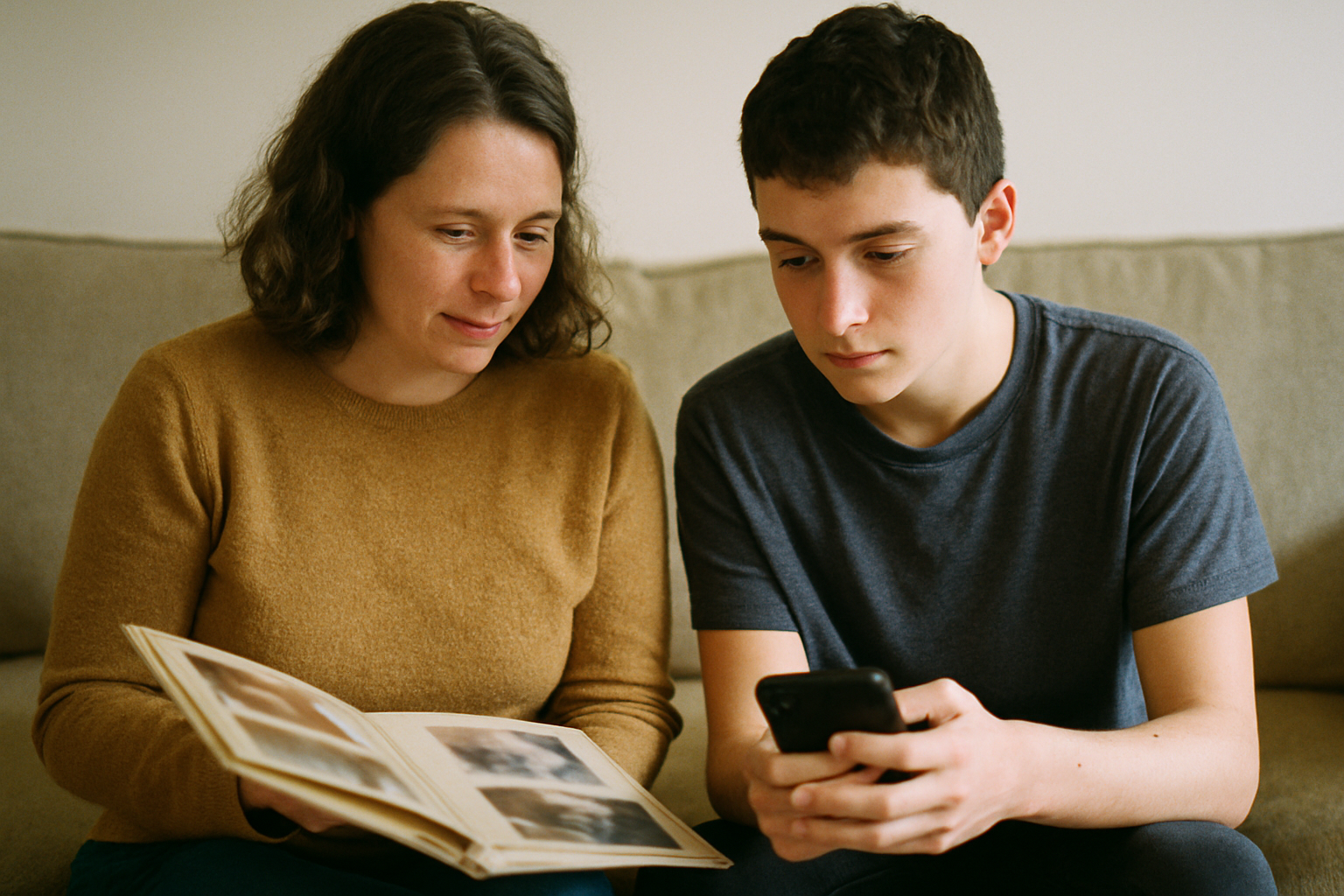
There’s a quiet trust in an old photograph. When you hold a faded print of your grandmother as a young woman, you don’t question its reality. The curl of her hair, the style of her dress, the hint of a smile—you accept it as a true fragment of a moment that happened. That image is a direct link to a person you love, a piece of evidence of their life before you knew them.
For decades, that trust has been the bedrock of family history. But the ground is shifting beneath our feet. The same artificial intelligence that can colorize a black-and-white photo with stunning accuracy can now create a photo from scratch, inventing moments that never were. The line between restoration and fabrication is blurring.
With news breaking that companies like Apple are now building tools to prove a photo is real, it’s clear we’ve entered a new era. The fundamental question is no longer just how to save our photos, but how to save their truth.
The short answer
To protect family photos from AI deepfakes, focus on provenance and privacy. Use new tools like Apple's upcoming hardware-level authentication for future photos, which will help prove an image is genuine. For existing photos, store them in a secure, private digital archive that doesn't use your data for AI training. Limit sharing on public social media and always keep original, high-resolution copies. This combination of verification and controlled access is key to preserving their truth for future generations.
Why We're Suddenly Talking About Photo Authenticity
For a few years, AI in photography felt like a fun novelty. We saw apps that could animate old portraits, making a stoic ancestor blink and smile. It was slightly eerie but mostly harmless. That technology, however, was just the beginning. The tools available today are exponentially more powerful, capable of creating hyper-realistic images and videos from simple text prompts or a handful of source photos.
This leap in capability has forced a response from the world’s biggest technology companies. As reported by outlets like The Verge and 9to5Mac, Apple is developing a hardware-level “reference image” tool to combat AI-generated photos. While the exact mechanics haven't been fully detailed, the goal is to create a kind of digital birth certificate for a photo the moment it's taken on an iPhone, providing a way to verify it hasn't been altered.
This is a landmark development. It’s an admission that, without a clear chain of custody, the digital image is becoming an unreliable narrator. But it also highlights a critical vulnerability: What about the millions of photos we already have? The shoeboxes of prints we’ve scanned, the digital pictures from the last twenty years—none of these will have Apple’s new seal of approval. Their authenticity will rely entirely on context and safekeeping.
Understanding the Risks to Your Family Archive
When we talk about “AI deepfake family photos,” the threat is twofold. It’s not just about malicious actors creating disinformation; it’s about the subtle erosion of our own personal histories.
First, there's the risk of manipulation. A real photo of your grandfather could be altered to place him next to someone he never met, or an AI could generate a smile on his face in a somber moment. While perhaps done with good intentions, it introduces a fiction into the family record. Over time, these small fictions can replace real memories.
Second, and more unsettling, is the risk of fabrication. Using photos of your family scraped from public social media profiles, AI can be trained to generate entirely new, fake “memories.” Imagine a completely plausible-looking photo of a family vacation that never happened. Without the original participants there to debunk it, how would future generations know the difference?
AI is a tool, and like any tool, it can be used to build or to break. Its impact on family history is a perfect example of this duality.
AI for Restoration
The same technology that powers deepfakes can be an incredible asset for preservation. It can repair water damage, fix tears, and colorize faded photos, rescuing memories that were on the brink of being lost forever.
AI for Fabrication
This power comes at a cost. The ability to convincingly generate pixels means the visual proof of a memory is no longer absolute. It creates a world where seeing isn't always believing, even within our own family albums.
How to Protect Your Digital Memories: A 4-Step Guide
So, how do we navigate this new reality? It’s not about abandoning digital photos. It’s about being intentional and creating a fortress of trust around your family’s visual legacy. Here’s a straightforward approach.
A Guide to Safeguarding Your Photos
Consolidate and Curate
Your family photos are likely scattered across phones, laptops, old hard drives, and various cloud services. The first step is to bring them all together. Creating a single, organized collection is foundational. As you gather them, focus on the highest-quality originals you can find. This central library is what you will work to protect.
Establish a Private Sanctuary
Once organized, your photos need a safe home. This is the single most important step. Public platforms and free photo services often have business models that rely on data. A true private archive, however, should have a business model that relies on privacy. At Memory Murals, we believe privacy is the heart of preservation. Your photos are never scanned for advertising or used to train AI models. All your data is encrypted in transit (TLS) and at rest (AES-256), and access is strictly limited to the people you personally invite.
Document the Provenance
An AI can fake a face, but it can't fake a story. The context surrounding a photo is its strongest defense against inauthenticity. For every important photo, document the “who, what, when, where, and why.” Record the story behind the photo in the photographer’s or subject’s own voice. This rich, human-generated context creates a layer of verification that algorithms can't replicate. It transforms a simple image file into a verified piece of family history.
Control Your Sharing
Rethink how you share family memories. Instead of posting to public social media feeds, use a secure, shared space where you control the audience. When you want to share a collection of photos with relatives, a private archive allows you to grant view-only access without giving up control of the original files. This intentional sharing keeps your precious memories within the circle of trust. For a deeper dive, read our guide on how to create a private, secure family archive.
The Future is a Hybrid of Technology and Tradition
Apple’s work on photo authentication is an exciting and necessary step. It shows that the industry recognizes the problem and is working on technological solutions to help us trust what we see. We should welcome these tools as they become available.
A Tool for the Future
Apple's reported authentication feature is a proactive measure. It essentially creates a digital watermark at the hardware level, allowing you to prove a photo hasn't been tampered with since it was taken. While details are still emerging, this signals a major shift towards built-in authenticity, but it won't retroactively apply to your existing library of scanned prints and older digital photos.
But for the century of photography that already exists, the solution isn't just technological—it's human. It's the stories we tell, the context we preserve, and the care we take in safeguarding our archives.
The truth of a family photo isn't just in the pixels; it's in the memory it holds. In an age of digital uncertainty, our job is to protect both. By combining smart new technologies with the timeless tradition of family storytelling, we can ensure our histories remain real, trusted, and true for the generations who will look to them for their own sense of belonging.
It's about creating a space where your family's history is safe from the noise and ambiguity of the wider internet. If you're ready to build that sanctuary for your own family, you can start your Memory Mural today. It’s a quiet place for your most important stories.
Get 50 questions to ask your parents — before the stories are gone
The exact prompts families use to draw out the stories nobody ever wrote down. Free, straight to your inbox.
No spam. Unsubscribe anytime.
Frequently asked questions
What is an AI deepfake photo?
An AI deepfake photo is a synthetic image created using artificial intelligence, specifically a technique called deep learning. These tools can alter existing photos or create entirely new, photorealistic images of people, often placing them in situations that never occurred. The technology can convincingly swap faces, change expressions, or generate a person's likeness from scratch, making it difficult to distinguish from an authentic photograph without careful inspection or specialized tools.
How can I tell if a family photo is a deepfake?
Detecting a sophisticated deepfake can be difficult, but look for subtle flaws. Check for unnatural details in the eyes, teeth, or hair. Look for inconsistent lighting, strange shadows, or blurry areas where elements are blended. The edges of a person's face or body might also appear distorted. While AI is rapidly improving, these small imperfections are often the clearest giveaways that an image has been manipulated or entirely fabricated.
Will Apple's new tool protect all my old photos from deepfakes?
No, Apple's reported hardware-level authentication tool is designed to verify photos at the moment they are taken on new devices. It won't be able to retroactively authenticate your existing library of photos, especially those that have been scanned from prints or taken on older digital cameras. It's a powerful step for future-proofing new memories, but protecting your current archive requires different strategies, like secure storage and careful curation.
What's the best way to protect my family photos from being used for AI?
The most effective method is to control their accessibility. Avoid uploading high-resolution family photos to public social media platforms or services with ambiguous data policies, as they can be scraped for AI training data. Instead, store your cherished memories in a private, secure digital archive that prioritizes user privacy. Limiting public exposure is the single best way to prevent your family's likenesses from being used without your consent.
Why is a private archive better than social media for photo security?
A private archive like Memory Murals is built on a foundation of privacy, not advertising. Your photos are not used to train AI models or target ads. Access is strictly controlled by you, limited to family and friends you invite. Social media platforms, by contrast, often have broad licenses to use your content and are public by default, making your photos vulnerable to data scraping. A private archive provides a secure sanctuary for your memories.
About the author
Patrick Moore, Founder of Memory Murals
Patrick Moore is the founder of Memory Murals. He built it after realizing how much of his own family's history had quietly slipped away — to help families preserve their stories, voices, and photos while they still can.
Related Stories
How-To Guides
How to Create a Private, Secure Digital Family Archive (2026 Step-by-Step)
Most family photos today live somewhere a stranger's algorithm can scan them or a forgotten password can lock them away forever. Here's how to build a private archive only the people you choose can see — and that doesn't belong to anyone but you.
Patrick Moore • May 27, 2026

Insights
Why Privacy is the Heart of Memory Murals
In an age of oversharing, Memory Murals was built on privacy. Learn why your family's story deserves a space free from ads, algorithms, and public scrutiny.
Patrick Moore • December 10, 2025

Insights
Google Photos Changes Mean Your Pictures Disappear Faster
A recent Google Photos change halves the time you have to recover deleted photos, from 60 days to just 30. This seemingly small update has big implications for your family's digital legacy, making accidental deletions more permanent. We'll explore what this means and why a dedicated archive offers better protection.
Patrick Moore • September 8, 2026
Preserve your family's memories in one private place.
Start free in minutes. No credit card required.