Photo Privacy in the Age of AI
A recent news story highlights a troubling reality: even apps designed to protect your photos from AI can be vulnerable. This post explores the ongoing battle for digital privacy, what it means for your family's memories, and how to choose a truly secure home for your most precious moments.
Patrick Moore, Founder • August 15, 2026
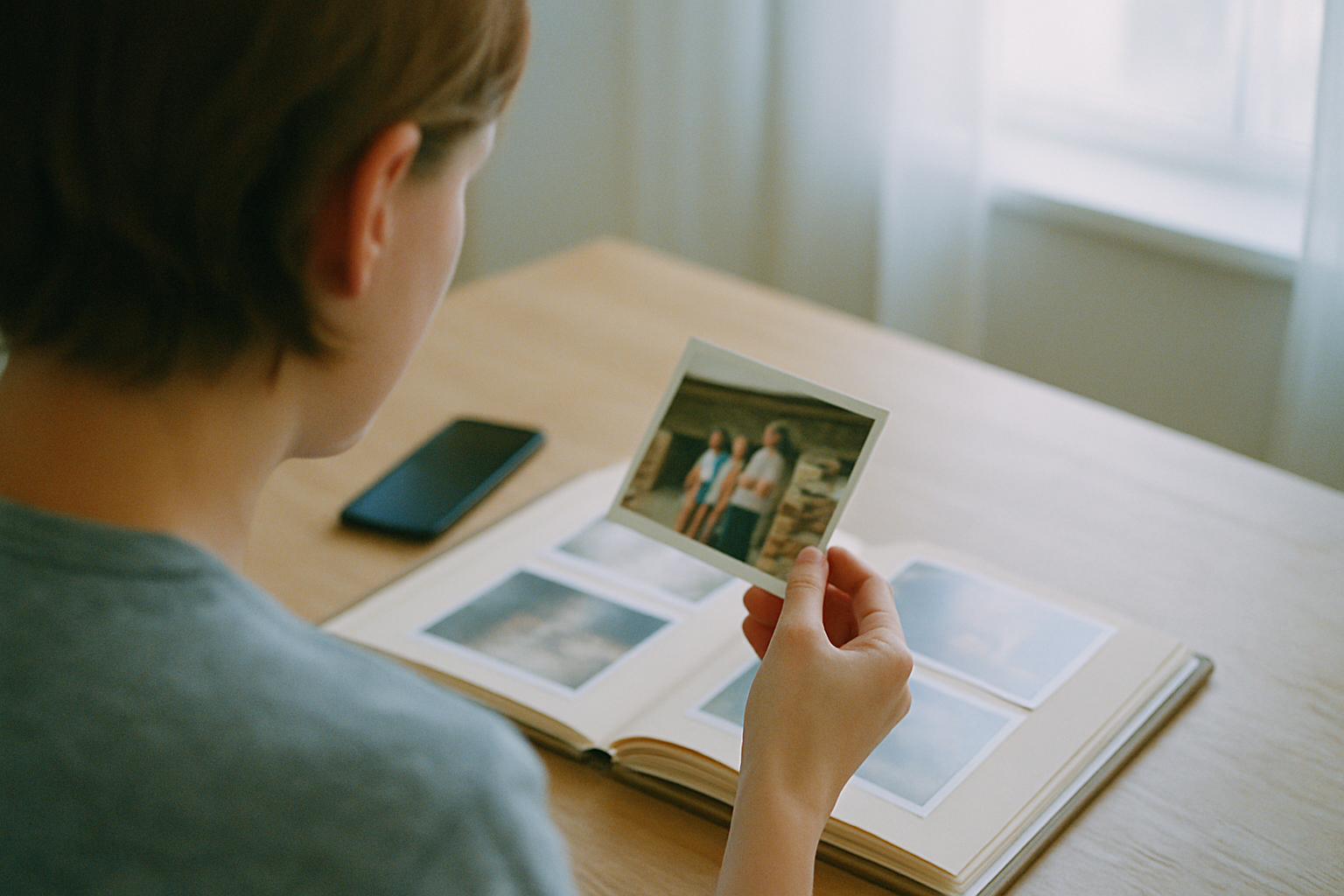
You do your research. You read the reviews. You find an app that promises to protect your precious photos—maybe it’s for sharing snapshots of the kids with grandparents, or maybe it’s a portfolio for your own creative work. A key feature catches your eye: it’s “anti-AI.” It promises to shield your images from the massive, invisible dragnet of data scraping that feeds artificial intelligence models.
You breathe a sigh of relief. You upload the picture of your daughter on her first bike, the faded scan of your parents’ wedding day, the portrait of your grandfather in his uniform. You’ve put them in a safe place.
Then you see a headline, like the ones that have been circulating recently. The very services designed to be a shield have been breached. The data, the images, the art—all scraped anyway. That feeling in the pit of your stomach isn’t just disappointment. It’s a sense of violation, a realization that the digital locks we trust can sometimes be little more than signs on a gate left wide open.
This is the modern battle for photo privacy. It’s a confusing, often technical, and deeply personal fight over who gets to see, use, and profit from our most meaningful moments.
The short answer
The battle for photo privacy is an ongoing struggle where services designed to block AI training can still be vulnerable to scraping. This happens because "anti-AI" can be a marketing claim, not a technical guarantee. True protection requires a fundamentally private architecture, a clear business model that doesn't rely on data, and explicit terms of service that forbid AI training on user content. It's less about a single feature and more about the platform's entire philosophy and foundation.
What Does "Anti-AI" Even Mean?
When a service claims to be “anti-AI,” it can mean several different things, none of which are foolproof.
Some platforms add a specific line to their Terms of Service forbidding the use of their content for AI training. This is a necessary legal step, but it’s not a technical barrier. An automated scraper, a bot designed to copy data from websites, doesn’t read legal documents. It simply copies what it can see.
Other services employ technical tools designed to disrupt AI models. You may have heard of techniques like “glazing” or “poisoning,” which add invisible pixels to an image. When an AI tries to learn from these altered images, it gets confused. These are clever and valuable tools for artists who must display their work publicly, but they represent a constant cat-and-mouse game. As the tools get better, so do the AIs designed to get around them.
The core issue is that if a photo is visible on the public internet—even if it’s behind a login on a social platform—it is technically accessible. The recent news reports, such as one from PetaPixel, underscore this very problem: a platform can have the best intentions but if its architecture exposes content to the web, it creates an attack surface for determined scrapers.
The Scraper's Advantage
Think of it this way: a public-facing website is like a storefront. You can put a “No Photos” sign in the window, but you can’t stop someone on the sidewalk from taking a picture of your display. A truly private service, by contrast, is like your home. The only people who see what’s inside are the people you explicitly invite.
Many services that feel private are actually storefronts. Social media accounts, even when set to “private,” often exist to keep other users out, not to build an impenetrable fortress against the platform owner or sophisticated bots. Their business models often depend on engagement and data, which incentivizes keeping content accessible, at least on some level.
This is why relying on a single feature or a policy statement is so risky. The fundamental question isn't, “Does this app have an anti-AI button?” The real questions are, “What is this company’s business model?” and “Is my data architected for privacy or for exposure?”
The Promise of 'Anti-AI' Features
These features demonstrate that a company is aware of and responding to user concerns about privacy. They can act as a deterrent against casual or less sophisticated scraping attempts. For many users, they provide a sense of security, which is a valid part of the user experience.
The Reality of Web Scraping
Determined and well-funded actors can often find ways to bypass these measures. A Terms of Service clause is a legal tool, not a technical one. Ultimately, the core architecture of the platform—whether it's a closed system or a public-facing one—matters far more than any single feature.
More Than Just Data
When a company’s dataset of stock photos is scraped, it’s a business problem. When your family photos are scraped, it’s a violation of something deeply personal.
These aren't just pixels. They're the irreplaceable records of your life. The photo of your dad holding you as a baby isn’t just “data” to be used to teach an AI how to render hands better. It’s a tangible piece of your story, your identity, and your love. The thought of that image being repurposed, remixed, or even used to create a disturbing deepfake is profoundly unsettling.
Our memories are not raw material for the next generation of algorithms. They are our legacy. They deserve to be treated with respect and protected in a space that understands their true value.
The Problem with "Free"
This brings us to a foundational principle of the internet: if the service is free, you are likely the product. Many large platforms offer incredible services at no cost because they monetize the data you provide—your clicks, your connections, and your content.
As we’ve seen with shifting policies from major tech companies, a promise not to use your data for AI one day can change the next. The terms can be updated, and suddenly, years of your family’s private moments become part of a training set. This isn’t necessarily malicious; it’s simply the business model. To avoid it, you must choose a different model.
What to Look For in a Private Archive
So how do you find a genuinely safe home for your family’s story? You have to look past the marketing and examine the foundation.
-
A Clear Business Model: Look for a service you pay for directly, usually through a subscription. When you are the customer, the company’s primary incentive is to keep you happy and secure, not to find alternative ways to monetize your presence.
-
Unalterable Terms of Service: Read the privacy policy. Does it explicitly and clearly state that they will never train AI models on your content? This should be an ironclad promise, not buried in legalese. Our policy on this at Memory Murals is simple and absolute: your memories are yours. Period.
-
A Private-by-Design Architecture: Ask how sharing works. Are you sent a public, guessable link, or do you invite specific people into a secure, shared space? A true archive is built like a home, not a storefront. You can learn more about what this means in our guide to creating a private family archive.
-
Privacy as a Core Value: Is privacy a feature the company bolted on in response to headlines, or is it the reason the company was founded? The difference is immense. For us, privacy is the heart of Memory Murals. We believe your family’s story deserves a sanctuary.
How Memory Murals Handles Privacy
We built Memory Murals to solve this exact problem. Your family's archive is a completely private space by default. We have a simple, subscription-based business model, so our only focus is serving you and protecting your legacy. Our terms are clear and permanent: your memories are yours, and we will never use them to train AI models. All your data is encrypted in transit (TLS) and at rest (AES-256) to provide a secure foundation for your story.
Protecting your memories isn't just a technical challenge; it's an act of trust. It’s about finding a partner who sees your family’s history not as data to be exploited, but as a treasure to be preserved. The ongoing battle for privacy can feel exhausting, but it’s a fight worth having.
Choosing the right home for these moments is one of the most important digital decisions you can make. If you're ready to build that sanctuary, you can start your private family archive today.
Get 50 questions to ask your parents — before the stories are gone
The exact prompts families use to draw out the stories nobody ever wrote down. Free, straight to your inbox.
No spam. Unsubscribe anytime.
Frequently asked questions
What does it mean when an app is 'scraped' for AI?
Scraping for AI means automated bots systematically visit a website or app to download its content, like photos and text. This data is then used as raw material to 'train' artificial intelligence models. Even if an app's policy forbids this, if the content is accessible on the web, it can be vulnerable to scraping. The goal for the AI company is to gather a massive dataset to teach its models to recognize patterns, generate images, or understand language.
Can AI use my photos if my account is private?
It depends on the platform's architecture and terms of service. On many social media sites, 'private' just limits who can see your content through their interface. If the platform itself reserves the right to use your data for AI training, your privacy setting doesn't matter. Furthermore, if the 'private' content is still served on the public web, it could be vulnerable to sophisticated scraping or data breaches. True privacy requires a service that contractually forbids AI training and is built to be a secure, closed system.
How can I protect my family photos from AI scraping?
The best protection is to choose a platform built fundamentally for privacy. Look for services with a clear, subscription-based business model—this means you are the customer, not the product. Scrutinize their terms of service to ensure they explicitly forbid using your content for AI training. Avoid platforms that rely on advertising or data monetization. Ultimately, storing your most precious memories in a dedicated, private digital archive is far safer than posting them on public or semi-public social networks.
Are 'anti-AI' tools for images effective?
Tools that 'poison' or 'glaze' images to disrupt AI models can be somewhat effective against some current AI systems, but it's an ongoing arms race. Scrapers and AI models are constantly evolving to bypass these protections. While they can add a layer of deterrence for images you must post publicly, they aren't a foolproof solution. For truly irreplaceable family photos, relying on a secure, private platform is a much more robust and long-term strategy than hoping a disruptive tool will work forever.
What's the difference between a photo sharing app and a private archive?
A photo sharing app is typically designed for broad, social distribution and engagement, often with a business model based on advertising or data analysis. A private archive, like Memory Murals, is designed for permanent preservation and security within a small, defined group. The focus is on long-term safety, context, and privacy, not on public 'likes' or 'shares.' An archive prioritizes keeping your data yours, while a sharing app's priority is often to maximize its own network and data collection.
About the author
Patrick Moore, Founder of Memory Murals
Patrick Moore is the founder of Memory Murals. He built it after realizing how much of his own family's history had quietly slipped away — to help families preserve their stories, voices, and photos while they still can.
Related Stories

Insights
Why Privacy is the Heart of Memory Murals
In an age of oversharing, Memory Murals was built on privacy. Learn why your family's story deserves a space free from ads, algorithms, and public scrutiny.
Patrick Moore • December 10, 2025
How-To Guides
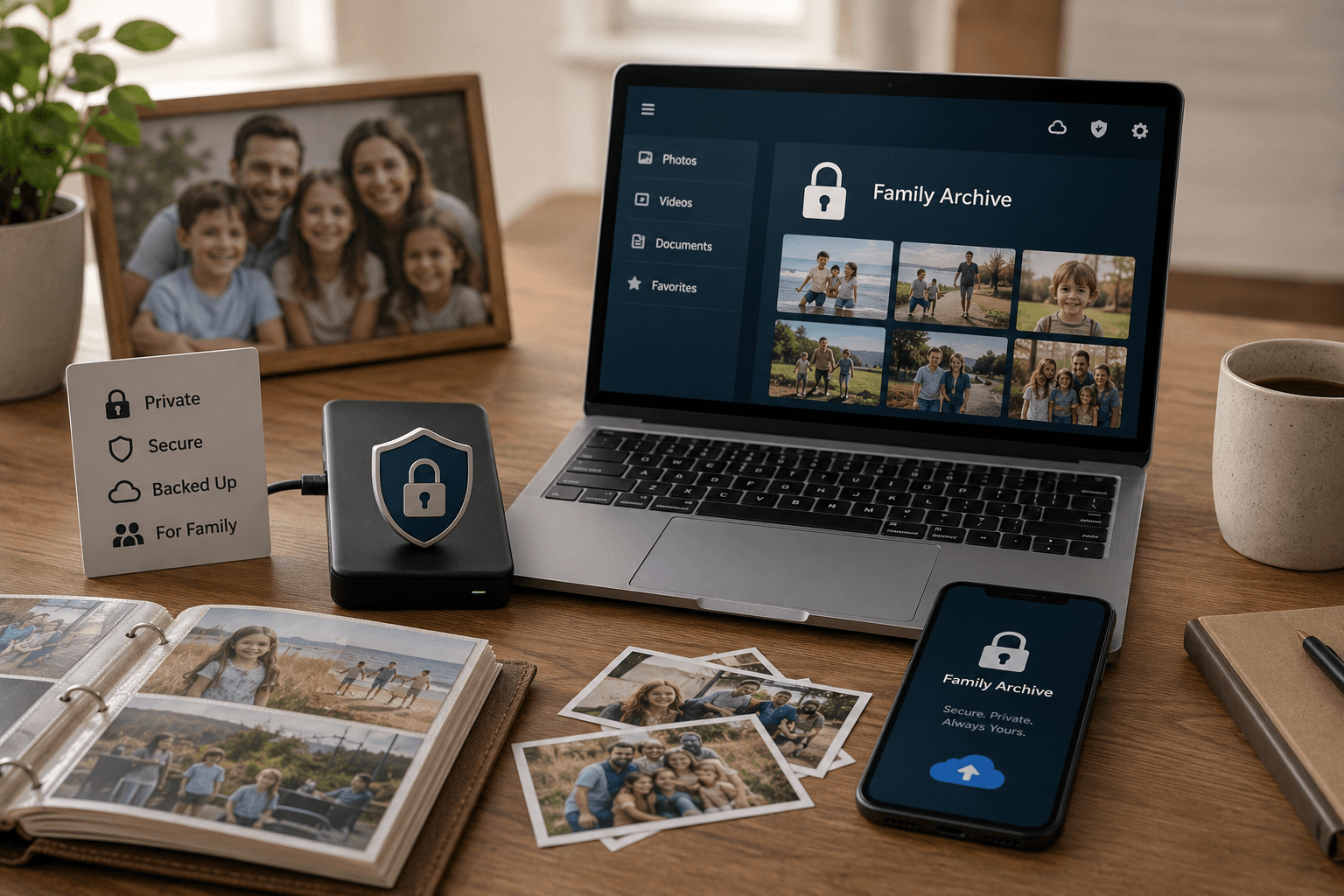
How to Create a Private, Secure Digital Family Archive (2026 Step-by-Step)
Most family photos today live somewhere a stranger's algorithm can scan them or a forgotten password can lock them away forever. Here's how to build a private archive only the people you choose can see — and that doesn't belong to anyone but you.
Patrick Moore • May 27, 2026
Insights
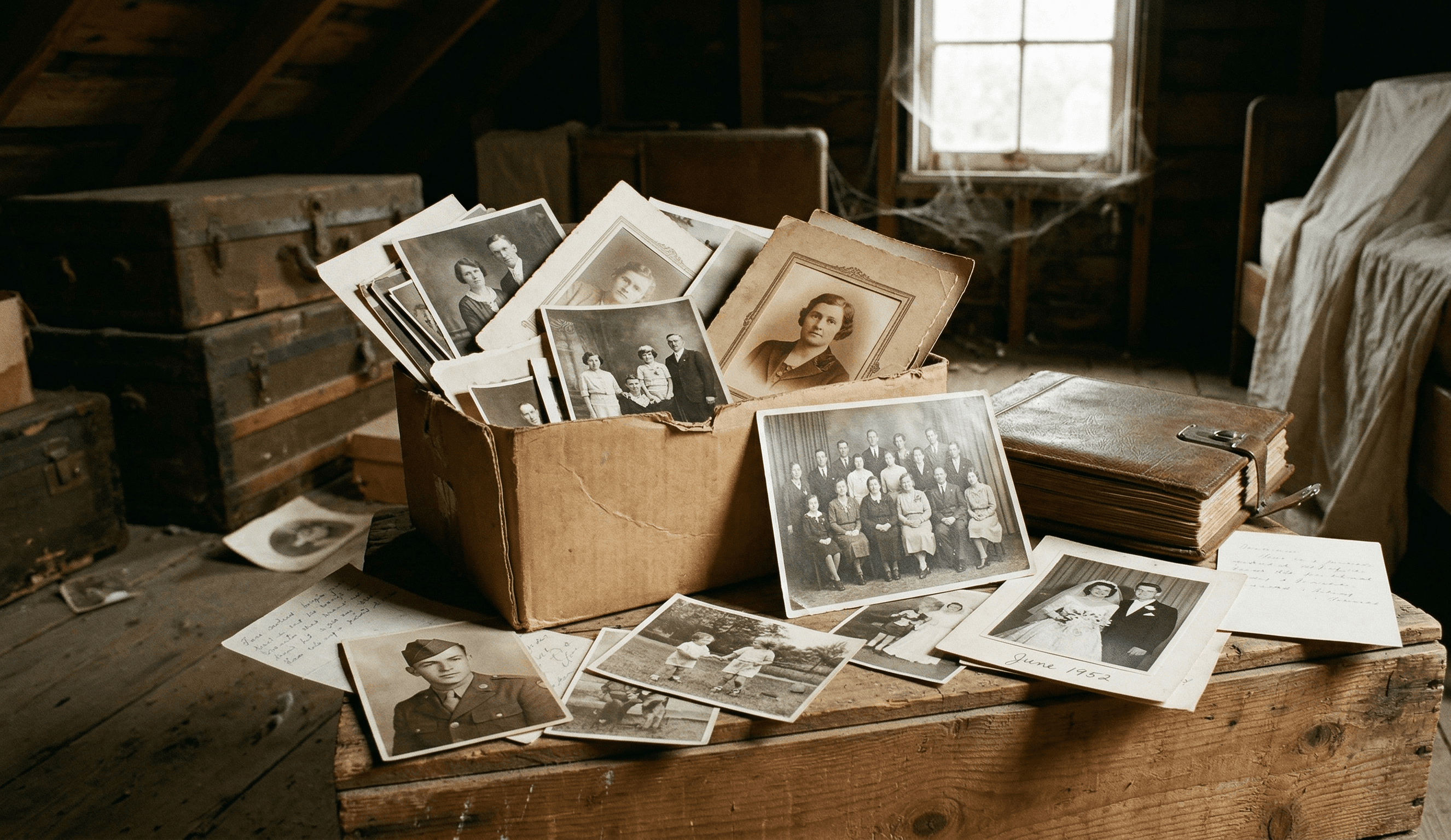
What Happens to Your Family Photos When You Die?
When someone dies, their iCloud, Google Photos, and social media don't transfer to family. One woman spent years fighting Apple for her husband's wedding photos. Here's what actually happens to your digital memories — and how to make sure your family never loses them.
Patrick Moore • April 8, 2026
Preserve your family's memories in one private place.
Start free in minutes. No credit card required.