A Guide to Protecting Tintypes & Daguerreotypes
You've found a box of your great-grandparents' photos, but some aren't paper. They're heavy, metallic, and strangely captivating. These tintypes and daguerreotypes are family treasures, but they're also fragile artifacts that require special care. This guide explains how to handle and store them.
Patrick Moore, Founder • June 27, 2026
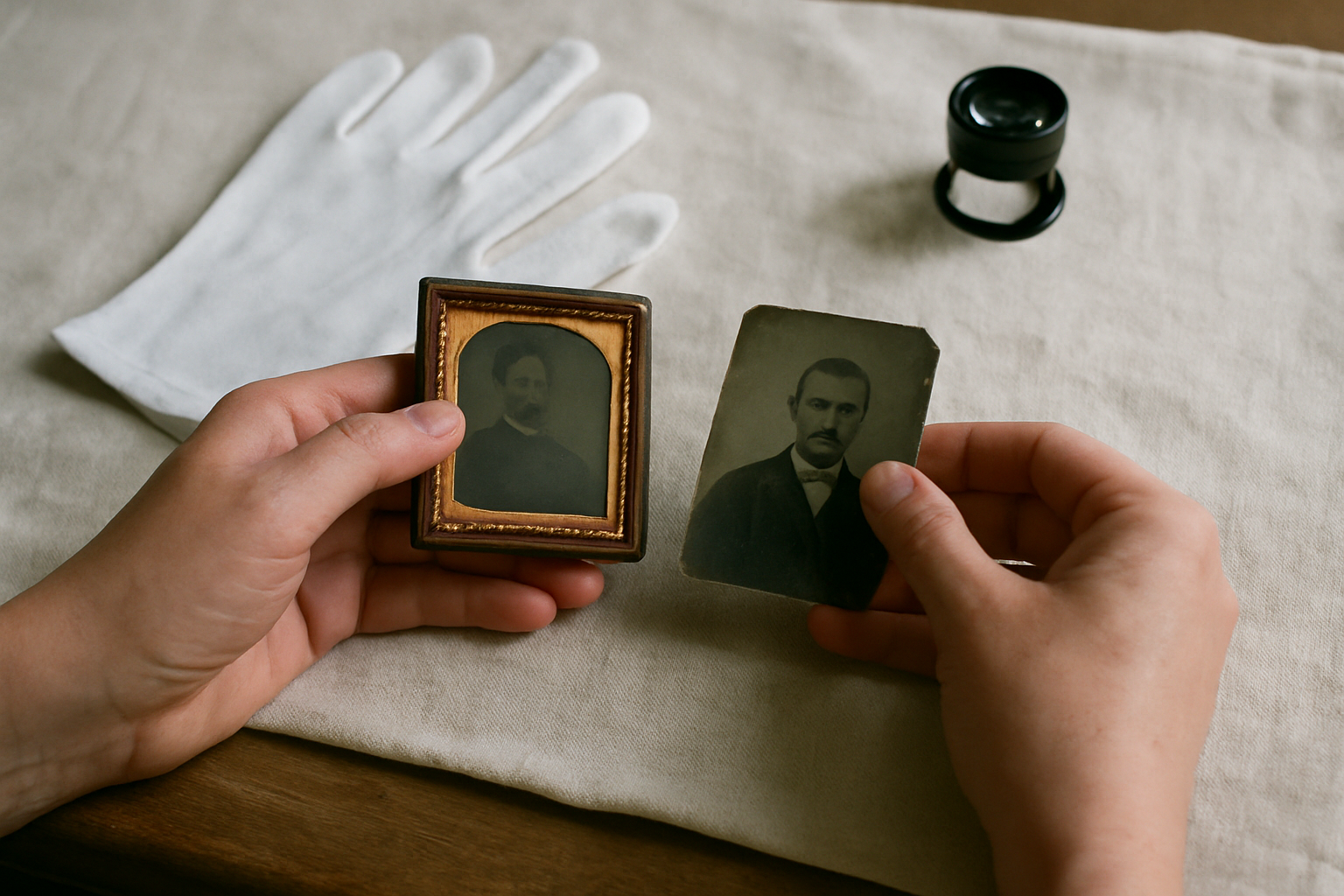
You’re sitting on the floor with a cardboard box that smells of cedar and time. Inside, nestled among stacks of familiar, paper-backed photos, you find something different. It’s heavy for its size, cool to the touch. The image isn’t on paper, but on a dark sheet of metal. A man with a severe haircut and an impossibly straight back stares out, his eyes seeming to follow you.
Or perhaps it’s a small, ornate case. You carefully pry open the clasp, and inside, under glass, is a silvery, shimmering image of a woman. You have to tilt it just right in the light to see her face clearly, like a ghost in a mirror. You’ve just found a tintype or a daguerreotype.
These aren't just old photos; they are artifacts. They were created with complex chemical processes that bear little resemblance to the film and digital photography that followed. And because they are so different, they require a unique kind of care. They are fragile survivors, and protecting them means understanding what they are.
The short answer
To preserve tintypes, handle them only by the edges while wearing nitrile or cotton gloves to protect them from skin oils. Never use water or chemical cleaners; only gently dust with a soft camel hair brush if necessary. Store each tintype in an individual, acid-free archival sleeve or envelope. Keep them in a cool, dark, dry place with stable humidity, like a closet in your main living space, not an attic or basement. Finally, create a high-resolution digital scan for safekeeping and sharing.
What Am I Holding? Tintype vs. Daguerreotype
Before you can protect your photo, it helps to know what it is. While there were many early photographic processes, the two you're most likely to find in a family collection are daguerreotypes (common from the 1840s to 1860s) and tintypes (common from the 1850s to the early 1900s). They look similar at first glance but are fundamentally different objects.
A daguerreotype is a one-of-a-kind image on a polished, silver-plated sheet of copper. This gives it a distinctive, mirror-like surface. You often have to angle it to see the image clearly. Because this surface is incredibly fragile—a single fingerprint can be permanent—they were almost always sold in protective, book-like cases made of wood and leather, with a decorative brass mat and cover glass.
A tintype, despite its name, contains no tin. It’s an image created on a thin sheet of iron that has been lacquered black or dark brown (a process called japanning). The image is technically a negative, but because it’s on a dark background, your eye perceives it as a positive. They are not reflective like a daguerreotype and have a more matte, subdued appearance. They were much cheaper and more durable, so while some came in cases, many were simply slipped into paper sleeves or albums.
Daguerreotype Characteristics
- Highly reflective, mirror-like surface.
- Image appears on a silver-plated copper sheet.
- Extremely fragile; a touch can damage it.
- Almost always found in a protective case under glass.
- The image can appear as a positive or negative depending on the viewing angle.
Tintype Characteristics
- Low-lustre, matte, or semi-glossy surface.
- Image is on a thin sheet of lacquered iron.
- More durable and resistant to handling.
- Often found loose, in paper sleeves, or albums.
- A magnet will stick to it (since it's iron).
First, Do No Harm: Handling Antique Photographs
Whether you have a daguerreotype or a tintype, the rules for safe handling are the same. The primary goal is to prevent any new damage from occurring. Every touch, every bit of dust, and every fluctuation in temperature is a potential threat to these 150-year-old heirlooms.
A Safe Handling Workflow
Wear Gloves
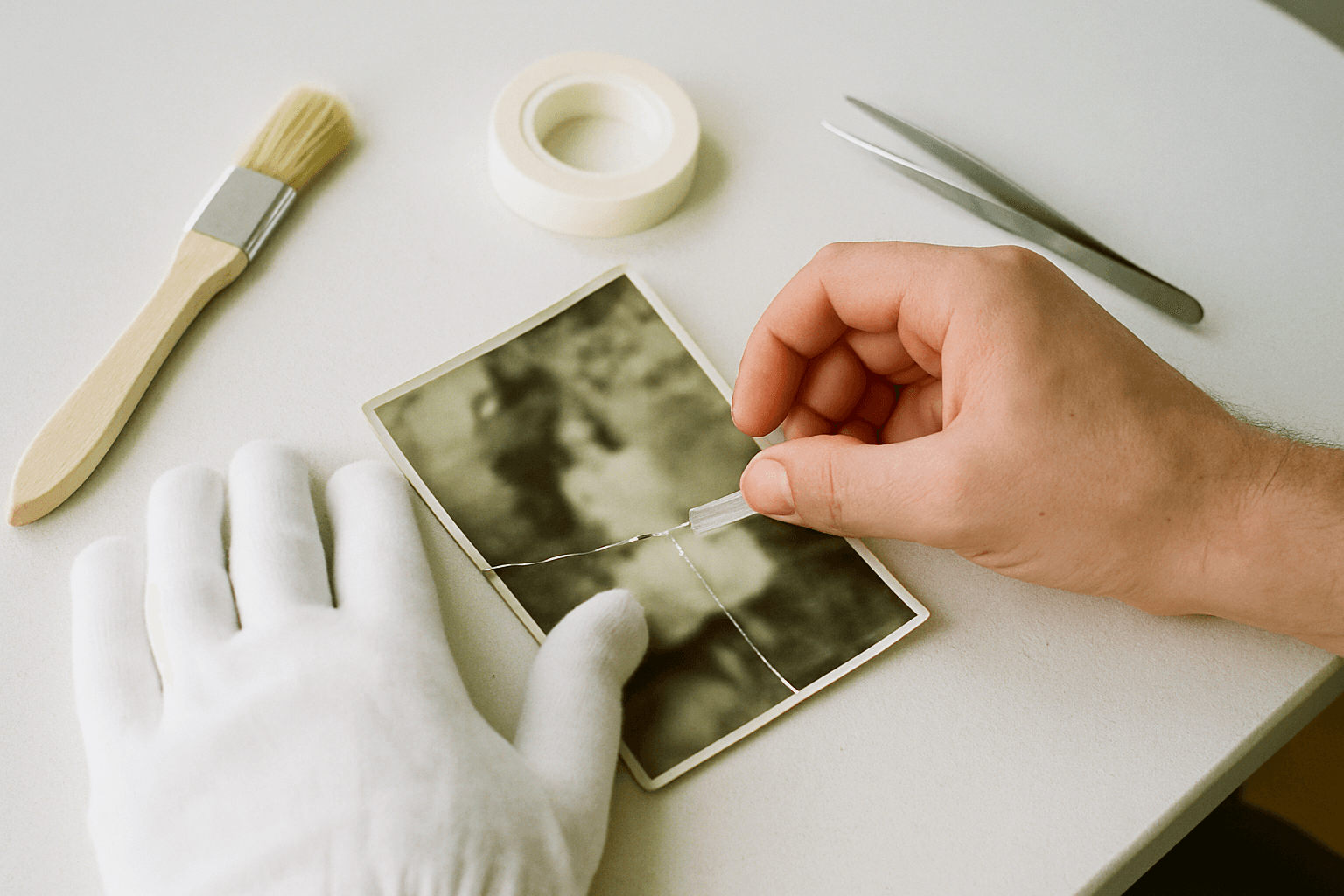
The oils, salts, and acids on your fingertips are corrosive to delicate photographic materials. Always wear clean, lint-free cotton or nitrile gloves before touching antique photos. This is the single most important step you can take.
Provide Support
Never hold a tintype by one corner or a cased daguerreotype by its cover. Support the object from underneath with a flat palm or use two hands to hold it by its edges. The metal plates can be bent, and old cases can have fragile hinges that might break.
Work in a Clean Space
Lay down a clean, soft cloth on a clear table. This prevents the photo from being scratched and ensures you have an uncluttered space where it won't be bumped or have something spilled on it.
Limit Light Exposure
While these early photos are more stable than later paper prints, all photographic materials are sensitive to light. Prolonged exposure to bright light, especially sunlight, will cause them to fade over time. View and work with them in normal indoor lighting, and never display them in direct sun.
To Clean or Not to Clean?
When you find an old photo, the first impulse is often to clean off the dust and grime of decades. With tintypes and daguerreotypes, you must resist this impulse. Aggressive or improper cleaning is the fastest way to destroy them completely.
Water is the Enemy
Never, under any circumstances, use water, glass cleaner, alcohol, or any other liquid on a tintype or an uncased daguerreotype. A tintype is an iron plate; water will cause it to rust immediately and irrevocably. The image surface of a daguerreotype is a delicate chemical tarnish that will be wiped away by liquids or even a damp cloth.
For loose surface dust, the only safe method for an amateur is to use a very soft, clean brush, like a new camel hair brush used by artists. Holding the plate at an angle, gently whisk the dust off the surface, starting from the center and moving outward. Do not apply pressure.
If a daguerreotype is under its original sealed glass, do not open the case. The seal is protecting the plate from the air, which causes it to tarnish. If the glass itself is dirty, you can gently clean the outside of the glass with a soft, dry cloth. If a photo has serious issues like flaking emulsion or heavy, adhered grime, your only safe option is to consult a professional photograph conservator.
Safe Harbor: Storing Your Antique Photos
The most critical factor in long-term preservation is a stable environment. Attics and basements are the worst possible places for photos due to their extreme temperature and humidity swings. You need a location that is cool, dark, dry, and stable.
~68°F
Ideal Temperature
Aim for a stable room temperature, avoiding major fluctuations.
30-40%
Ideal Humidity
High humidity encourages mold and corrosion; low humidity can make emulsion brittle.
Your storage materials are just as important. Standard paper envelopes and cardboard boxes are acidic and will cause your photos to yellow and degrade over time. Invest in materials specifically designed for archival photo storage.
Acid-Free Sleeves
Each individual tintype should be placed in its own acid-free, lignin-free paper sleeve or an inert plastic sleeve made of polyester, polypropylene, or polyethylene. This prevents them from scratching each other and protects them from dust.
Four-Flap Enclosures
For more fragile photos, a four-flap enclosure (also called a phase box) provides more rigid support and makes it easier to remove the photo without touching its surface. This is ideal for bent or flaking tintypes.
Cased Photo Storage
For daguerreotypes and other cased images, it's best to store them in their original cases. You can wrap the case in archival tissue paper and store it in an archival box. Storing them flat is generally recommended.
Archival Boxes
Store your sleeved photos vertically or flat inside an archival-quality, acid-free box. These boxes buffer against environmental changes, block out light, and provide physical protection from pests or accidents.
Creating a Digital Copy
Proper physical storage is about preserving the artifact. Digital storage is about preserving the image and the story it holds. A high-quality digital scan is your insurance policy against fire, flood, or loss. It allows you to share the image with family without risking the original, and it's the first step in figuring out the context of these old portraits.
Digitizing these objects can be tricky. A daguerreotype’s mirror surface will reflect your scanner's light source, creating a bright glare. Tintypes can have bends and flaking paint that a scanner might not capture well. While a good flatbed scanner can produce excellent results, you may need to experiment with positioning or even create a black cardboard shroud to block reflections.
For truly precious or difficult images, using one of the best services to digitize old family photos is a worthwhile investment. Professionals have the equipment and expertise to handle these fragile heirlooms safely.
Once you have that digital file, the real work of preservation begins. Who is the person in the portrait? What was their story? This is often the hardest part, especially with unlabeled family photos. This is where the digital world offers a profound advantage. You can attach names, dates, locations, and stories directly to the image file, ensuring that context is never lost again.
This is why we built Memory Murals. It’s not enough to just save a picture; you have to preserve the story behind it. Once you have a safe digital copy, you can add it to your family's collection in Memory Murals, where you can attach the names, dates, and stories that bring the image to life. You can start building your family's private archive today.
That stern-looking man in the tintype stops being a stranger. He becomes your great-great-grandfather, who left his farm to fight in the Civil War, and whose letters home are in another box upstairs. The photo is no longer just an object; it's a connection, a doorway into a life that led to yours. And that is a treasure worth protecting.
Get 50 questions to ask your parents — before the stories are gone
The exact prompts families use to draw out the stories nobody ever wrote down. Free, straight to your inbox.
No spam. Unsubscribe anytime.
Frequently asked questions
What is the difference between a tintype and a daguerreotype?
A daguerreotype is a photograph on a highly polished, silver-plated sheet of copper, creating a mirror-like image. They are very fragile and almost always housed in a protective case. A tintype is a photograph made on a thin sheet of iron lacquered black or brown. They are less reflective, more durable, and were often kept in albums or handed around, so they may be found without a case.
Can you clean old tintypes with water?
No, never use water or liquid cleaners on a tintype. Since tintypes are made on a sheet of iron, water will cause them to rust almost immediately, permanently damaging the image. For loose dust or debris, you should only use a very soft, dry brush, like a camel hair brush, to gently whisk the surface. For more significant cleaning, consult a professional photo conservator.
How should I store antique tintypes and daguerreotypes?
Store them in a cool, dark, and dry environment with stable temperature and humidity—avoid attics and basements. Each photo should be placed in its own acid-free, archival-quality sleeve or four-flap enclosure. Then, store them flat or vertically in an archival box. If they are in their original cases, it's best to store them in the closed case to protect the delicate surface.
Is it safe to scan a daguerreotype?
Scanning a daguerreotype can be risky and requires extreme care. The surface is incredibly fragile and can be scratched easily. Furthermore, their mirror-like surface makes them very difficult to scan without capturing reflections. While a high-quality flatbed scanner can work, it is often best to consult a professional digitization service that has experience with cased images to avoid accidental damage to an irreplaceable artifact.
Why are my old tintypes bent or flaking?
Tintypes are on a thin iron plate, which can be easily bent over time with improper handling or storage. The image itself is held in a collodion emulsion layer on the metal. As the plate flexes or experiences changes in humidity, this emulsion can become brittle, crack, and flake off, taking parts of the photograph with it. This is why rigid, flat storage and careful handling are so important for their long-term preservation.
About the author
Patrick Moore, Founder of Memory Murals
Patrick Moore is the founder of Memory Murals. He built it after realizing how much of his own family's history had quietly slipped away — to help families preserve their stories, voices, and photos while they still can.
Related Stories
How-To Guides
What to Do with Your Parents' Photo Collection: A Gentle Estate Guide
A practical, emotionally honest guide for going through your parents' photo collection — whether you're cleaning out a house after a death, helping a parent downsize, or staring at the boxes for the third weekend in a row. What to keep, what to let go, what to scan first, and how to forgive yourself for the parts that hurt.
The Memory Murals Team • April 28, 2026
Comparisons
Best Photo Scanning Services for Old Family Photos (2026)
When you have a thousand photos and zero free weekends, paying a service makes sense. But 'per item' isn't 'per photo,' turnaround ranges from a week to three months, and almost nobody tells you what happens to your files. Here's the honest comparison.
Patrick Moore • May 27, 2026
How-To Guides
DIY Photo Repair: A Gentle Guide to Fixing Old Photos Before Scanning
Before you scan that box of family photos, a little physical care can make a world of difference. This guide walks you through simple, archival-safe DIY photo repair for common issues like tears, creases, and surface grime, ensuring you get the best possible digital copy for preservation.
Patrick Moore • June 30, 2026
Now give it somewhere to live.
The file you just saved outlasts nothing on its own. Put it where your family can still find it in thirty years.