
How to Help Your Kids *Truly* Know Their Grandparents
It's easy for the connection between kids and grandparents to remain surface-level. This post explores practical, heartfelt ways to bridge that generational gap, ensuring your children build a deep, lasting bond and inherit the family stories that define them.
Patrick Moore, Founder • June 12, 2026
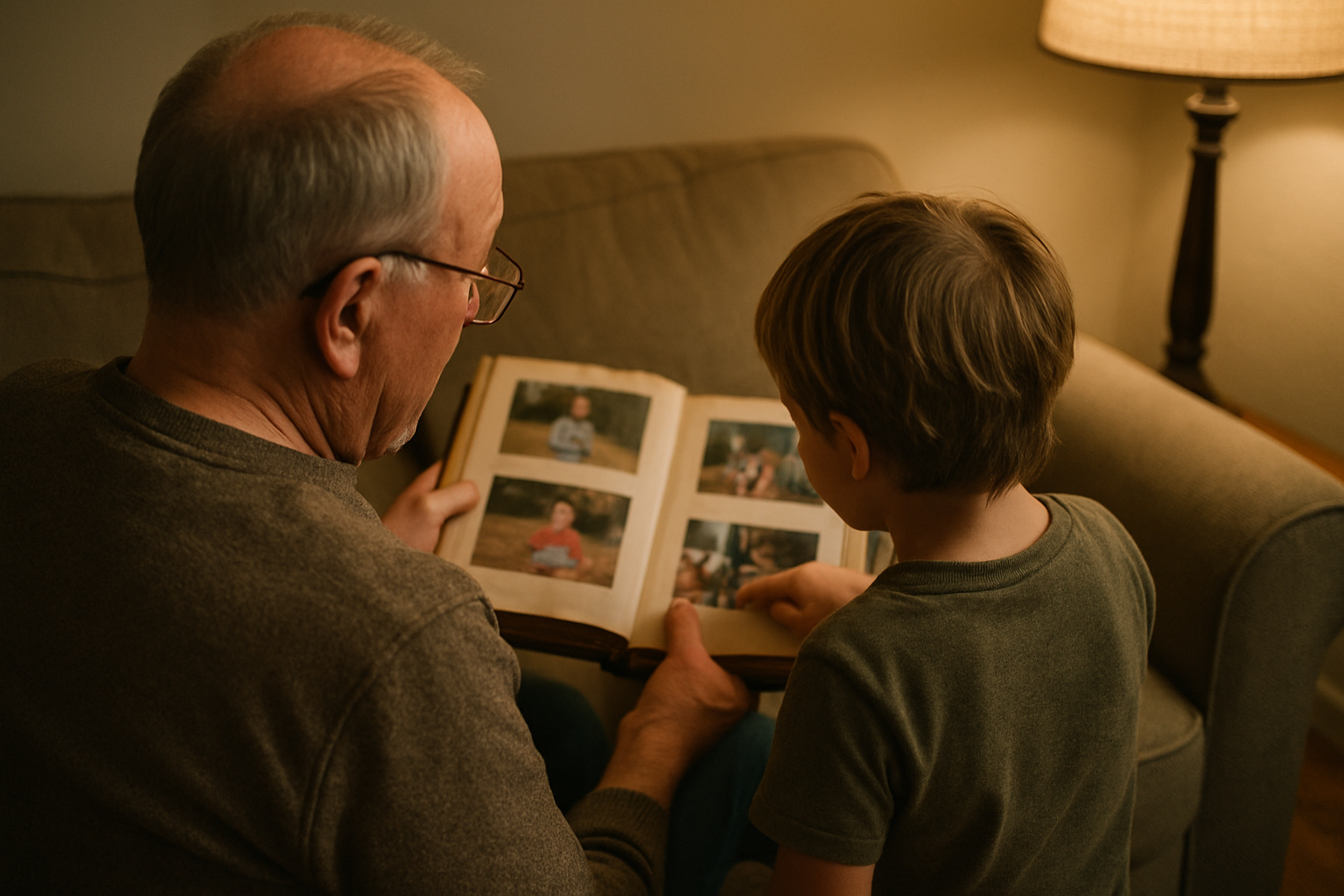
My seven-year-old son, Leo, was sitting on the floor with my dad, looking at a photo from the 1960s. It’s a picture of my father, impossibly young and lanky, standing proudly next to his first car.
“Was it fast, Grandpa?” Leo asked.
“Yep,” my dad said.
“Was it blue?”
“Yep.”
And that was it. The conversation stalled, and they moved on. I felt a familiar pang in my chest—not of frustration, but of a missed opportunity. My dad isn't a man of many words, and my son didn't know the right questions to unlock the story behind the photo: the story of the summer he worked two jobs to buy that car, the girl he took to the drive-in, the sound the engine made. My son saw a grandpa; I saw a whole person he might never get to meet.
We all want our children to have a deep, meaningful relationship with their grandparents. We want them to inherit the stories, the wisdom, the quirks, and the unconditional love that shaped us. But in the rush of modern life, with miles and busy schedules between us, that connection can easily remain surface-level. It’s a bond we have to intentionally cultivate, before it’s too late.
The short answer
To help kids truly know their grandparents, you must create regular, low-pressure opportunities for them to share experiences, not just pleasantries. Use open-ended story prompts and shared activities—like cooking or looking at old photos—to spark natural conversation. Make a habit of recording these moments, even just the audio on your phone. This transforms fleeting conversations into a lasting family archive, ensuring your child has access to their grandparents' voices, laughter, and wisdom for the rest of their life.
Moving Past the Surface Level
For many families, interactions with grandparents are condensed into holidays, birthdays, and the occasional Sunday dinner. These are precious moments, of course, but they often revolve around group activities and polite, surface-level questions. “How’s school?” “What did you get for your birthday?” “Are you eating your vegetables?”
These exchanges are about checking in, not connecting. They don't leave much room for the real stories—the ones that reveal character, struggle, and joy. Knowing that Grandma makes the best apple pie is lovely. Knowing the story of how she learned the recipe from her grandmother in a tiny kitchen during the Depression, and how it was a taste of sweetness in a hard time… that’s a piece of her soul. That’s a legacy.
Our kids are losing access to these legacies. They see their grandparents as finished products, wise old figures who have always been this way. They don't see the shy teenager, the ambitious young parent, the person who made mistakes and learned hard lessons. To help our kids know them, we have to become gentle facilitators, creating the space for those other, younger selves to emerge.
Building Bridges, Not Just Visits
The key is to shift from passive visits to active, shared experiences. An activity, no matter how small, takes the pressure off direct conversation and allows stories to surface naturally. It gives both child and grandparent something to do with their hands, letting their minds and memories wander.
Cook a Family Recipe
The sensory act of measuring flour or peeling apples can trigger powerful memories. Let your parent lead, explaining the 'why' behind each step. It's a history lesson and a cooking class in one.
Tend a Garden
Whether it's a small pot of herbs on a windowsill or a full vegetable patch, working with the soil is a primal, grounding activity that spans generations. It teaches patience and nurtures conversation.
Look Through Old Photos
This is the single most effective catalyst for storytelling. Don't just flip through an album; ask specific questions. "Who took this picture?" "How did you feel in this moment?" "Tell me about the people who aren't in this photo."
Play a Simple Game
A game of cards, checkers, or dominoes provides a simple structure for interaction. The friendly competition and turn-based nature create easy pauses for stories and laughter to fill the gaps.
For a more focused approach, you can create a special ritual, like a 'Grandparent Story Day.' Don't make it a formal, intimidating interview. Frame it as a fun project.
How to Host a 'Grandparent Story Day'
Frame it as a Treasure Hunt
Tell your kids you're going on a treasure hunt for family stories. Their job is to be the detectives who uncover the clues. This turns it into a game, not a chore.
Co-Create the Questions
Brainstorm questions with your kids beforehand. What are they genuinely curious about? A kid's question, like "Did you ever get in big trouble?" can be more effective than our adult ones.
Set a Comfortable Scene
Choose a quiet time of day. Have their favorite snacks and drinks ready. The goal is a relaxed, cozy atmosphere where they can forget they're being 'interviewed.'
Just Press Record
Use your phone's voice memo app. Place it on a table between them and then put it out of your mind. The goal is to capture the audio, not to produce a perfect recording. Then, just listen. You can find a complete guide on how to record your grandparents' stories for more detailed tips.
Unlocking the Stories Within
The magic is in the questions. Good questions go beyond facts (the 'what' and 'when') and dig into feelings and motivations (the 'how' and 'why'). They are open-ended and invite reflection.
If you find conversations stalling, try rephrasing your questions. Instead of asking about a topic, ask about a specific moment in time.
Generic Question
"What was your first job?" (Often gets a one-word answer: "A paper route.")
Story-Unlocking Question
"Tell me about a time at your first job when you felt really proud of yourself, or a time you messed up and learned something important." (Invites a narrative with character and emotion.)
Think about questions that tap into the five senses, as they are powerful memory triggers. Ask about the smell of their childhood home, the taste of their favorite candy as a kid, the sound of the music they danced to as a teenager. For a comprehensive list to get you started, explore these questions to ask your grandparents before it's too late.
The Grandparenting Buffer
There's real science behind this connection. Research summarized by the American Psychological Association links greater grandparental involvement to fewer emotional and behavioral problems in children. This 'grandparenting buffer' provides a unique sense of security and belonging for a child's developing brain.
From Conversation to Legacy
These conversations are beautiful, but they are also ephemeral. The story shared over a cup of tea can be forgotten by next week. The real tragedy is not just that our grandparents will one day be gone, but that their unique voice, their specific way of telling a story, and the sound of their laughter could be lost forever.
This is why capturing these moments is as important as creating them. An audio recording of your dad telling a story about his first car is a thousand times more powerful than you retelling it later. It's a direct link to him, preserved in time for your son, and your son's children.
This is the reason we built Memory Murals. It's a private, secure space designed specifically for these moments. You can upload that 10-minute audio clip from your 'Story Day,' pair it with the old photo that sparked the conversation, and add a few notes about the context. Over time, you build a living, breathing archive of your family's most important people. It's a place where your child can return, years from now, to hear their grandpa's voice and truly understand the person he was.
It’s not just about storing files; it's about curating a legacy. You can start building your family's Legacy for free and see how it feels to give these precious stories the permanent home they deserve.
After my dad's one-word answers, I didn't push. Instead, later that evening, I sat with him alone. I pulled up that same photo on my phone. "Dad," I said, "tell me about the girl you first took for a ride in this car." A slow smile spread across his face. And for the next twenty minutes, he wasn't just 'Grandpa.' He was a seventeen-year-old kid again, full of nerves and hope, driving down a country road on a summer night. And this time, I was recording.
Get 50 questions to ask your parents — before the stories are gone
The exact prompts families use to draw out the stories nobody ever wrote down. Free, straight to your inbox.
No spam. Unsubscribe anytime.
Frequently asked questions
What are good questions to ask grandparents to get them talking?
Instead of generic questions, ask about specific feelings and sensory details. Try questions like, 'What's a piece of mischief you got into as a kid?' or 'What did your childhood kitchen smell like?' Questions about their first love, a time they felt incredibly proud, or a song that makes them feel young again can unlock rich, personal stories far more effectively than simple factual inquiries. The goal is to spark a memory, not just get an answer.
How can I help my shy child connect with their grandparents?
Focus on shared, low-pressure activities rather than direct conversation. Bring out an old photo album and let them look through it together; the photos act as natural story prompts. You could also try a simple, collaborative project like baking a family recipe, potting a plant, or building with LEGOs. Working side-by-side creates a comfortable space for connection to grow organically without the pressure of face-to-face interviews.
What's the best way to record grandparents' stories?
The best way is the simplest one you'll actually use. Your smartphone's voice memo app is a powerful, unobtrusive tool. Place it nearby, press record, and then focus on the conversation. Don't worry about perfect audio quality. The most important thing is capturing the authenticity of their voice and the stories they share. For a more organized approach, you can use apps designed for preserving family memories, which allow you to pair recordings with photos and notes.
Why is it important for kids to know their grandparents?
Knowing their grandparents gives children a stronger sense of identity and belonging. They learn where they come from, understand family history, and gain wisdom from their elders' life experiences. This connection, often called the 'grandparenting buffer,' is linked to better emotional resilience in children. It provides a vital link to their heritage and a source of unconditional love that shapes their development in profound ways, grounding them in a story larger than their own.
How can we connect with grandparents who live far away?
For long-distance relationships, create consistent digital rituals. Schedule regular video calls that are activity-based, not just chats. Have grandpa or grandma read a bedtime story over Zoom. Play a simple online game together, like checkers or a word game. You can also start a 'story-by-mail' project, where you send a question in the mail and they send back a written or recorded answer. These intentional efforts make the distance feel smaller and keep the connection strong.
About the author
Patrick Moore, Founder of Memory Murals
Patrick Moore is the founder of Memory Murals. He built it after realizing how much of his own family's history had quietly slipped away — to help families preserve their stories, voices, and photos while they still can.
Related Stories
Lists & Roundups
40 Questions to Ask Your Grandparents Before It's Too Late (And Why Each One Matters)
Your grandparents are the last living link to a world nobody else around you ever saw — your parent as a kid, the country you came from, the century before yours. These 40 questions unlock the stories that disappear when they do.
The Memory Murals Team • May 2, 2026

How-To Guides
You Have the Questions. Here's How to Actually Record the Answers.
Every article gives you a list of questions to ask your grandparents. Almost none of them tell you what to do next. Here's the part nobody writes: how to actually capture the answers so they outlive the conversation.
Patrick Moore • April 11, 2026
Insights
AI Grandkid Photos: Boomer Fun vs. Millennial Privacy Nightmare
A grandparent excitedly shares an AI-generated photo of their grandchild as a tiny astronaut. For them, it's harmless fun. For the Millennial parents, it's a digital privacy violation. This post explores the generational divide over AI-generated kid photos and offers a path forward for families.
Patrick Moore • September 21, 2026
Preserve your family's memories in one private place.
Start free in minutes. No credit card required.