
Questions for Your Siblings About Childhood
Your siblings are the only other people who experienced your childhood firsthand. These 40 questions are designed to go beyond the usual 'remember when' and uncover the forgotten details, inside jokes, and different perspectives that make your shared history so rich. Start a conversation that deepens your bond and preserves your unique family story.
Patrick Moore, Founder • July 15, 2026
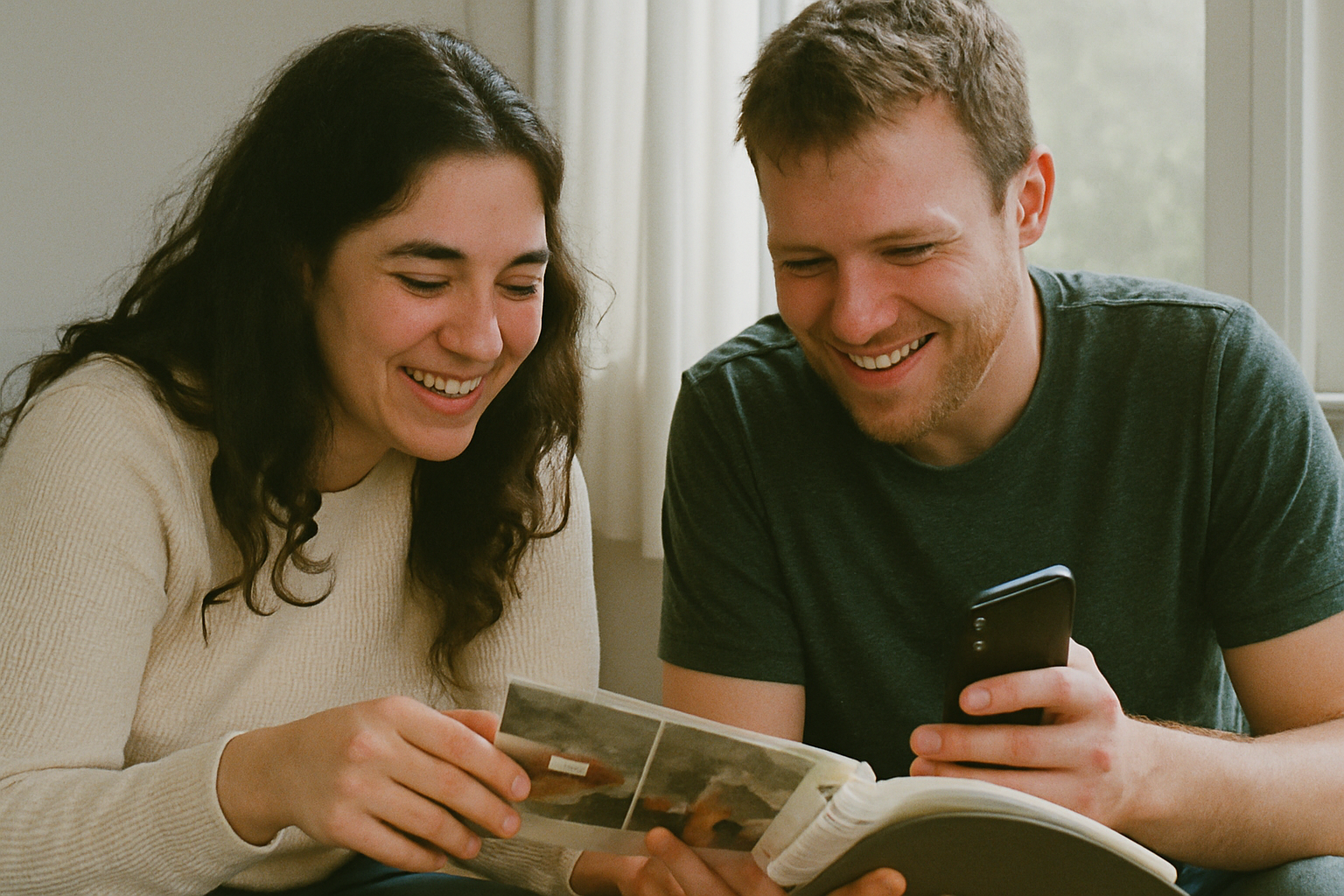
There's a shorthand with siblings, a shared language built over thousands of unremarkable moments. A single word can conjure the floral pattern of a long-gone sofa; a raised eyebrow can communicate an entire family saga. You were both there for the scraped knees, the terrible haircuts, and the station wagon vacations.
But what about the stories you don't share? The memories where your perspective is the only one you've ever known. You remember a family argument as terrifying; they remember it as funny. You remember a specific holiday as magical; they barely remember it at all. Your memory is just one draft of a story you wrote together.
Your sibling holds the only other eyewitness account. Talking with them isn't just a nostalgic trip—it's a form of collaborative archaeology. Together, you can excavate the past, piece together the fragments, and see your shared history in a richer, more complete way.
The short answer
The best questions to ask siblings about childhood go beyond simple facts and explore feelings, perspectives, and sensory details. Ask about their secret hiding spots, their version of a famous family argument, a smell that reminds them of home, or a rule they thought was unfair. The goal is to uncover their unique experience of the same events, revealing forgotten details and strengthening your bond by creating a more complete picture of your shared history.
The Other Side of the Story
Memory isn't a perfect recording. It's a reconstruction, colored by our age, our role in the family, and our personality. If you were the oldest, you might remember feeling responsible and protective. Your younger sibling, however, might remember you as being bossy and in charge. Neither of you is wrong. You simply had different vantage points.
These differing perspectives are what make these conversations so valuable. They add depth and color to the black-and-white version of events you hold in your head. Learning that your brother was secretly terrified during the thunderstorm you found exciting doesn't invalidate your memory; it enriches the story. It helps you understand not just what happened, but what it was like for them.
This process of sharing stories can be a powerful way to understand your own family narrative. By asking your siblings, and even asking your parents questions about their own lives, you start to see the patterns, themes, and emotional currents that shaped all of you.
How to Ask Without It Feeling Like an Interview
The goal is a conversation, not an interrogation. Creating a comfortable atmosphere is key to unlocking genuine stories. You want your sibling to feel like they're reminiscing with you, not being put on the spot.
Choose a Relaxed Setting
Don't spring a list of 40 questions on them over a hurried lunch. Bring them up during a long car ride, a quiet evening on the porch, or a phone call with no particular agenda. Let the conversation breathe.
Use Photos as Prompts
An old photo album or a shoebox of loose pictures is the perfect catalyst. A simple, "Wow, look at this. What do you remember about this day?" is a low-pressure way to begin. It anchors the conversation to a specific moment.
Listen More Than You Talk
Your main job is to listen. When your sibling shares a memory, don't immediately jump in to correct a detail or share your own version. Ask follow-up questions like, "How did that feel?" or "What happened next?" Let their story unfold on its own terms.
Share Your Own Stories
Make it a true exchange. When they share something, offer a related memory of your own. Your vulnerability will encourage theirs. It shows that you're in it together, exploring this shared past as equals.
Here are 40 questions divided into themes. You don't need to ask all of them. Pick a few that resonate with you and see where the conversation leads.
The Early Years & First Memories
- What's your very first memory of our family?
- What's your first memory of me?
- What's a scent that instantly takes you back to our childhood home?
- Describe our childhood home from your perspective. What was your favorite room or hiding spot?
- What was your favorite toy, and what happened to it?
- What was a food you loved that Mom/Dad made? What was one you hated?
- Do you remember being scared of anything as a little kid?
- What's a story about me as a toddler that I wouldn't know?
- Who was your first best friend in the neighborhood?
- What's one thing you think I don't remember about our early childhood?
School Days & Growing Pains
- Who was your favorite teacher and why?
- What was the most trouble you ever got into at school? Did I know about it?
- What was your go-to after-school snack?
- What did you want to be when you grew up?
- Were you proud of me for anything I did at school, or secretly embarrassed?
- What's a fashion choice you made that you now regret?
- What was the biggest fight we ever had? What was it about from your side?
- What was your favorite band or singer that drove our parents crazy?
- Did you ever feel like I got away with more, or that you did?
- What's a moment you felt really awkward or out of place as a teen?
Family Dynamics & Relationships
- Who do you think was Mom's favorite? Dad's favorite? Why?
- What's a family rule you thought was completely unfair?
- What's a memory of our grandparents that stands out to you?
- What was your favorite family vacation? What's one specific memory from it?
- What's a family tradition you hope we continue?
- In your opinion, what was the biggest challenge our family faced?
- What's something you think we learned from our parents about relationships?
- When did you first see our parents as real people, not just "Mom and Dad"?
- Is there a family story we tell that you remember differently? This can be especially helpful when trying to identify people in unlabeled family photos.
- What is a quality you admire in me that you think comes from our family?
The Unseen & Unspoken
- What's something you were worried about as a kid that you never told anyone?
- Was there a time you felt I really let you down?
- Was there a time you felt I really had your back?
- What's a secret you kept from our parents that you can tell me now?
- What's a misconception you think I have about your childhood experience?
- What's a piece of advice you wish you could give your younger self?
- What's a moment you felt truly understood by me?
- Is there anything you wish we had done differently as siblings?
- What's a happy memory of just the two of us, with no one else around?
- Looking back, what are you most grateful for about our childhood?
Turning Memories into a Legacy
Once you've had this conversation, don't let those stories fade away again. The feeling of connection is wonderful, but the memories themselves are precious and fragile. A simple voice memo on your phone (with permission!) is a fantastic start. Hearing the actual sound of your sibling's laughter as they recall a ridiculous moment is a treasure in itself.
We built Memory Murals to be the permanent home for these conversations. It’s a place to do more than just store a file; it’s a place to give it context. You can upload the audio of your chat, pair it with the old family photos you were looking at, and add your own written reflections. It turns a fleeting conversation into a foundational piece of your family story, creating a private, secure archive that future generations can explore.
This is the heart of what it means to truly capture childhood memories—not just as static images, but as living stories. You can create a permanent, shareable archive of your conversation and start building a richer, deeper family history today.
Don't Aim for Perfection
Remember, the goal isn't to create a perfect, fact-checked timeline. It's to capture the feeling, the different perspectives, and the emotional truth of your shared past. Embrace the messy, contradictory, and hilarious parts. That's where the real story lives.
Your sibling is more than just family; they are a co-author of your earliest chapters. The story of your childhood isn't complete without their voice. Reaching out to ask these questions is more than an interview—it's an invitation to remember together, to understand each other better, and to honor the shared ground on which you both stand.
Get 50 questions to ask your parents — before the stories are gone
The exact prompts families use to draw out the stories nobody ever wrote down. Free, straight to your inbox.
No spam. Unsubscribe anytime.
Frequently asked questions
Why is it important to ask siblings about your childhood?
Asking siblings about your childhood is crucial because they hold a unique, parallel perspective. They can recall details you've forgotten, offer a different interpretation of the same event, and help fill in gaps in your shared story. This process not only preserves family history but also strengthens your adult bond by validating and enriching your collective memories. It turns individual recollections into a more complete and colorful family narrative.
How can I start a conversation about childhood with my sibling?
Start casually, perhaps by sharing an old photo or a specific memory that pops into your head. Say something like, 'I saw this picture and it made me think of that summer at the lake. What do you remember about it?' Avoid a formal interview setting. Instead, weave these questions into a relaxed phone call or visit. The goal is a natural, shared exploration of the past, not an interrogation.
What if my sibling and I have different memories of the same event?
It's completely normal for siblings to have different memories. Memory is subjective and shaped by age, personality, and individual experience. Instead of seeing it as a conflict, view it as an opportunity. Acknowledge their version and share yours without judgment. These differing perspectives often provide a more three-dimensional and honest picture of your family's history, revealing more about your individual journeys.
What are some good open-ended questions to ask a sibling about growing up?
Good open-ended questions avoid simple yes/no answers. Try asking things like, 'What's a family tradition you secretly loved or disliked?' or 'Who do you think was Mom/Dad's favorite and why did we all think that?' Another great one is, 'What's a story about me from childhood that you've never told me?' These types of questions encourage detailed stories and reveal surprising new insights into your shared past.
How can I record my sibling's stories about our childhood?
The easiest way is to use the voice memo app on your phone during a conversation (with their permission, of course). For a more organized approach, you can schedule a video call and record it. Afterwards, services like Memory Murals can help you transcribe the audio and pair the stories with relevant family photos, creating a permanent, shareable archive of your conversation that preserves not just the facts, but the sound of their voice telling the story.
About the author
Patrick Moore, Founder of Memory Murals
Patrick Moore is the founder of Memory Murals. He built it after realizing how much of his own family's history had quietly slipped away — to help families preserve their stories, voices, and photos while they still can.
Related Stories
How-To Guides
How to Capture Your Kids' Childhood Memories (a Simple System That Sticks)
You have thousands of photos and almost none of the story behind them. Here's a simple, all-ages system for capturing your kids' childhood memories — the everyday ones you'll actually want back — in under a minute at a time, and keeping them somewhere they won't get lost.
Patrick Moore • July 10, 2026

Lists & Roundups
50 Questions to Ask Your Parents Before the Stories Are Gone (The Complete List)
The 50 questions families actually use to draw out the stories nobody ever wrote down — organized into eight conversations, from their childhood bedroom to what they hope you keep doing after they're gone.
Patrick Moore • July 8, 2026
How-To Guides
Preserving Your Childhood Art: A Guide for Parents and Grandparents
That ever-growing pile of your child's art is a treasure trove of memories, but it's also overwhelming. How do you decide what to keep and how to save it forever? This guide offers a practical, heartfelt approach to digitally preserving your child's artwork, ensuring these precious creations become a lasting part of your family's story.
Patrick Moore • July 4, 2026
Preserve your family's memories in one private place.
Start free in minutes. No credit card required.