Google's New AI Policy & Your Family Data
Google recently updated its privacy policy, clarifying it uses publicly available information to train its AI models. For families, this raises questions about photos and stories shared online. This post explains what the change means for your digital memories and how to protect what's most precious.
Patrick Moore, Founder • August 1, 2026
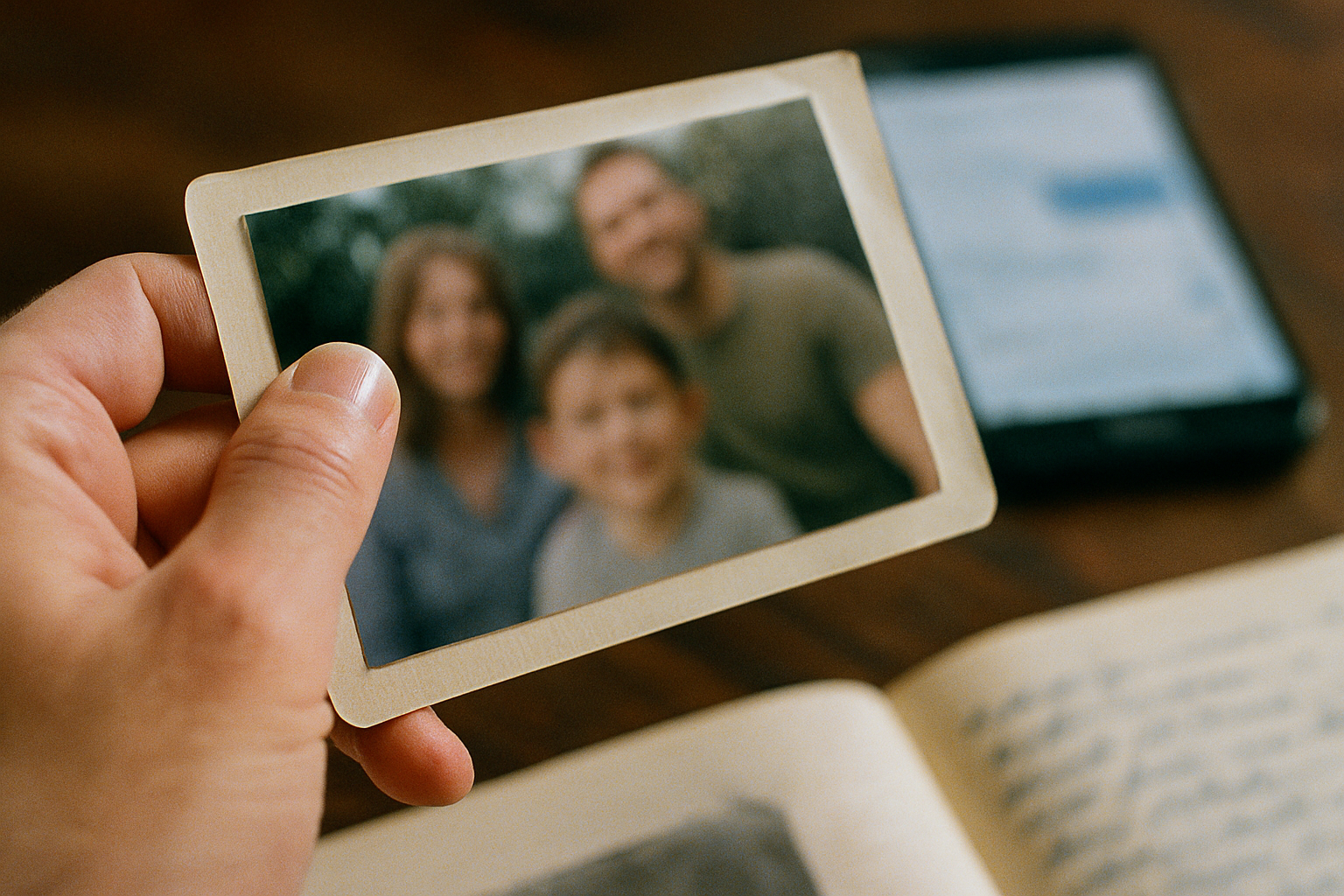
You post a photo of your daughter’s first bike ride to your family blog. The sun is perfect, her smile is wide, and the story you write beside it captures the wobble, the crash, and the triumphant pedaling all the way to the curb. You share the link with grandparents, aunts, and uncles. It feels like a perfect, modern way to share a classic family moment.
For years, we’ve used public-facing tools to share our private lives. Blogs, social media, and link-sharing photo albums became the digital equivalent of passing a photo album around the living room. It’s easy, it’s often free, and it connects us.
But a recent update to Google's privacy policy, covered in outlets like Mashable, brings a critical question into focus: who else is looking at that photo album? The policy clarifies that Google uses publicly available information to train its artificial intelligence models. That family blog, that public photo album—they’re part of the public internet. And that means your family’s stories could be becoming data points.
The short answer
Google's updated privacy policy confirms it uses publicly available data from the web and its services to train its AI models. For families, this means photos, stories, or videos shared on public blogs or via public links on services like Google Photos could be used. To protect your family's data, it is crucial to review all your sharing settings, limit what you make public, and consider using a dedicated private platform built specifically to safeguard family memories, not to harvest them for data.
The Shift from Content to Data
Let’s be clear: this isn’t necessarily a brand-new practice. For years, tech companies have used public web data to improve their services. What’s new is the context and the scale. The rise of generative AI like Google's Bard has created an insatiable appetite for training data—language, images, and the connections between them.
Google's policy update makes this explicit. It states they may use “publicly available information” to help train their AI models. The ambiguity of that phrase is where the concern lies for families. That blog post about the bike ride? Public. A Google review you left with an anecdote about your grandfather? Public. A Google Photos album shared with a 'link anyone can view'? Effectively public.
Your memories, shared with the best of intentions, risk being decontextualized and ingested into a massive system that learns from them, but doesn't understand their meaning. The photo of your daughter isn't a cherished moment; it's a data point about lighting, composition, and the concept of 'joy.'
Public vs. Private on Google's Services
It's important to distinguish between different types of data. Content stored privately in your Google Drive, personal emails in Gmail, or photos in a non-shared Google Photos library is treated with a higher level of privacy. The policy change primarily concerns information you or others have made accessible to the wider internet. The problem is, it's often hard to remember what you've shared publicly over the years.
The Unintended Legacy
Most of us have a sprawling digital footprint. It’s not just one blog or one album. It’s years of posts, comments, and shared links scattered across the web. Each piece is a breadcrumb leading back to your family’s story. When viewed in aggregate, it forms a detailed picture—one you likely never intended to paint for a corporate data scraper.
This is the fundamental trade-off of using free, public-by-default platforms for something as intimate as your family history. You get convenience, but you give up control. To truly understand the stakes, it helps to see the two sides.
Sharing on Public Platforms
It's incredibly easy and often free. Grandparents know how to click a link, and you can share a moment with dozens of people in seconds. These platforms are ubiquitous, requiring no special setup for your family members.
Your Memories Become the Product
When a service is free, your data is often the currency. Your family's life—your photos, stories, and connections—can be analyzed and used for purposes you never agreed to, from ad targeting to AI training. You lose the right to keep your story just for your family.
An occasional public post is one thing, but using these platforms as your primary family archive is another. It's like building your family home in the middle of a public square. It's easy for visitors to find, but you have no real privacy. For a deeper dive into evaluating your family's online presence, see our guide on how to audit your family's digital footprint.
Choosing a Sanctuary, Not a Stage
This is why we built Memory Murals. We believe there is a fundamental difference between public 'content' and a private family 'legacy.' Your family’s history shouldn't be raw material for the next algorithm. It's a sacred inheritance that deserves a space designed to protect it.
A true private archive operates on a completely different model. It’s not about public sharing; it’s about intentional preservation. The principles of such a space are clear and should be the standard for anyone handling precious memories.
You Own and Control Your Data
The platform is merely a custodian. Your stories, photos, and videos belong to you. The terms should explicitly state that your data will not be sold, shared, or used to train third-party models.
Invitation-Only Access
There are no public links. You decide, person by person, who gets to see your family's archive. This eliminates the risk of your memories being scraped by web crawlers.
A Clear Business Model
You pay a subscription for the service. This is a healthy, transparent transaction. It means the company works for you, not for advertisers or data brokers. Your privacy is a feature, not an afterthought.
Built for Preservation, Not Performance
The tools are designed to help you save and contextualize memories, not to maximize engagement. There are no 'likes' or public comment threads, just a quiet, focused space for your family's narrative.
At Memory Murals, all your data is encrypted in transit (TLS) and at rest (AES-256). We believe privacy is the heart of preservation, and our entire platform is built on that foundation.
A Quick Privacy Check-Up
Feeling concerned about your family's data doesn't have to lead to paralysis. You can take concrete steps today to create a more private and intentional digital legacy. It starts with a simple audit and a shift in mindset.
A 3-Step Digital Audit
Review Your Sharing Settings
Go through your most-used services. Check your Google Photos privacy settings, look at old blog posts, and review your social media profiles. Change album sharing settings from 'public' or 'anyone with the link' to 'private' and invite people directly. Delete old content you no longer wish to be public.
Pause Before You Post
Ask a new question before sharing: "Who is this for?" If the answer is "just family," consider if a public platform is the right venue. A text message, a direct email, or a post inside a dedicated private space like Memory Murals might be a better choice.
Choose a Central Home
The best way to protect your archive is to consolidate it. When your most important memories live in one secure place, you're not trying to track down dozens of old accounts or public links. You have a single front door, and you hold the only keys.
The internet's evolution is a constant reminder that the digital world is not a neutral space. The platforms we use have their own incentives, and those incentives aren't always aligned with a family's desire for privacy and permanence.
This isn't about deleting every online photo or retreating from the digital world. It's about being intentional. It’s about drawing a line between the parts of your life you share with the world and the stories you save just for your family. It’s about creating a space where your family’s history can unfold safely, on your own terms. If you're ready to build that private sanctuary for your own family, you can start your Memory Murals archive today.
That photo of the bike ride is more than just data. It's a memory. It deserves a home that understands the difference.
Get 50 questions to ask your parents — before the stories are gone
The exact prompts families use to draw out the stories nobody ever wrote down. Free, straight to your inbox.
No spam. Unsubscribe anytime.
Frequently asked questions
What does Google's new privacy policy say about AI training?
Google's updated privacy policy clarifies that the company uses publicly available information from the internet and its own products to train its AI models, such as Bard and Cloud AI. This means content that isn't set to private could potentially become part of the dataset used to develop future AI technologies. The policy aims to be more transparent about this existing practice.
Are my private files on Google Photos used to train AI?
Google states that it does not use content from apps where you primarily store personal content—like Gmail, Drive, and Google Photos—for advertising purposes. The policy update focuses on 'publicly available' information. However, any photos in albums shared with a public link or on public platforms like a Blogger blog could be considered public and therefore used for AI training.
How can I protect my family photos from being used for AI training?
The most effective way is to ensure your photos are not publicly accessible. Keep photo-sharing albums private and share them directly only with specific people. Avoid using public, guessable links. For ultimate peace of mind, consider using a dedicated private family archive service that is not in the business of scraping data for AI model training and has a clear privacy-first policy.
What is considered 'publicly available information' by Google?
While Google doesn't provide an exhaustive list, 'publicly available information' generally includes any content that can be accessed without needing special permission or a login. This includes public websites, blogs (like those on Blogger), articles, and content from Google products that you have made public, such as reviews on Google Maps or public Google Photos albums.
Are private family archives like Memory Murals safer from AI training?
Yes. Services like Memory Murals are designed as private sanctuaries. Their business model is based on subscriptions, not data monetization. Your photos and stories are not considered 'publicly available information' and are protected by strict privacy policies. They are not scraped or used to train large, general-purpose AI models. Access is invitation-only, giving you complete control.
About the author
Patrick Moore, Founder of Memory Murals
Patrick Moore is the founder of Memory Murals. He built it after realizing how much of his own family's history had quietly slipped away — to help families preserve their stories, voices, and photos while they still can.
Related Stories

How-To Guides
How to Audit Your Family's Digital Footprint Before It's Too Late (2026)
If your family had to recover your photos, voicemails, and stories on a Wednesday afternoon with no warning, how much would they actually find? Most families don't know. Here's the 5-step audit to find out before it matters.
Patrick Moore • May 15, 2026

Insights
Why Privacy is the Heart of Memory Murals
In an age of oversharing, Memory Murals was built on privacy. Learn why your family's story deserves a space free from ads, algorithms, and public scrutiny.
Patrick Moore • December 10, 2025
Insights
AI Grandkid Photos: Boomer Fun vs. Millennial Privacy Nightmare
A grandparent excitedly shares an AI-generated photo of their grandchild as a tiny astronaut. For them, it's harmless fun. For the Millennial parents, it's a digital privacy violation. This post explores the generational divide over AI-generated kid photos and offers a path forward for families.
Patrick Moore • September 21, 2026
Preserve your family's memories in one private place.
Start free in minutes. No credit card required.