
Sparking Their Memories
Tired of the same old interview questions? This guide offers creative, gentle ways to help seniors share their stories using sensory prompts, music, photos, and shared activities—perfect for those who are reluctant or facing memory challenges.
The Memory Murals Team • June 28, 2026

You ask your dad about his time in the army, and he tells you the same story he always tells—the one about the terrible food and the funny sergeant. You love the story, but you know there must be a thousand others locked away. Or maybe you ask your mom about her childhood, and she just smiles and says, "Oh, it was so long ago, I don't remember much."
It’s a common, quiet frustration. You want to know the person they were before they were your parent. You want to preserve their legacy, to understand the moments that shaped them. But direct questions can feel like an interrogation, and for some, especially those facing memory challenges, it can feel like a test they’re afraid to fail.
What if there was another way in? A side door to the stories that a direct question can’t unlock. There is. It involves less talking, and more experiencing.
The short answer
To spark memories without direct questions, use creative memory prompts for seniors. This involves engaging their senses with familiar smells, tastes, or textures; playing music from their youth; looking through old, unlabeled photos together; or handling meaningful objects. These indirect methods can bypass the pressure of a formal interview, often unlocking stories and emotions that questions alone cannot reach. The key is creating a shared, low-pressure experience rather than a Q&A session.
The Problem with Questions
Formal interviews and question lists have their place. We’ve even written guides on how to interview your parents. But they rely on a specific type of memory—the kind you can summon on command. This is called explicit memory, and it can be the first to fade or become unreliable with age or illness.
Creative prompts, on the other hand, tap into implicit memory. This is the memory of senses, emotions, and motor skills. It’s the feeling of a wool coat, the smell of your grandmother's kitchen, the muscle memory of tying a specific knot. These memories are stored in different parts of the brain and are often more durable. By creating an experience that triggers a sensory memory, you allow stories to surface naturally, without the pressure of performance.
This approach shifts the dynamic from an interview to a shared activity. You’re not there to extract information; you’re there to connect. The stories become a beautiful byproduct of the time you spend together.
More Natural & Spontaneous
Stories that emerge from a sensory prompt often have more emotional texture. They are less rehearsed and more connected to the feeling of the moment, providing a richer, more authentic glimpse into the past.
Less Predictable & Structured
This method requires patience. You can't direct the outcome. An afternoon spent baking might yield one small, precious anecdote or none at all. The goal is the connection itself, not a specific result.
Let Photos and Objects Do the Talking
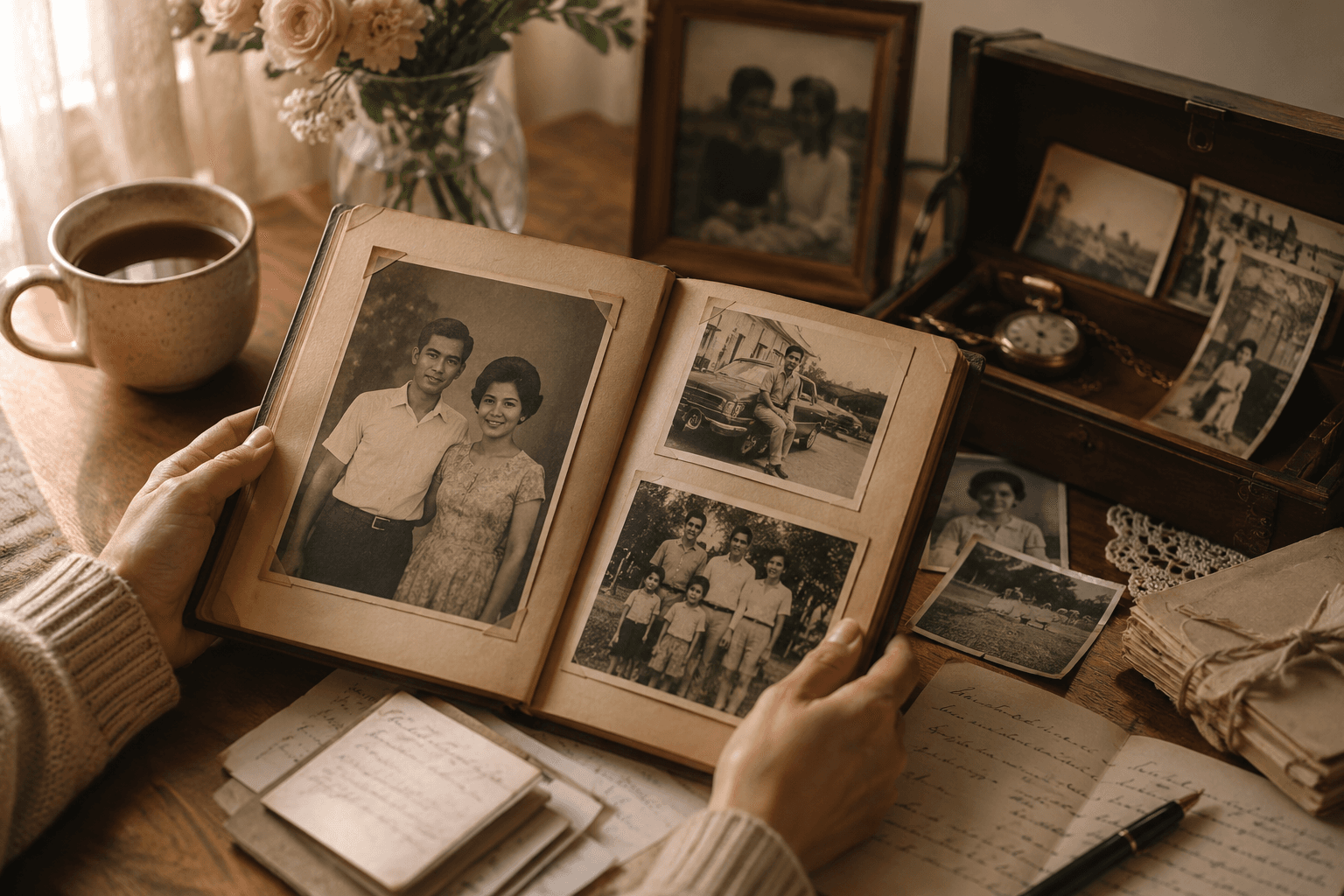
Photos are the most obvious memory trigger, but we often use them in a way that creates pressure. Pulling out a shoebox of old, unlabeled photographs can be a more powerful tool than a perfectly curated album.
Instead of asking, "Who is this?" or "When was this taken?" try a more open-ended approach:
- "This looks like such a happy day. I wonder what was going on."
- **"Look at the clothes people are wearing. That style is really something."
- "I don't recognize this place. It looks beautiful."
This invites observation and speculation, not a factual quiz. Sometimes, the most powerful thing you can do is simply sit in silence and look at a photo together. Let the memory surface on its own time.
If you have faded or damaged pictures, taking the time to restore the old photos first can be a project in itself. Seeing a face come into clear focus can be a profoundly moving experience that unlocks a new layer of memory. Objects work in a similar way. A father’s old watch, a mother’s recipe box, a collection of keys—these items have a physical weight that connects directly to the past.
How to Create a Simple Memory Box
Find a Container
It doesn't need to be fancy. A simple shoebox, a small wooden chest, or a fabric-lined basket will do. The act of opening it together is what matters.
Gather a Few Items
Don't overwhelm them. Select 5-7 objects with potential stories: a military medal, a faded concert ticket, a foreign coin, a dried flower from a corsage, an old report card.
Explore Without Expectation
Present the box as a collection of interesting things. Let them pick up an object that catches their eye and simply hold it. Wait for them to speak first. The texture and weight can be powerful triggers.
Listen and Capture
If a story emerges, just listen. Don't interrupt with questions. You can quietly record the audio on your phone or jot down notes afterward. The primary goal is the shared moment.
Music as a Time Machine
Of all the sensory prompts, music is perhaps the most potent. Our brains forge incredibly strong links between music and emotion, especially to the songs we loved in our adolescence and early adulthood. Hearing a song from the past doesn't just remind you of a time; it can make you feel the way you felt then.
This is particularly true for individuals with cognitive decline. Music therapy is widely used in dementia care as a way to engage seniors, ease agitation, and support communication. For many people with dementia, familiar music seems to stay reachable even as other memories fade.
Creating a playlist is simple:
- Ask about their era: What years were they between 15 and 25? This is often the period of peak musical memory.
- Search for hits: Look up the Billboard charts or popular artists from that time.
- Think beyond pop music: Include songs from their wedding, hymns they might have sung in church, patriotic songs, or even commercial jingles from the era.
Play the music in the background while you're doing something else, like cooking or looking at photos. Don't announce, "I'm playing this to make you remember." Let the music work its magic. You might be surprised when your quiet mother suddenly starts humming along and says, "You know, I saw him in concert once..."
A Note on Memory Loss
When using these techniques with a loved one experiencing memory loss, it's vital to release any attachment to factual accuracy. The goal is not to get a perfect historical record. It's about validation, connection, and quality of life. If a story is jumbled or combines different events, that's okay. The emotion it evokes is real and valuable. This journey is often about preserving stories after a dementia diagnosis in whatever form they take.
These methods aren't tricks or shortcuts. They are acts of love and patience. They are a way of saying, "I want to spend time with you, in your world, on your terms." You are creating a safe space for memories to land.
And when those precious, unexpected stories do surface—the one about the first car, the high school dance, the day they met your other parent—you'll want a place to keep them safe. That’s why we built Memory Murals. It's a private, secure space to save these audio snippets, transcribed stories, and scanned photos, creating a rich tapestry of a life well-lived. You can start building your family's archive today at app.memorymurals.com/signup.
Ultimately, the gift of this approach is twofold. You help your loved one feel seen, heard, and valued. And the stories you gather become a part of you, a deeper connection to your own history, preserved for generations you haven't even met.
Get 50 questions to ask your parents — before the stories are gone
The exact prompts families use to draw out the stories nobody ever wrote down. Free, straight to your inbox.
No spam. Unsubscribe anytime.
Frequently asked questions
How do you get a senior to talk about their past?
Instead of a direct interview, create a comfortable, shared experience. Use creative memory prompts like looking through old photos, listening to music from their youth, or baking a family recipe. These sensory activities can trigger memories more naturally than direct questions, which can sometimes feel like a test. The goal is to make reminiscing a pleasant activity, not an obligation, which often encourages more open sharing.
What are good memory triggers for the elderly?
Effective memory triggers often engage multiple senses. Auditory prompts like popular songs from their teens or 20s are powerful. Visual cues, such as old family photos (especially unlabelled ones), yearbooks, or meaningful objects like a wedding ring or military medal, can unlock stories. Sensory triggers, including the smell of a favorite perfume, the taste of a childhood food, or the texture of a specific fabric, are also excellent for evoking vivid memories.
How can I help a parent with dementia remember their life?
For a parent with dementia, focus on emotional connection rather than factual accuracy. Use gentle, creative memory prompts that don't rely on direct recall. Playing music from their past is especially effective, as musical memory is often preserved. Look at photos together and comment on the feeling of the image. The goal is to create moments of joy and connection in the present, celebrating the emotions a memory brings, even if the details are hazy.
What is a sensory memory prompt?
A sensory memory prompt is a technique that uses one of the five senses—smell, taste, touch, sight, or sound—to evoke memories. Unlike a verbal question, a sensory prompt draws on the brain's emotion and memory centers, which are closely tied to the senses. Examples include the smell of cinnamon, the feel of a wool blanket, or the sound of a specific song, each capable of unlocking deeply buried life stories.
Why won't my parent talk about their childhood?
A parent might be reluctant to discuss their childhood for many reasons. They may feel the memories are too distant, unimportant, or even painful. Sometimes, the pressure of a formal interview can cause them to shut down, especially if they're concerned about their memory. It might not be a conscious refusal, but rather a difficulty in accessing those stories on command. A gentler approach using photos, music, or objects can often make sharing feel more natural and less daunting.
Related Stories
How-To Guides
How to Preserve a Parent's Stories After a Dementia Diagnosis — A 2026 Guide
A diagnosis doesn't take everything at once. Here's a 2026 practical guide to recording your parent's stories at every stage — what to capture first, how to interview without pressure, and where these recordings should live.
The Memory Murals Team • May 14, 2026

How-To Guides
From 'I Don't Remember' to 'Unforgettable': How to Get Your Loved Ones to Share Their Best Stories
To unlock a family member's history, stop acting like a biographer and start acting like a key-holder. Here's how to move past one-word answers.
Patrick Moore • January 28, 2026

How-To Guides
How Seniors Can Record Their Life Story: A Practical Guide for Families
Many seniors want to share their stories but don't know where to start. This guide offers practical, gentle ways for them to take the lead in recording their own life story, from simple audio apps to creative writing prompts, ensuring their unique voice is preserved for generations.
Patrick Moore • June 16, 2026
Keep what's left of their voice.
A private place for the recordings, photos and stories — no feed, no algorithm, nobody else's eyes on it.