
Apple's Camera-Free Glasses & Family Privacy
Apple's rumored delay of their smart glasses to 2027, potentially without a camera, signals a major shift in tech. It highlights a growing public hunger for privacy, a principle we've built Memory Murals around. What does this mean for how we capture and share our family's most precious moments?
Patrick Moore, Founder • July 28, 2026
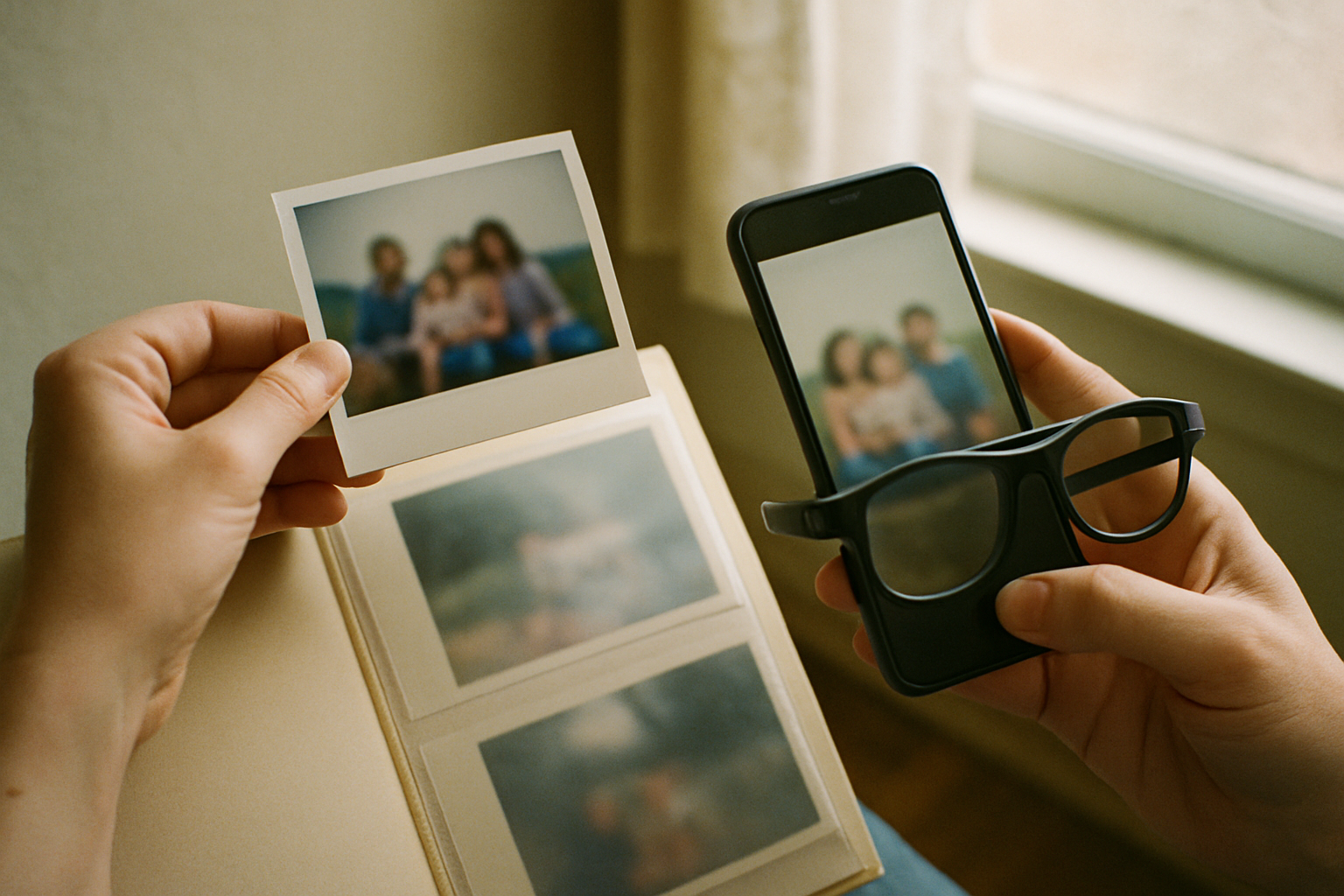
Picture a backyard barbecue for a grandparent’s 80th birthday. The whole family is there—kids chasing each other through the sprinklers, cousins catching up over potato salad, the guest of honor telling a story you’ve heard a dozen times but still love.
Now, imagine one of the younger cousins is wearing a sleek pair of smart glasses. They’re not holding up a phone, but a tiny, almost invisible lens is pointed at the group. Suddenly, the atmosphere shifts, just slightly. Is this moment being recorded? Will that heartfelt, slightly rambling story from Grandpa end up on a server somewhere, analyzed by an algorithm?
The joy of the moment is suddenly tinged with a subtle, modern anxiety. This feeling—the quiet unease of being passively observed by technology—is becoming more and more familiar. And it seems the world’s biggest tech company is finally taking notice.
The short answer
Recent reports suggest that due to significant Apple smart glasses privacy concerns, the company has delayed its launch to 2027 and may be developing a camera-free version. This potential move signals a major industry acknowledgment of public demand for technology that respects personal boundaries. For families, this trend away from constant, public-facing capture validates the desire for more intentional, truly private spaces to preserve memories, which is the entire philosophy behind dedicated family archives.
A Quiet Backlash to 'Capture Everything'
For years, the trajectory of personal technology seemed clear: more cameras, more sensors, more data, all the time. But recent headlines suggest a potential course correction. According to reports from sources like ETV Bharat and Technology Org, Apple is planning to launch its first smart glasses at WWDC 2027, a delay prompted by internal debates over privacy implications.
This isn't just a product delay; it's a statement. For a company of Apple's scale to potentially sideline a key feature like a camera on a major new product, it tells us the public's simmering privacy concerns have reached a boiling point. The idea of a privacy-focused wearable, as speculated by The Indian Express, could set a new standard, directly challenging competitors like Meta's Ray-Ban glasses.
This cultural shift isn't happening in a vacuum. We're all becoming more aware of the constant drumbeat of massive data breaches affecting everyone from healthcare patients to energy customers. The convenience of connected technology has come with a steep, often invisible, price. The backlash isn't about rejecting technology itself, but about demanding more control. It’s a collective realization that the most precious parts of our lives—our family's faces, our private conversations, our unguarded moments of joy—shouldn't be the raw material for someone else's business model.
When Your Memories Become Market Research
Many of the platforms where we share our family photos operate on a “public by default” model, both socially and technically. While they offer incredible convenience, their core business is built on data. Every photo you upload, every person you tag, every caption you write becomes a data point that helps them build more accurate profiles for advertisers.
This creates a fundamental conflict of interest. Is the platform's primary goal to help you preserve your memories, or to analyze them for commercial gain? When you look at it this way, the trade-off becomes clearer.
The Convenience of Mainstream Platforms
With just a few taps, you can share a baby's first steps with hundreds of friends and family. Features like facial recognition automatically sort your photos, and powerful search tools let you instantly find that picture from the 2019 beach trip. These platforms are ubiquitous, often free to use, and deeply integrated into our digital lives.
The Hidden Cost of 'Free'
Your family's private history becomes a corporate asset. These companies' primary allegiance is to their advertisers and shareholders, not to the sanctity of your memories. Privacy policies can and do change, and as we've seen with services like Meta, your content can be used to train AI. You're trading privacy and ownership for convenience, a deal that feels less appealing with each new data breach headline.
This model also contributes to what some have called a digital orphan crisis, where our memories are trapped on platforms that may not exist in 10 or 20 years, their futures dictated by market forces, not our family's desire for continuity.
The Case for a Private Family Archive
Apple's rumored pivot toward privacy isn't just a corporate strategy; it reflects a deeply human need for safe, private spaces. It’s the very need we founded Memory Murals to address. We believe that a family’s story is a sacred thing, not a data set to be monetized.
A private family archive operates on a completely different philosophy. It’s not a social network for public performance; it's a digital heirloom for private preservation. It's a quiet, walled garden where your family's story can grow, protected from the outside world.
Here’s what that philosophy looks like in practice:
You Own and Control Your Data
Our business model is a simple subscription. You pay us to safeguard your memories, and that's it. We will never sell your data, use your photos to train AI, or share your stories with advertisers. Your family's legacy is yours alone.
Strictly Invitation-Only
You have complete control over who sees your family’s archive. There are no public profiles, no algorithmic friend suggestions, and no risk of a stranger stumbling upon a personal photo. It’s a secure space for just you and your loved ones.
Built for Context, Not Clutter
A camera roll with 50,000 images isn't a story; it's a database. We focus on helping you connect the dots, pairing photos with the stories behind them. This context is what transforms a simple picture into a cherished memory and answers the question of why thousands of photos aren't preserving memories.
Designed for the Long Term
Social media is about the now. An archive is about forever. Every feature we build is designed with a single goal: to ensure your family’s story is preserved with richness and integrity for your children, grandchildren, and beyond. This is the core of creating a true digital legacy.
Choosing Your Tools Intentionally
The conversation around Apple's smart glasses is a perfect opportunity to think more intentionally about the tools we use to document our lives. It’s a reminder that not every piece of technology is right for every purpose. A public social network is great for sharing a funny meme with a wide audience. It’s a poor choice for preserving your mother’s life story.
If the rumors are true, Apple is choosing to prioritize user trust over a feature that, while powerful, carries immense social and ethical baggage. It’s a lesson we can all apply. By consciously choosing tools that align with our values, we can reclaim our privacy without disconnecting from the world.
What to Look for in a Private Archive
When evaluating a service to hold your family's most important memories, ask these questions:
- What is the business model? Look for a clear, subscription-based service. If it's free, you are the product.
- What does the privacy policy say? It should explicitly state that your content will not be sold or used for AI training.
- Can I get my data out? True ownership means you can easily download all of your photos, videos, and stories at any time.
- How is my data secured? The service should use industry-standard security like encryption in transit (TLS) and at rest (AES-256).
The future of technology doesn't have to be an all-or-nothing trade-off between privacy and innovation. The most hopeful interpretation of the Apple news is that the industry is finally realizing that trust is the most valuable feature of all.
Ultimately, the moments that make up a family’s history are too important to be treated as casual collateral in the data economy. They deserve a space built on a foundation of respect and privacy. The best memories aren't captured by a passive, always-on device, but by the conscious, loving act of saving a story for the people who matter most. If you're looking for a dedicated place to build that legacy, we invite you to try Memory Murals.
Get 50 questions to ask your parents — before the stories are gone
The exact prompts families use to draw out the stories nobody ever wrote down. Free, straight to your inbox.
No spam. Unsubscribe anytime.
Frequently asked questions
What are the main privacy concerns with smart glasses?
The primary privacy concern with smart glasses is the potential for non-consensual recording. Without a clear indicator, people around the wearer may not know they are being filmed or photographed, which raises issues of consent and personal space. There are also data privacy risks regarding where that captured footage is stored, how it's analyzed by the tech company, and whether it could be used for targeted advertising or surveillance. These issues are what's reportedly causing Apple to reconsider its approach.
Why would Apple make smart glasses without a camera?
Apple might release camera-free smart glasses to focus on privacy and sidestep the social stigma associated with public recording devices. Instead of capturing video, the glasses could function as a display for notifications, navigation, and audio, acting as a wearable heads-up display. This would allow them to enter the market by offering utility without the significant privacy backlash faced by competitors, potentially making privacy-focused wearables a new trend as suggested by some industry analysts.
Are my photos safe on platforms like Google Photos or Instagram?
Safety on large tech platforms is complex. While they have robust security to prevent hacks, their business models often rely on using your data. Your photos and interactions can be analyzed to train artificial intelligence and target advertising. Their privacy policies can change, potentially giving them more rights to your content over time. For true privacy and ownership, where your memories aren't a product, a dedicated, subscription-based family archive is a more secure choice.
What is a private family archive?
A private family archive is a secure, invitation-only digital space designed specifically for preserving and sharing family memories like photos, videos, and stories. Unlike social media, its purpose is long-term preservation, not public performance. The business model is typically a subscription, meaning the company's responsibility is to you, the user, not advertisers. This ensures your family's legacy is kept safe, organized, and free from data mining, accessible only to the people you choose.
How is Memory Murals different from social media photo sharing?
Memory Murals is fundamentally different because it’s a private archive, not a social network. We have a subscription-based model, so we never sell your data or use your family photos for advertising or AI training. Access is strictly by invitation, creating a safe space for genuine sharing without the pressure of "likes" or public scrutiny. Our focus is on pairing stories with photos to build a meaningful, lasting digital heirloom for future generations, rather than on fleeting, public posts.
About the author
Patrick Moore, Founder of Memory Murals
Patrick Moore is the founder of Memory Murals. He built it after realizing how much of his own family's history had quietly slipped away — to help families preserve their stories, voices, and photos while they still can.
Related Stories

Insights
Why Privacy is the Heart of Memory Murals
In an age of oversharing, Memory Murals was built on privacy. Learn why your family's story deserves a space free from ads, algorithms, and public scrutiny.
Patrick Moore • December 10, 2025
How-To Guides
How to Create a Private, Secure Digital Family Archive (2026 Step-by-Step)
Most family photos today live somewhere a stranger's algorithm can scan them or a forgotten password can lock them away forever. Here's how to build a private archive only the people you choose can see — and that doesn't belong to anyone but you.
Patrick Moore • May 27, 2026

Insights
SK Telecom's AI Photo Search: What It Means for Your Family's Privacy
SK Telecom's new service turns your photo library into a searchable AI database, raising new questions about data privacy. This technology can find any person, object, or place in your pictures, but what happens to that data? We explore the implications and why a private archive is more important than ever for your family's memories.
Patrick Moore • August 31, 2026
Preserve your family's memories in one private place.
Start free in minutes. No credit card required.