Memorygram vs. Storyworth
Storyworth creates a beautiful printed book from written stories, while Memorygram captures a loved one's actual voice through audio recordings. We compare their core features, pricing, and process to help you decide which service is the right fit for preserving your family's unique legacy.
Patrick Moore, Founder • August 21, 2026
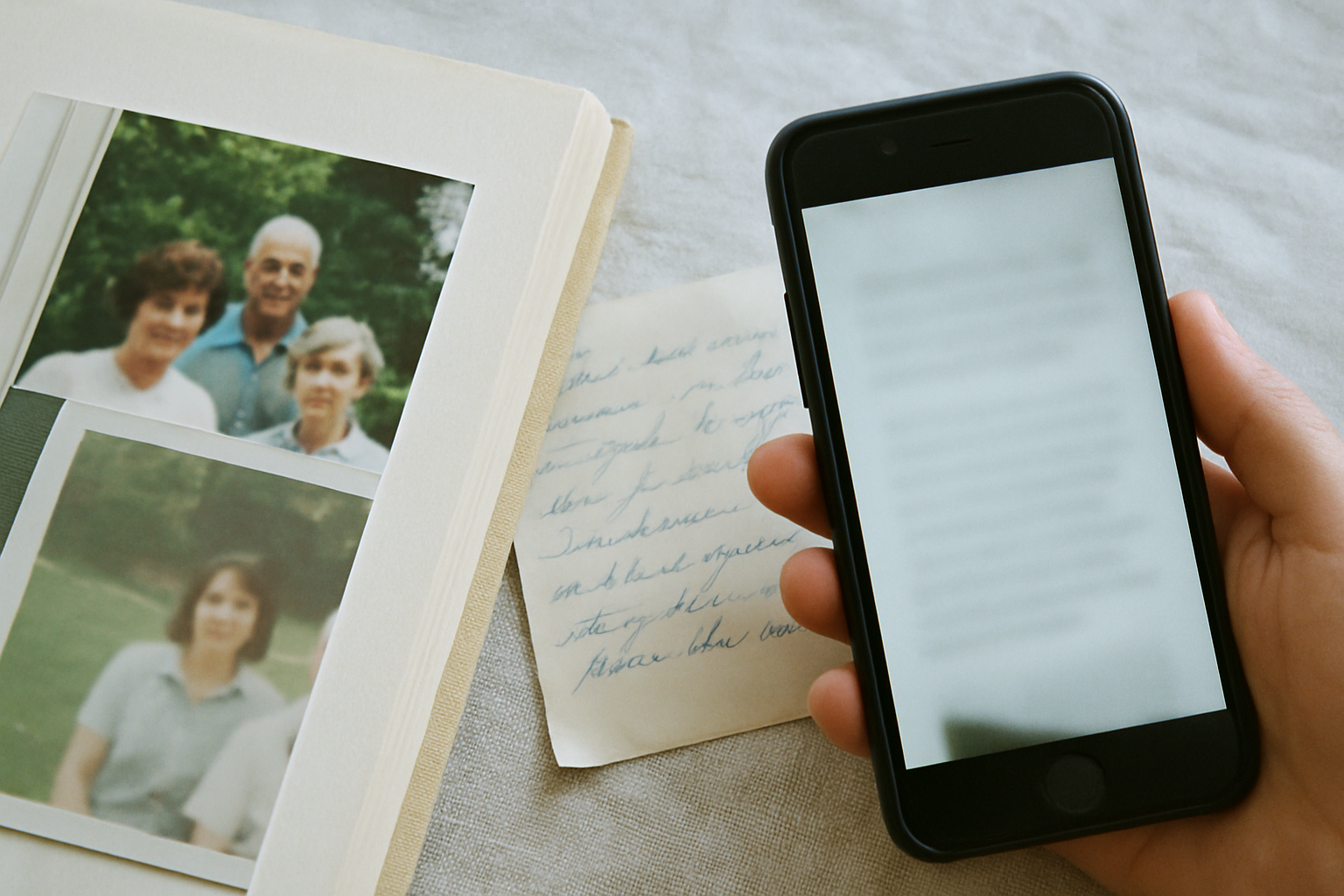
Picture a grandfather who isn't much of a writer. His emails are short and to the point. But ask him about the summer he learned to drive, and he’ll lean back, a smile playing on his lips, and spin a tale full of vivid detail, perfect comedic timing, and the specific, rumbling laugh you’d recognize anywhere.
His story isn't just in the words; it's in the telling. It's in the way his voice gets quiet when he talks about his own father, or the way it swells with pride describing his first car. For families with a storyteller like this, the medium matters just as much as the memory itself.
This is the central question when comparing two popular memory-keeping services, Memorygram and Storyworth. Both aim to help you preserve your family's legacy, but they go about it in fundamentally different ways. One gives you their words on a page; the other gives you the sound of their voice.
Choosing between them isn't about which is 'better,' but about which is a better fit for the person whose stories you want to save, and for the way your family wants to remember.
The short answer
When comparing Memorygram vs Storyworth, the key difference is the final product. Storyworth uses weekly email prompts to help a loved one write their life story, which is then compiled into a beautiful hardcover book. It's ideal for those who want a tangible heirloom. Memorygram uses audio prompts to capture spoken stories, creating a digital archive of your loved one's actual voice. It's best for preserving the personality and emotion behind the stories in a shareable, audible format.
How Storyworth Works: The Path to a Book
The Storyworth process is built around a single, elegant goal: creating a physical book. When you gift a subscription, the recipient begins receiving one story prompt via email each week for a year. These are questions like, "What was your first job?" or "What's the best advice you've ever received?"
They write their answer and email it back. The story is then saved to a private online account where you and other invited family members can read it. You can also upload photos to accompany the stories. At the end of the year, you select which stories to include, design a cover, and the company prints and ships a handsome hardcover book. It’s a structured, year-long project with a clear, satisfying conclusion.
How Memorygram Works: The Path to a Voice Archive
Memorygram takes a different approach, centering the entire experience on the human voice. Instead of written prompts, your loved one receives questions via text message or a mobile app, often with the option for them to simply call a number and speak their reply.
They record their answer, telling the story in their own words and their own voice. The audio file is automatically saved and transcribed in a digital archive. Family members can listen to the recordings almost immediately, creating a more dynamic and ongoing experience. The goal isn't a single finished object, but a living, growing library of audible memories that capture the storyteller's true personality.
Comparing the Heirlooms
Ultimately, your choice will likely come down to what kind of heirloom you want to create. Each has its own profound strengths and inherent limitations.
The Storyworth Book
A beautifully bound book is a timeless, classic heirloom. You can hold it in your hands, place it on a coffee table, and pass it down through generations without worrying about file formats or dead links. It's a finite, completed work that feels substantial and permanent. For family members who aren't tech-savvy, a book is universally accessible.
What's Lost in Writing
The process of writing can feel formal and intimidating for some, and it inevitably loses the nuance of the spoken word. The laughter, the accent, the emotional cracks in a voice, the thoughtful pauses—all the texture that makes a story feel alive—is flattened into text. It preserves the memory, but not the sound of the person telling it.
The Memorygram Audio Archive
Hearing a loved one's voice is incredibly powerful. Memorygram captures the essence of the person, not just their memories. You can share a link to a specific story with a cousin across the country in seconds. An audio archive is a living collection that can be added to indefinitely, preserving a legacy that feels immediate and deeply personal.
The Digital Challenge
The primary output is intangible. It lives on a server and requires a phone or computer to access. While you can download the files, ensuring their preservation for future generations requires more active digital stewardship than putting a book on a shelf. It doesn't provide the same sense of a single, 'finished' project.
Process, Pacing, and Participation
Beyond the final product, the day-to-day experience of using each service differs significantly. Understanding these differences can help you choose the one your family member is most likely to enjoy and stick with.
The Medium: Writing vs. Speaking
This is the most critical distinction. Is your loved one a natural writer who enjoys crafting a story on the page? Or are they a born conversationalist who shines when they can just talk? Choosing the medium they are most comfortable with is the single biggest factor for success.
The Pacing: Project vs. Process
Storyworth is a year-long project with a defined end. This structure can be motivating for some, but feel like a deadline-driven homework assignment to others. Memorygram is more of an ongoing process, allowing for more flexibility to record when inspiration strikes, without the pressure of a looming book deadline.
The Output: Tangible vs. Sharable
A book is a wonderful object for a small group to gather around. A digital audio file can be shared with hundreds of family members around the world instantly via a simple link. Consider how your family connects and shares things today.
The Content: Curated vs. Candid
The act of writing and editing encourages a more polished, curated narrative. Speaking into a recorder often yields more candid, spontaneous, and conversational stories. Neither is better, but they produce a different style of storytelling.
Where Memory Murals Fits In
At Memory Murals, we built our platform on a simple belief: the most meaningful family archive contains more than just one type of memory. A prompted story is wonderful, but it becomes even more powerful when placed alongside the faded photograph it describes, the scanned recipe it mentions, and the short video clip from that same era.
Both Storyworth and Memorygram are excellent tools for extracting stories. But what happens next? Where do those stories live in the broader context of a person's life? This is the question we set out to answer. We designed Memory Murals to be the private, secure home for all of it.
You can upload the audio files from Memorygram, the transcribed text from a Storyworth book, the home videos you digitized, the letters you scanned, and the thousands of photos on your phone. Our platform helps you connect them, creating a rich, multi-layered tapestry of a life that a single-format service can't replicate. It’s not just about collecting stories; it’s about understanding the life behind them.
Your family’s stories deserve a safe place
Photos, voice recordings, and the stories behind them — private, ad-free, free to start.
Start preserving memories freeFree plan available • No credit card required
If you see memory preservation as a holistic project—one that includes photos, audio, video, and text from your whole family—Memory Murals is designed for you. It's a collaborative space to create a private, secure family archive that grows with you over time.
The prices, verified this week
StoryWorth publishes its tiers openly again — they were checkout-only for part of August — so a real comparison is possible for the first time in months. Every figure was checked against the vendors' own live pages on 7 September 2026.
| What you pay for | StoryWorth | Memorygram |
|---|---|---|
| Headline price | $59 Basic / $109 Color / $199 Unlimited | $123.50 list, $98.80 on sale |
| Pricing model | Annual; only Unlimited auto-renews, at $99/yr | One-time purchase, no subscription |
| Interior colour | Black-and-white on Basic; colour from $109 | Full colour |
| Page count | Up to 480 black-and-white; up to 300 in colour | Not published |
| Books included | One (two on Unlimited) | One Legacy Book |
| Extra copies | $39 B&W / $79 colour ≤300pg / $99 colour ≤480pg | $89, or $77 on sale |
| Several storytellers | Yes, on the $199 Unlimited tier | A second storyteller is $50 |
| Voice playable from the book | No | Yes — QR code on the cover |
| Prices published openly? | Yes, on the pricing page | No — checkout store only |
Headline price
- StoryWorth$59 Basic / $109 Color / $199 Unlimited
- Memorygram$123.50 list, $98.80 on sale
Pricing model
- StoryWorthAnnual; only Unlimited auto-renews, at $99/yr
- MemorygramOne-time purchase, no subscription
Interior colour
- StoryWorthBlack-and-white on Basic; colour from $109
- MemorygramFull colour
Page count
- StoryWorthUp to 480 black-and-white; up to 300 in colour
- MemorygramNot published
Books included
- StoryWorthOne (two on Unlimited)
- MemorygramOne Legacy Book
Extra copies
- StoryWorth$39 B&W / $79 colour ≤300pg / $99 colour ≤480pg
- Memorygram$89, or $77 on sale
Several storytellers
- StoryWorthYes, on the $199 Unlimited tier
- MemorygramA second storyteller is $50
Voice playable from the book
- StoryWorthNo
- MemorygramYes — QR code on the cover
Prices published openly?
- StoryWorthYes, on the pricing page
- MemorygramNo — checkout store only
Memorygram is the awkward one to price. None of its figures appear on its homepage — you have to reach the checkout store before you see a number. The Legacy Book lists at $123.50 and sells at $98.80 under a 20%-off sale that has been running under a rotating name every time we have checked across four months (currently a "Grandparents Day Sale"), so treat $98.80 as the real price and $123.50 as an anchor. It does not publish a page count, a collaborator limit, or shipping terms, and we are not going to guess at them.
The short version on cost: the $59 headline makes StoryWorth look like the obvious saving, and it is — as long as black-and-white photographs inside the book are acceptable. For a full-colour book the two land within about ten dollars of each other, at which point price stops being the deciding factor and the QR playback does.
If Remento is also on your list, we compare all three in Remento vs StoryWorth vs Memorygram.
So, Which One Should You Choose?
There's no single right answer, only the right answer for your family.
Choose Storyworth if:
- Your primary goal is a beautiful, physical book to have and to hold.
- Your storyteller is a confident writer who is comfortable with email.
- You appreciate a structured, year-long project with a clear finish line.
Choose Memorygram if:
- You want to capture the actual voice, personality, and emotion of your loved one.
- Your storyteller is a better talker than a writer.
- You value a more flexible, ongoing process and the ability to share memories instantly and digitally.
Consider Memory Murals if:
- You want to preserve all kinds of memories—photos, videos, audio, and documents—in one integrated place.
- You envision a collaborative archive built by the whole family, not just one storyteller.
- You want to connect memories to each other to build a richer, more contextual life story.
Whether written on a page or carried on a sound wave, a preserved story is a priceless gift. It’s a bridge across time, connecting generations. The best service is simply the one that gets those stories told, in whatever form feels most true to the person telling them. From there, you can begin the beautiful work of building a lasting family legacy. You can start your own private archive today.
Get 50 questions to ask your parents — before the stories are gone
The exact prompts families use to draw out the stories nobody ever wrote down. Free, straight to your inbox.
No spam. Unsubscribe anytime.
Frequently asked questions
What is the main difference between Storyworth and Memorygram?
The fundamental difference is the medium. Storyworth collects written answers to email prompts over a year and compiles them into a hardcover printed book. Memorygram, on the other hand, collects spoken answers to audio prompts, creating a digital library of your loved one's actual voice. The choice is between a tangible, written heirloom and an intimate, audible legacy.
Is Storyworth or Memorygram better for a grandparent who isn't tech-savvy?
It depends on their comfort zone. If your grandparent is comfortable writing and replying to emails, Storyworth is very straightforward. If they prefer talking over typing, Memorygram's process of simply recording a voice memo on their phone might be easier. Both require some interaction with technology, but one favors writing skills while the other favors speaking.
Can you get a physical book from Memorygram?
Memorygram's primary product is a digital audio archive, not a physical book. While you could manually transcribe the audio recordings and use a separate service to create a book, it's not an integrated feature. If a printed book is your main goal, Storyworth is designed specifically for that purpose, making it the more direct path to a physical heirloom.
How much do Storyworth and Memorygram cost?
Both services operate on a subscription model, but for different outcomes. Storyworth's fee typically covers a year of prompts and one copy of the final hardcover book. Memorygram is usually a recurring subscription for access to their audio recording platform and digital archive. For the most current pricing and plan details, it's always best to check their respective websites directly.
Which service is better for capturing someone's personality?
While well-written stories can be deeply personal, many find that an audio recording captures personality more completely. With an audio service like Memorygram, you preserve the sound of their laughter, the specific cadence of their speech, their thoughtful pauses, and the emotion in their voice. These are nuances that text alone often cannot convey, offering a more vivid and intimate portrait of the storyteller.
Is Memorygram or Storyworth cheaper?
StoryWorth, if you can live with a black-and-white interior. Its Basic tier is $59 and includes one hardcover up to 480 pages, but the inside pages are black and white with a colour cover. Full colour means the $109 Color tier, which caps at 300 pages. Memorygram's Legacy Book lists at $123.50 and sells at $98.80 on a near-permanent sale, in full colour. So the honest colour-for-colour comparison is roughly $109 against $98.80, and the honest cheapest-book comparison is $59 against $98.80. Verified 7 September 2026.
Does Storyworth keep the audio recordings?
StoryWorth's deliverable is the written book. Its higher tiers add phone transcription and guided phone interviews, but what you are buying is the printed volume. Memorygram is the one that prints a QR code on the cover so the finished book can play the recordings back — no StoryWorth tier ships that. If preserving the actual sound of the voice is the point rather than the words, that single difference outweighs the price gap.
About the author
Patrick Moore, Founder of Memory Murals
Patrick Moore is the founder of Memory Murals. He built it after realizing how much of his own family's history had quietly slipped away — to help families preserve their stories, voices, and photos while they still can.
Related Stories

Comparisons
StoryWorth vs Remento vs Tinybeans vs FamilyAlbum vs Memory Murals: Honest 2026 Comparison
Five tabs open, a Mother's Day deadline, and a credit card half-pulled out. The honest side-by-side on StoryWorth, Remento, Tinybeans, FamilyAlbum, and Memory Murals — including which one is the bridge between photo-sharing and story-capture, and which gift will actually arrive in time.
Patrick Moore • April 24, 2026
Comparisons
Best StoryWorth Alternatives in 2026: 6 Tools Compared
Most people search 'StoryWorth alternatives' for the same reason — the $59 sticker becomes $206 once you add color, an extra book, and expedited shipping. Six real alternatives compared honestly, including the one that handles photos and stories together.
Patrick Moore • May 1, 2026

Comparisons
Memorygram vs Remento: Which Story-Sharing App is Right for Your Family?
Choosing an app to capture your family's precious stories feels like a big decision. Both Memorygram and Remento offer compelling ways to record life stories, but they approach the task differently. We'll explore their unique features to help you find the perfect fit for your family's legacy.
Patrick Moore • August 18, 2026
See the version we built.
Voice-first, multi-contributor, and priced on one page — $12.99/mo, $99.99/yr, or a $7 weekend pass. Free for 7 days.