How to Preserve a Parent's Stories After a Dementia Diagnosis
A diagnosis doesn't take everything at once. Here's a 2026 practical guide to recording your parent's stories at every stage — what to capture first, how to interview without pressure, and where these recordings should live.
The Memory Murals Team • May 14, 2026
A diagnosis doesn't take everything at once. It takes some things first — names, then routines, then the story of how your parents met. The window for recording is longer than people think, and shorter than they hope. Here's what to do in it.
This is a 2026 practical guide to recording your parent's stories at every stage. It is not a medical guide. It will not tell you what dementia is or how it progresses — clinicians and the Alzheimer's Association do that better than we can. What this post will tell you is what to record, in what order, using which techniques, and where to keep these recordings so a grandchild can find them in twenty years.
The framing matters. We're not going to talk about "before it's too late." That phrasing makes every visit feel like a deathbed interview, which is exactly the wrong posture — and as we'll get to in the recording-technique section, it actively reduces the quality of what you'll capture. We're going to talk about the years you have.
What a diagnosis actually changes about recording
Most families react to a diagnosis with two assumptions, and both are wrong.
The first wrong assumption is we have time. The brain does what the brain does — it slots dementia into the same mental category as "elderly" and lets you reason about the timeline like a normal slow decline. The window for recording feels open-ended.
The second wrong assumption is the opposite of the first: we don't have time. The morning after the diagnosis, the recording project becomes urgent, every visit becomes a Big Conversation, and the parent — already shaken by the news — gets handed a microphone and asked to recount their entire life. This burns the runway you do have.
The honest version is in between. The story-telling self tends to go before most families think it does. Memory degrades unevenly — for many people with dementia, recall for names (of people, of places, of side characters in a story) can become difficult earlier than recall for the big specific moments at the center of a story. So your father may still vividly remember the day he first met your mother long after he's started losing the names of his coworkers. That asymmetry is your opening. You record the big specific stories now, while access to them is still intact, even if surface details start slipping.
For families thinking about recording a parent before any diagnosis, we wrote a piece on the case for doing it preventively. The version of that argument that applies now is sharper but the same shape: the cost of recording today is small, the cost of not recording is unbounded, and the best window is rarely the one you think it is.
What to capture first
You don't have time to record everything. You have time to record the right things. Here's the priority order.
1. Voice itself. Before stories, before content, capture the sound of your parent's voice. Timbre is irreplaceable, degrades fastest, and is the asset most surviving family members say they wish they had more of. A five-minute recording of your mother reading a recipe in her own voice will, in a decade, matter as much as a perfectly transcribed two-hour life history. Start by recording her voice doing something normal — telling a story she's told before, leaving you a voicemail, reading a passage from a book she loves.
2. The six to eight anchor stories every family has. Every family has them: how they met, the move, the loss, the proudest moment, the regret that turned out fine, the dumbest decision that turned out brilliant, the one time they almost gave up, the one person who mattered most outside the family. You can name three of these right now. List the others. These are the stories that get told at every funeral, every wedding toast, every Thanksgiving. They are also the stories your parent can probably still tell, and tell well, even years into decline.
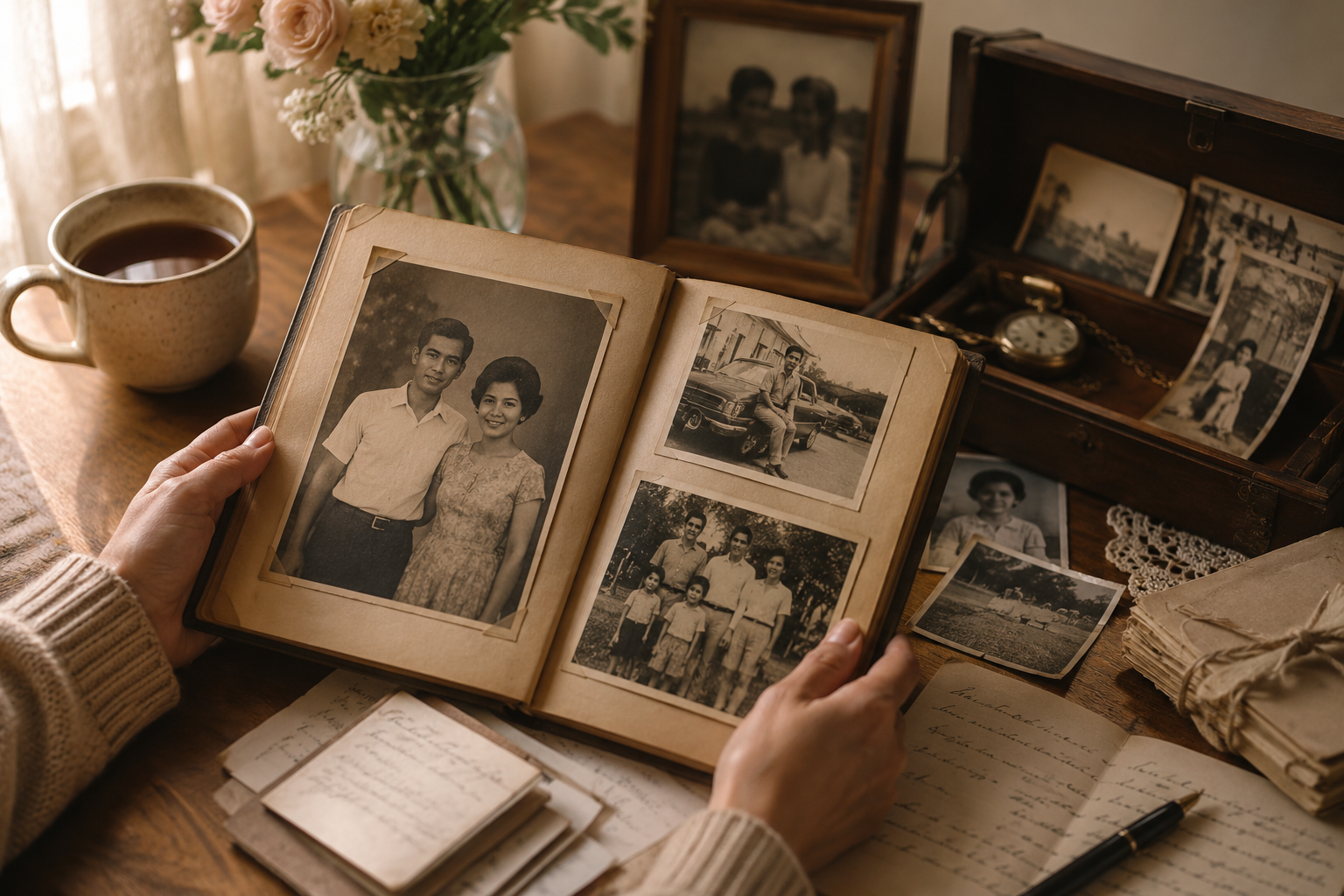
3. Names attached to faces. Pull out an old photo album. Don't ask "tell me about this." Ask "who is this?" Then "who is this?" Then "who is this?" You're not collecting stories yet — you're collecting names, which is the part of memory that goes first. You'll need them later. For a longer list of prompts that work without putting pressure on the conversation, our post on questions to ask your mom has twenty-five specific ones.
4. Origin story. Where they grew up, what their parents did, what their childhood smelled like. The further back in time you go, the longer the memory tends to hold. Save the recent decades for later — they'll go later.
What's not on this list: an exhaustive chronological autobiography. That's a project for someone with five years of stable cognition ahead of them. You don't have that. Don't try to build it.
Recording technique without the deathbed-interview vibe
The biggest mistake families make is sitting their parent down with a microphone and saying "tell me your life story." This produces nothing. The parent freezes. They feel the weight of the request, they sense the urgency behind it, and they shut down or give you a sanitized summary they don't actually mean.
Here's what works instead.
Record when they're sharpest. For many people with dementia, there's a daily rhythm: clarity tends to be highest in the morning, after breakfast, before the day's accumulated fatigue. Sundowning — late-afternoon and evening confusion that many people with dementia experience — is well-documented. Record in the morning. If your parent is in a memory-care facility, ask the staff when they're sharpest; they know.
Keep sessions short. Sessions much longer than twenty or thirty minutes tend to degrade in quality — for them, because attention thins, and for you, because you start asking worse questions. If you have time for an hour, do two or three short sessions with breaks instead. The recording quality and the conversation quality both go up.
Ambient recording beats interviews. Some of the best material you'll capture isn't an interview. It's a story told over dinner, on a car ride, while looking through a photo album. Phone in your pocket, voice memo running. Always ask for general consent first (more on this in the next section); once you have it, let the phone run during normal conversation. This catches the unprompted speech that direct questions rarely produce.
Start small and specific. Never open with a big question. Open with a tiny, specific one they almost certainly know the answer to. "What kind of car did Grandpa drive?" is a better opening than "tell me about your dad." A small question primes the larger memory. After three or four small questions, the larger story usually arrives on its own.
Never correct in the moment. If they get a year wrong, or a name wrong, or contradict something you know is true, do not correct them while the recording is running. Two reasons: it derails the story, and once derailed it rarely comes back. The version they remember is the version worth keeping. You can footnote the historical record later. You can't re-record what they almost said before you cut them off.
These tactics are not specific to dementia — they're the tactics of good interviewing, full stop. Our post on interviewing a dad who's not a talker covers the broader version of the same playbook. The dementia-specific addition is just patience and a shorter clock.
The rest of this guide is organized by stage. These are recording stages, not clinical ones — defined by what kind of material is still capturable from your parent, not by where they sit on a medical staging scale. Use them as a rough map; your family will fit them imperfectly, and that's normal.
Stage 1: Just diagnosed
Capacity is mostly intact. Long-form interviews are still on the table. Video is still on the table. The relationship is still mostly what it was, with a diagnosis hovering at the edge of every conversation.
This is the easiest stage to record in and the hardest stage to want to record in. Families often freeze here. The diagnosis is still raw. Sitting down to record feels like accepting something neither party is ready to accept. So families wait until "we've adjusted." And then they wait. And the runway shrinks.
Here is the part almost no one writes about: this is also the only stage when you can clearly ask for consent. While your parent can still understand what's being asked and what they're agreeing to, have the conversation. Tell them what you want to record, why, and who's going to hear it. Get a yes on the record — literally record the consent conversation. Most parents say yes, with relief. The recording becomes a gift instead of a transaction.
Once consent is in, the rest is logistics.
Coordinate with siblings. Decide who is recording what, whose phone the audio lives on, where the master copy goes. The most common failure mode is one sibling records two hours of material and nobody else in the family knows it exists. Pick a shared archive on day one.
Don't overschedule. One short session a week is more sustainable than three hours on a holiday visit. Sustainability wins. The families who capture the most material are not the ones who tried hardest in month one — they're the ones who kept going in month nine.
Record the consent conversation itself. It is content. Your parent talking about why they want their stories preserved is, in a decade, going to mean as much to your kids as any specific story they go on to tell.
Stage 2: Moderate decline
Names start slipping. Sentences drift. Your parent might tell you the same story twice in an afternoon with different details each time. Sundowning is real now — late afternoons get harder. The diagnosis stops feeling like a hovering threat and starts feeling like daily weather.
Recording in this stage requires technique changes.
Switch from interview to ambient. Direct questions land less reliably now. But your parent will still speak fluidly, often beautifully, when not being interviewed. The trigger for that speech is almost always physical — a photo, an object, a familiar room, a song. Hand them a photo album. Don't ask questions. Let the album do the work. The phone is recording in your pocket.
Capture the unprompted speech. This is the gold. The story they start telling you in the car on the way to a doctor's appointment, the comment they make about your hair that turns into a memory of their mother, the song that comes on the radio and makes them say a name you didn't know. This material almost never comes from a planned recording session. It comes from being present, ready, and recording.
Photo-album-as-stimulus is the highest-yield single technique in this stage. Old photos pull memories out from underneath the verbal channel. A parent who can't tell you what they had for breakfast can sometimes name a cousin they haven't seen in fifty years, with a story attached, because the photo is right in front of them. Print physical photos if you can — screens compete with the photo for attention.
Holidays are concentrated opportunity. Our piece on Mother's Day with a mom who has dementia covers this terrain in more detail. The short version: holidays gather extended family in one room, surface old stories naturally, and create the conditions where ambient recording works best.
Don't try to "catch up" in this stage by doing long sessions. Adapt to the new mode.
Stage 3: Late stage — when the story is told about them
There comes a point — gradually, and then suddenly — when your parent can no longer reliably tell their own stories. The archive doesn't stop. It changes shape.
Now the story is told about them, by the people who knew them. And the surprising thing, the thing almost nobody warns you about, is that this material can be as valuable as anything your parent recorded themselves.
Pivot to family members. Aunts, uncles, cousins, your other parent, your siblings — they all carry stories about your parent that your parent never told you. The aunt who watched the wedding from the bridesmaid line knows things their daughter doesn't. Record those people now. They get older too.
Old voicemails. Carrier voicemail systems often retain messages for a window after a phone is disconnected. Try this fast — most carriers will retrieve voicemail for active accounts, but the window for inactive ones closes. Phone backups (iCloud, Google Drive) frequently contain voice memos and voicemails that have been forgotten about. Search them.
Letters and written records. Letters they wrote to their parents, college friends, your other parent during deployments or long-distance years. Cards they wrote to you and your siblings. These are stories in their own voice — handwriting is a voice — and they often go further back than anything you would have thought to ask about.
Friends. The friend who hasn't seen your parent in twenty years almost certainly carries three stories you've never heard. Reach out. Most people say yes. Many will be grateful you asked.
The archive in this stage is collaborative. Your job changes from being the recorder of one person's voice to being the curator of many. Our piece on Father's Day with a dad who has dementia describes what this can look like in a specific family setting.
The story is still being written. Just not by them anymore. That's still a story worth keeping.
Where these recordings should live
By stage 3 you have hours of voice memos, photographs, letters scanned to PDF, video clips from family members, voicemails from before the disconnect. They are scattered across iCloud accounts, Google Drives, your phone, your sister's phone, and an SD card from the camcorder your dad bought in 2003. This is the moment most families realize they need a real home for the archive.
The home needs three properties.
Owner-controlled. Not locked to one sibling's iCloud account. If that account ever closes — death, hack, billing lapse — everything in it is gone. The archive needs to belong to the family, not to one person's vendor account.
Tagged by person. Twenty years from now, your daughter will want to find every recording of her grandfather telling a story. She should be able to type his name and have them all surface — not scroll through nine years of chronological backups looking for the right voicemail.
Accessible to everyone who should have access, without one person being the gatekeeper. The aunt who recorded a wedding story should be able to upload it. The grandchildren should be able to listen. View-only access should be configurable per person.
That's what Memory Murals is built for. The product page has the specifics.
Where this archive lives next
The recordings you make over the next several years are going to outlive everyone in this conversation. Memory Murals is where they belong — alongside the photos, the letters, the voice memos from your grandfather you'd nearly forgotten about, and every memory that comes after.
Related Stories
How to Record Your Parent's Voice Before Dementia Takes It
After a dementia diagnosis, voice fades in a specific order — vocabulary, then patterns, then the laugh. Here's a 7-step plan to record your parent before that order runs out.
The Memory Murals Team • April 23, 2026
Mother's Day With a Mom Who Has Dementia: 9 Gentle Ideas That Actually Work
Practical, gentle ideas for celebrating Mother's Day when your mom has dementia — what works in memory care, what to record while you still can, and what to do when she doesn't recognize you.
The Memory Murals Team • April 30, 2026
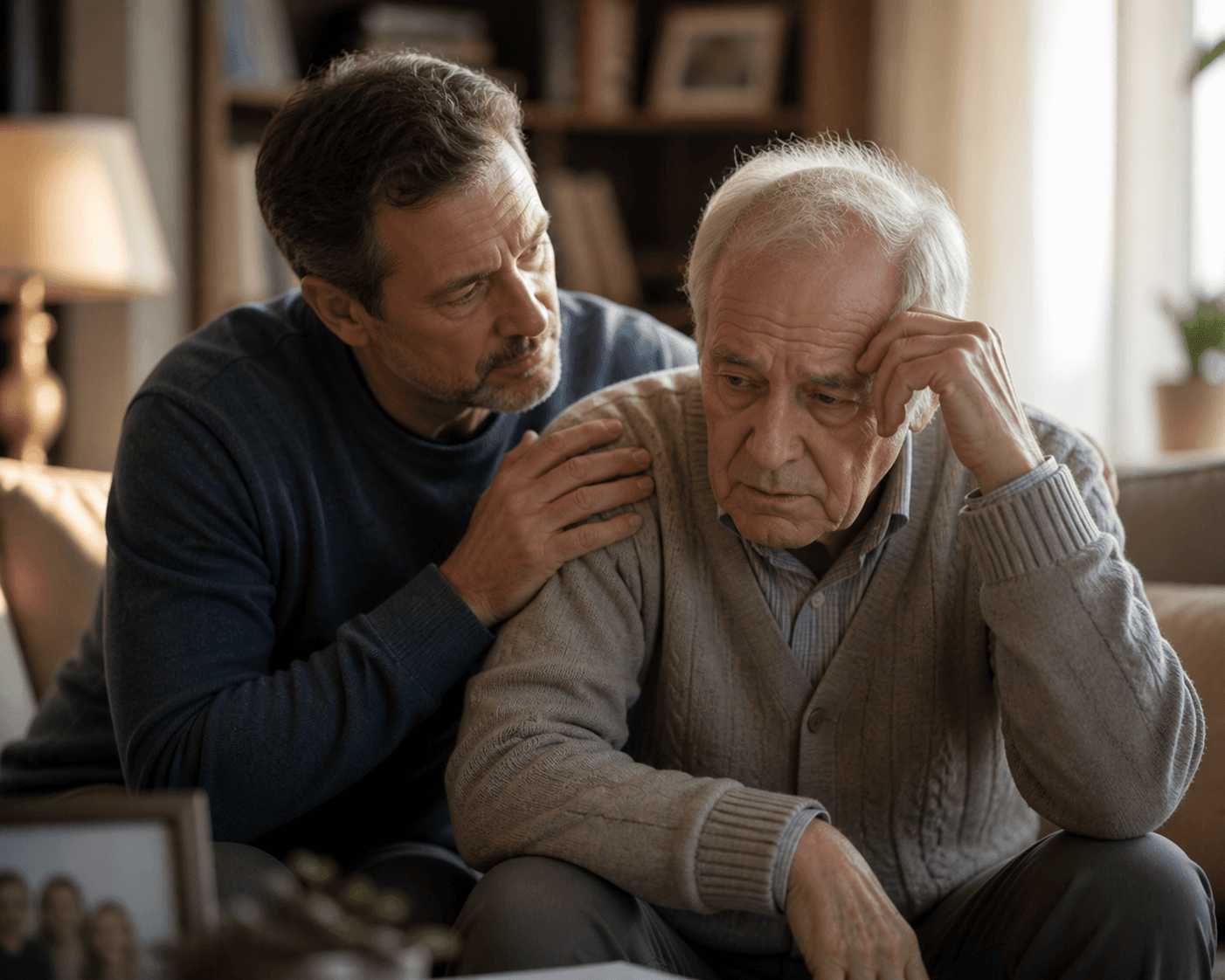
Father's Day With a Dad Who Has Dementia: 9 Gentle Ideas That Actually Work
Practical, gentle ideas for celebrating Father's Day when your dad has dementia — what works in memory care, what to record while you still can, and what to do when he doesn't recognize you.
The Memory Murals Team • May 2, 2026