
Your First Mother's Day Without Her
Nobody tells you about the ads. The pastel-colored avalanche of 'Treat Mom to brunch!' and 'She deserves the world!' that starts hitting your phone in April. Here's what actually helps when Mother's Day arrives and she's not here.
The Memory Murals Team • April 16, 2026
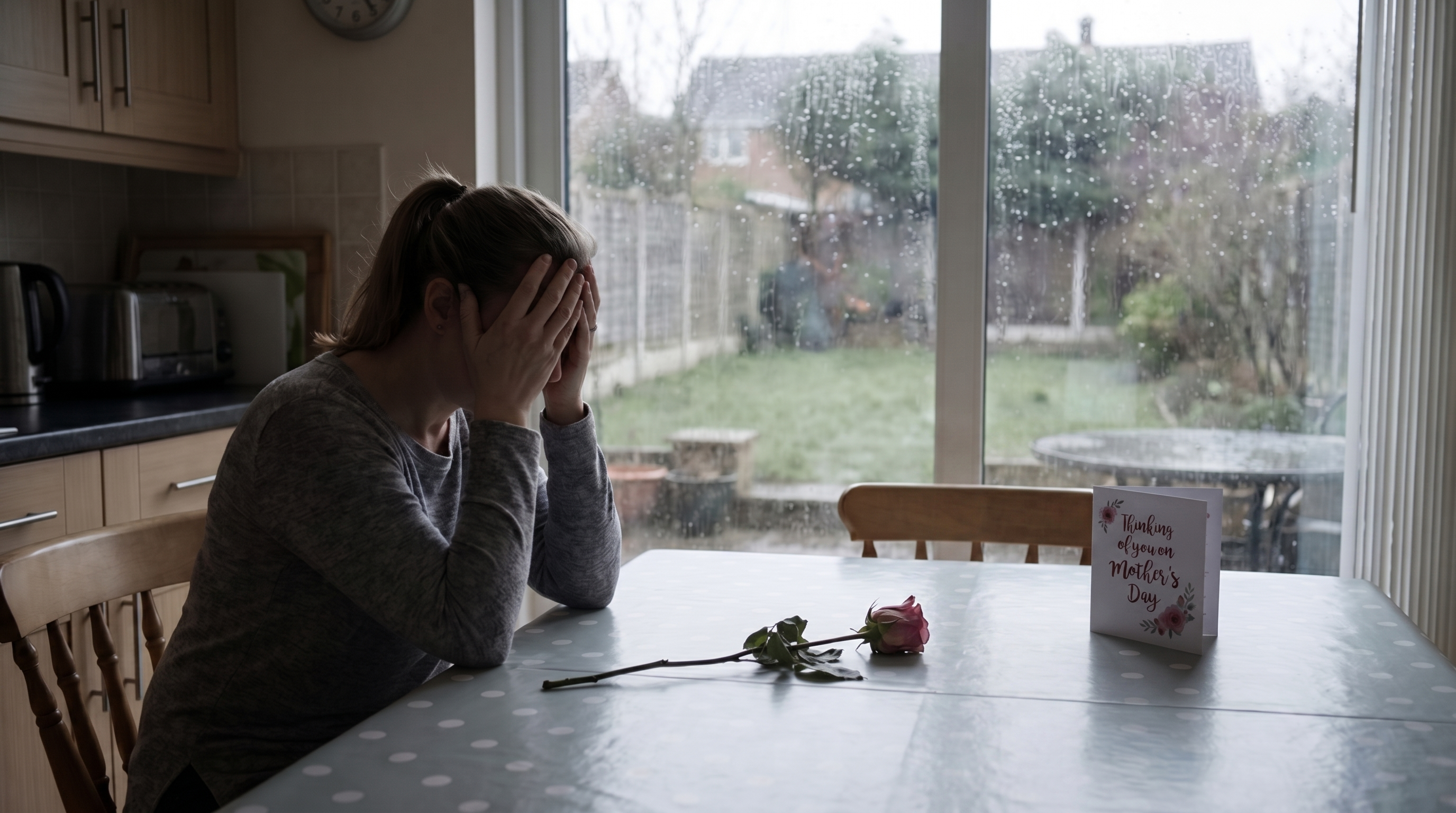
Nobody tells you about the ads.
The pastel-colored avalanche that starts somewhere around the second week of April. "Treat Mom to brunch!" "She deserves the world!" "Don't forget to tell her you love her!"
Every email. Every Instagram story. Every checkout counter with the card display right there at eye level.
And you're standing in the middle of it thinking — I would give anything to buy her one more stupid card.
If this is your first Mother's Day without your mom, I need you to know something before we go any further: there is no right way to do this. There is no five-step grief plan that makes this Sunday feel okay. Anyone who tells you otherwise is selling something.
But there are a few things that people who've been through it wish someone had told them. That's all this is.
What actually helps
There's no right way to spend your first Mother's Day without your mom, and no five-step plan that makes it hurt less. What helps most people: let yourself feel whatever comes without performing grief or joy, do one small thing to honor her — cook her recipe, visit a place she loved, write her a letter — and spend the day with people who knew her rather than alone.
It's Going to Be Weird. Let It Be Weird.
The thing about grief on a holiday is that it doesn't show up the way you expect.
You might be totally fine at breakfast. You might lose it in the car when a song comes on. You might feel guilty for laughing at something your kid said, because how are you laughing right now? Or you might feel nothing at all, and then feel guilty about that.
All of it is normal. Every bit.
The first Mother's Day without her isn't about healing or closure or any of those words people throw around. It's about surviving a day that the entire world has decided is about the person you just lost. That's a specific kind of hard that doesn't get talked about enough.
So here's my only rule: whatever you feel, let it happen. Don't perform grief. Don't perform joy. Just... be in it.
A note if you're supporting someone
If someone you love is going through their first Mother's Day without their mom, the best thing you can do is acknowledge it. Not fix it. Not say "she's in a better place." Just say: "I know this day is hard. I'm thinking about you." That's it. That's enough.
Write Her a Letter
Not a social media post. Not a caption. A real letter, on paper or in your notes app at 2 AM — whatever feels right.
Tell her about the thing that happened at work. Tell her about the argument you had with your brother. Tell her you burned the rice again and you can hear her laughing about it.
You're not sending it anywhere. That's not the point. The point is that the conversation doesn't have to end just because she's gone. Some people write one letter and put it away. Some people write one every year. There's no wrong version of this.
Cook the Thing She Always Made
You know the one. The recipe that never had a recipe because she just knew. The one where "a pinch" meant half the jar and "cook until it looks right" was the only instruction you ever got.
It won't taste the same. That's okay. The kitchen will smell like her house for an hour, and that hour is worth the entire day.
If you don't have her recipe — if it died with her because nobody thought to write it down — that's one of those quiet losses that hits harder than people realize. Maybe this is the year you call your aunt or your grandma and try to piece it together. The conversation alone might be the best part.
Visit a Place That Was Yours
Not the cemetery, necessarily. Although if that's your place, go.
I mean the place that was yours. The restaurant where you always sat in the same booth. The park where she walked the dog. The store she dragged you to every Saturday morning when you were twelve and hated every second of it and would give anything to go back.
You don't have to do anything when you get there. Just sit with it for a minute.
Share a Memory With Someone Who Loved Her Too
Grief can be incredibly isolating. You're carrying this weight and everyone around you seems to have moved on, and you feel like you're the only person in the world who still picks up the phone to call her before remembering.
But you're not the only one. Your dad is doing it too. Your sister. Her best friend. The neighbor she talked to every morning.
Pick up the phone. Say "I've been thinking about Mom today." And then let the stories come. You'll hear ones you've never heard. You'll remember ones you thought you forgot. And for a few minutes, she'll be right there in the room with you. There's real science behind why hearing a loved one's voice can bring them back so vividly.
47%
Regret Not Recording
of Americans regret not recording or documenting a conversation with a loved one who has since died
In a 2022 YouGov survey of 6,090 U.S. adults, 47% said they regret not recording or documenting a conversation with a loved one who has since died.
Start Something New in Her Name
A few people I know have turned Mother's Day into something different. Not a replacement — a redirect.
One woman plants a new flower in her garden every year. "Mom's garden," her kids call it. Someone else donates to the local library because that's where her mom took her every Thursday. Another family does breakfast at the diner her mom loved — same booth, same terrible coffee, same argument about who's paying.
The tradition doesn't have to be profound. It just has to be hers.
Record What You Still Remember
This one's harder to talk about because it feels urgent in a way the others don't.
Here's the thing nobody warns you about: you start forgetting. Not all at once. Not the big things — not yet. But the small stuff. The way she answered the phone. The phrase she always used when she was annoyed. The sound of her laugh, specifically. Not laughing in general. Her laugh.
It fades. Slowly, then all at once. Research confirms that every unrecorded day is a permanent loss when it comes to family memories.
If there are stories you still carry — things she told you, things you watched her do, the way she was with your kids — write them down. Record a voice memo. Put them somewhere your family can find them in twenty years.
This isn't an ad. This is the thing I wish someone had told me to do when I still remembered everything clearly. By the time you realize the details are slipping, some of them are already gone.
One way to hold onto it
Memory Murals was built for exactly this — a private place to record stories, save voices, and keep the details that matter before they fade. It's free to start, and nobody sees it but your family. If that's helpful, it's there. If not, a notebook works too. The format doesn't matter. Doing it does.
Give Yourself Permission to Skip It
I mean it. You are allowed to turn off your phone, close the curtains, watch bad movies, and pretend it's a Tuesday. You are allowed to tell people you don't want to talk about it. You are allowed to unfollow every brand account that's flooding your feed with pink hearts.
Mother's Day is a Hallmark holiday. Your grief is not obligated to perform on its schedule.
If this year you need to just get through it, that is enough. Getting through it is honoring her. Because she would want you to be okay more than she would want you to be sad on a specific Sunday in May.
It Doesn't End on Monday
The ads will stop. The brunch specials will go away. People will stop asking how you're doing.
And Tuesday morning will be quiet, and the missing will still be there, and that's the part that nobody talks about — it's not just one day. It's all the days. The random Wednesday when you smell her perfume on a stranger. The Thursday when your kid says something and you think Mom would have loved that. The Friday night when you reach for the phone.
The grief doesn't have a schedule. So the honoring doesn't have to either. If you're looking for a way to start, here are questions to ask your mom before it's too late — many of which can also be answered by siblings, aunts, or friends who knew her best.
If you want to keep her alive in the everyday — not just on holidays — that's what this is really about. Not Mother's Day. Not a single brunch or a single card or a single Instagram post with a throwback photo.
It's the Tuesday stuff. The small, invisible, constant act of carrying someone with you after they're gone.
You already know how to do that. You've been doing it since the day she left.
For the People Around You
If you landed here because someone you love is facing their first Mother's Day without their mom, here's what actually helps — and what doesn't.
What doesn't help:
- "She's in a better place"
- "At least she's not suffering"
- "You need to stay strong"
- "I know how you feel" (unless you've actually lost your mom)
- Changing the subject when she comes up
What actually helps:
- "I've been thinking about your mom today"
- "Want to tell me a story about her?"
- Saying her name. Just using her actual name in conversation.
- Showing up without being asked
- Checking in on the random Tuesday three weeks later when everyone else has stopped
The best thing you can do is make space for the person to talk about their mom without it being awkward. Grief gets lonely when everyone tiptoes around it.
If you're past Sunday and ready for the longer arc — pulling voicemails off the carrier, gathering recordings, building one place where her stories can live — our hub for grieving families is the practical companion to this piece.
What's Coming Next on the Grief Calendar
Mother's Day is one specific hard day, but it isn't the only one in the first year. The calendar is built like a series of small ambushes, each with its own shape. Knowing which is coming next is part of how you brace for it — and part of how you make small plans in advance instead of running into the day flat-footed.
The companion pieces below cover the other firsts most grievers report being hit hardest by, with the same approach: specific rituals, honest tone, what actually helps and what to avoid.
- The first Father's Day without him — for the other parent, or for anyone whose dad is gone. Different cultural script, different ambushes, same shape of grief. Read the first Father's Day piece →
- The first Christmas without your mom — December has its own specific cruelty because the whole calendar has been engineered to remind you of her for six straight weeks. Twelve quiet rituals for getting through it. Read the first Christmas piece →
- The first birthday without your parent — yours, or theirs. Two different days, both brutal, slightly different shapes. Nine ways to mark it without breaking down. Read the first birthday piece →
- The first anniversary of a parent's death — the strangest day on the grief calendar, with almost no cultural script. What helps, what to avoid, and why the run-up is often worse than the day. Read the first anniversary piece →
Each of these is its own animal. Pick the one that's coming next on your calendar and read that one. You don't have to brace for all of them today.
If you're reading this because Sunday is coming and you're dreading it — I'm sorry. I'm sorry the ads won't stop, and the world won't slow down, and the card aisle at CVS feels like a minefield right now.
But you're going to get through it. Not gracefully, probably. Not without crying in a parking lot, maybe. But you'll get through it. And she'd be proud of you for that.
She was always proud of you.
Get 50 questions to ask your parents — before the stories are gone
The exact prompts families use to draw out the stories nobody ever wrote down. Free, straight to your inbox.
No spam. Unsubscribe anytime.
Related Stories

Lists & Roundups
25 Questions to Ask Your Mom Before It's Too Late (And Why Each One Matters)
Most of us think we know our mothers. But between the school pickups and the phone calls, there's an entire life you've never asked about. These 25 questions will change that.
Patrick Moore • March 31, 2026

Insights
The Sound of Home: Why a Loved One's Voice is the Ultimate Time Machine
We obsess over HD video but overlook our most powerful connection: the human voice. Here's why recording your family's voices might be the most important thing you ever do.
Patrick Moore • January 20, 2026

Insights
First Christmas Without Your Mom: 12 Quiet Rituals to Get Through the Day
The first Christmas without your mom is a particular kind of hard the rest of the year doesn't prepare you for. Twelve quiet rituals — not platitudes — for surviving the day she's not here.
The Memory Murals Team • May 14, 2026
Keep what's left of their voice.
A private place for the recordings, photos and stories — no feed, no algorithm, nobody else's eyes on it.