
The Father's Day Gift for the Dad Who Has Everything
Dad doesn't want another grilling tool. He doesn't want a tie. The one thing he won't ever buy himself — and won't admit he wants — is the only Father's Day gift that actually lasts: an hour of his own voice, recorded before he can't give it anymore.
Patrick Moore, Founder • April 21, 2026

My dad's Father's Day gifts have followed the same arc for thirty years.
Tie. Mug. Tool he didn't need. Grilling spatula he already had two of. A book about a war he doesn't read books about. One year, in what I still think of as a low point, a battery-powered jar opener. He smiled. He hugged me. He put it in the drawer where small disappointments go to die.
I'm not telling you this because my dad is hard to shop for. I'm telling you this because every dad is hard to shop for, and the reason isn't that they don't want anything. It's that the thing they actually want — the only one that would mean anything — isn't sold in stores.
It's an hour of their own voice. Recorded. Saved. Listened to by their kids and grandkids in 2055, when nothing else from this Father's Day exists anymore.
Dads don't ask for this gift because asking would feel weird. They wouldn't even know how to phrase it. So we keep buying jar openers. Meanwhile the actual gift — the one he'd treasure if he saw it twenty years later — sits there unwrapped because nobody thought to give it.
This post is about how to give it this June.
The whole post in one line
The best Father's Day gift for a dad who has everything isn't a thing. It's an hour of him talking, recorded, saved somewhere it'll survive thirty years. You hand him a list of questions, you hit record, you ask, he talks. That's the gift. Total cost: a Sunday afternoon and the willingness to actually press the button.
The reason gift guides fail with dads
Most Father's Day gift guides start from the wrong premise. They assume dads want stuff — better stuff, smarter stuff, more personalized stuff — and the entire shopping problem is finding the right item.
That's not the problem. The problem is that dads, as a category, are weirdly resistant to receiving things. They will tell you they don't need anything. They will mean it. Then they'll get something anyway, and the gift will go in a drawer, and everyone will pretend the drawer was the goal.
Why? Because the dads of 2026 — boomer dads, Gen X dads, even a lot of millennial dads — were raised in a culture where men weren't supposed to want gifts. They were supposed to give gifts. Receiving feels exposing. Receiving something nice feels actively uncomfortable.
But there's one thing dads will accept without flinching: attention. Specifically, attention paid to them as a person rather than them as a role.
Most dads
Rarely asked
say their adult kids don't really know much about their pre-fatherhood life — and most have never been asked
Almost none
Recorded
Most adults have no audio of their father's voice answering real questions about his life
Short
The Father's Day call
runs out fast — most never get past 'how's the weather'
That last one is the killer. The Father's Day phone call is famously short. Not because nobody cares — because nobody knows what to say. We've trained ourselves to keep dad-conversations transactional. Sports, weather, work, kids, repeat. There's no script for "tell me what your father was like."
A recorded interview isn't a gift in the gadget sense. It's a permission slip. You're handing him a structured reason to talk about himself for an hour without it feeling like he's hijacking the conversation. Dads will accept that. They will, in fact, love that. They just need someone to set it up.
The gifts that look meaningful but aren't
Before we get to what works, let's be honest about what doesn't. The "meaningful Father's Day gift" SERP is full of options that sound great on paper and fail in practice.
What sounds meaningful but usually isn't
The framed photo collage. The "World's Best Dad" mug version 47. The personalized whiskey decanter. The custom golf balls. The leather wallet with his initials. The "Reasons I Love You" jar with 365 little notes. These all signal meaningfulness — they're personalized, they're thoughtful, they took effort to source. But six months from now they're objects in a house full of objects. They don't change anything about how he's known.
What's actually meaningful (and almost never given)
A recording of him telling the story of how he met your mom. His voice describing his father. The five-minute version of why he picked his career, what he almost did instead, what he'd do differently. These are the gifts that get more valuable every year. They're also the gifts that, if he's gone in 2042, become the single most precious file your family owns. No mug appreciates like that.
The "experiences over things" framing has been hammered into Father's Day gift guides for a decade now. Take him to a ballgame. Plan a fishing trip. Book the chef's table. Those are real upgrades over the mug. But experiences are still on a decay curve — the day ends, the memory fades, and ten years later you remember you went to the game but not what either of you said during it.
A recorded conversation is the only Father's Day gift that gains value with time. Year one it's nice. Year ten it's irreplaceable. Year twenty it's the thing your kids fight over.
Be fair to the gift-guide list
None of those traditional gifts are wrong. A nice tie, a fishing trip, a card he'll actually keep — all great. The argument here isn't to skip them. It's to add the recording on top. The whole ritual takes an hour. It pairs with everything else. You can hand him the gift, take him out for the experience, and record the conversation while you're at it. The cost of adding it is functionally zero. The upside is permanent.
What the actual gift looks like
Here's the format. There's nothing fancy about it. The whole thing is built to be doable by someone who has never recorded anything intentional in their life.
Step 1: A printed card with the questions on it
Pick 8-10 questions in advance. Print them on a single sheet of paper or write them in a card. Hand it to him at the start of the visit. Title it something specific like "Questions for Dad — June 2026" so it feels like a gift, not a to-do list. The card itself becomes part of the gift; he'll keep it.
Step 2: An hour of recorded conversation
Phone on the table, voice memo running. Tell him you want to save his voice answering these, not just your memory of him answering. Walk through the questions. Don't skip the silences — they're where the real answers live. When you're done, save the file in two places.
That's the gift. The card is the wrapping. The hour is the present. The file is the heirloom.
The reason this works on dads in particular is that it solves the "I don't want to be a burden" problem. He's not being asked to perform. He's not being asked to be sentimental on demand. He's being asked specific questions, one at a time, that he can answer at his own pace. It feels like a conversation. It is a conversation. It just happens to be a conversation that exists forever afterward.
What to actually ask
The mistake most people make is asking dad questions that are too big. "Tell me about your life" is paralyzing. Nobody answers that. The questions that work are specific enough to spark a real memory, open enough to let him wander.
We have a full list of 50 questions to ask your dad before it's too late that's worth reading in full. For a Father's Day gift specifically — where you have one hour, not a lifetime — you want a tighter set. Eight to ten, picked across categories so the conversation has shape.
Here's a Father's Day starter set that works on almost any dad.
The eight that work
- "Who was your father, really?" — not what he did. Who he was. Most dads have never been asked this directly and the answer is usually the most honest thing he'll say all day. If this is the one question you'd most want a real answer to, the eight questions to ask dad about his dad this Sunday is the whole gift wrapped around that single thread.
- "What were you like at twenty-five?" — bypasses the dad-version-of-himself and gets to the human version. The answers are wilder than you'd expect.
- "What's a moment from your twenties or thirties you still think about?" — the deflection-then-real-answer pattern hits hard here. Wait through the silence.
- "How did you actually decide to do the work you did?" — most dads have a sanitized origin story for their career. The unsanitized one is more interesting.
- "What were you scared of when you became a father?" — the only acceptable form of "tell me about your feelings" question. He'll answer it.
- "What's something you wish your father had told you?" — gets you the inheritance of advice he's been carrying his whole life without saying out loud.
- "What's a story about me as a kid you've never told me?" — turns the lens around. Suddenly he's giving you a memory you didn't have.
- "If you could leave a one-minute message for your great-grandkids, what would you want them to know about you?" — the closer. Save this for the end. Whatever he says becomes the most playable, most replayed, most powerful part of the file.
That last question is the one. It's the one that, when his great-grandchild plays it for the first time in 2068, is going to make a room of people he never met cry.
The card trick
Print the questions. Hand him the printed copy at the same time you hand him a cup of coffee. Give him five minutes to read it before you start recording. Dads do better with prep. They don't like being ambushed by the question "tell me about your father" — they do well with that question if they've had three minutes to think about it. Letting him see the questions in advance isn't cheating. It's the difference between a usable answer and a stammering one.
How to actually pull this off
The execution is where most well-intentioned plans fall apart. Let's make it concrete.
The Father's Day audio-interview gift — start to finish
Two weeks before: pick your tool
You need exactly one thing — a place to record audio and keep it for thirty years. Your phone's voice memo app technically works, but only if you commit to moving the file off the phone immediately and labeling it. Phones get lost. Voice Memos folders become graveyards. Memory Murals was built specifically for this — private, voice-first, designed to outlast the device. So were a couple of others. The tool matters less than the fact that you've picked one before Sunday morning.
One week before: pick the questions and print the card
Use the eight above, or borrow from how to record your grandparents' stories for a different angle. Print them on a single sheet of nice paper. Title the page. Sign it. This becomes part of the physical gift — the questions in his hand, the conversation in your archive.
Father's Day morning: tell him the plan early
Don't surprise him at minute fifty-eight of a visit with "hey can we do an interview." Mention it when you arrive. "I want to record you answering some questions today as part of your gift. Not for social media. Not for anyone but our family. Just so we have your voice on these." He'll say yes. He may say "what kind of questions?" Hand him the card.
After the meal: hit record
The natural window is post-meal, pre-dessert. The conversation has slowed. Phones come out anyway. Put yours flat on the table, voice memo running, and start with question one. Don't read every question robotically — let him answer, let it breathe, ask follow-ups. The card is a guide, not a script.
Sunday night: save it twice, label it forever
One copy in your archive. One copy somewhere else (email it to yourself, AirDrop to a laptop, upload to a shared family folder). Label it with the date and his name — "Dad — Father's Day 2026 — life questions" — so future-you can find it without scrubbing through six hundred audio files. Same logic as saving a deceased loved one's voicemail — a file in one place isn't preserved, it's just waiting to be lost.
Next April: put a calendar reminder for 2027-06-13
Two weeks before next Father's Day. New questions. The annual version of this is what turns a one-time recording into a multi-decade archive. Five years in, you have an irreplaceable record. Twenty years in, you have the only real autobiography he'll ever leave.
Six steps. Most of the work is in steps 1 and 2 — picking a tool and printing a card. The actual recording is the easy part. It always is.
The long-distance version
Not everyone gets to be in the same room with their dad on Father's Day. The audio-interview gift still works — sometimes better.
Option A: Record over a phone or video call
Most phones can record both sides of a call with built-in tools or a free third-party app. Mac users can use QuickTime to record a FaceTime audio session. Whatever you use, tell him you're recording. Don't surprise him. The recording doesn't need to be studio quality — it needs to capture his voice. Fifteen years from now, the slight phone-line warble is going to sound like home.
Option B: Send him a recording prompt and have him send it back
Mail the question card a week before. Ask him to record himself answering one question a day for a week using his phone's voice memo app. Tell him not to edit. Tell him to be casual. Have him AirDrop or email the files back. This is harder logistically but produces something that genuinely sounds like him alone, not him being interviewed — which has its own kind of intimacy.
The video-call version is easier. The send-and-return version is more powerful. Both beat the call where you talk about the weather for nine minutes.
The archive question (and why a camera roll isn't an answer)
You did the hard part. You have the recording. Now you have to actually keep it.
This is where most people lose the plot. They record an hour of their dad's voice, save it to their phone, mean to "do something with it later," and then their phone breaks in 2029 and the file is gone. Or it's "saved" in a Voice Memos folder with eighty other unlabeled files, none of which they can find when they actually want to play one.
A real archive does three things a phone can't:
Labels that survive
Date, person, one-line description. Not "Voice Memo 247." Something like "Dad — Father's Day 2026 — childhood and career." Future-you needs to find this file in 2046 without having any of the context you have right now.
Durability across devices
Not tied to one phone, one cloud account, one app. Your dad's voice should survive the next four phones you own and the next two cloud services that get acquired and renamed.
Family access without your password
Your sister, your kids, his grandkids — they should all be able to play these recordings without going through you. The whole point is that they outlive you having the password.
We built Memory Murals around exactly this problem — private by default, audio-first, designed to be navigable by people who didn't make the recording. But the platform isn't the point. The point is that you pick something before Sunday so the file has somewhere to live the moment you stop recording. Not a Voice Memos folder. Not a text thread. Somewhere intentional.
The worst outcome isn't picking the wrong tool. It's the one we see constantly: someone records a beautiful interview with their dad, saves it to their phone, and discovers two years later that half their voice memos are gone after a forced iCloud cleanup. The recording was made. The recording was lost. There is no second chance for that conversation.
Why this matters more than the gift guides admit
Here's the thing nobody quite says out loud in the Father's Day content factory.
You don't have unlimited Father's Days left. Even if your dad is in great health. Even if he's only sixty. Statistically, the number of Father's Days remaining is a small two-digit number, and that's the optimistic case. Twenty more good ones is a lot. Thirty more is rare.
Each one of those is a chance to add to an archive, or to not. The flowers and the ties and the mugs are zero-impact additions to a life-long pile of nice gestures. The recording is a permanent change to what your family will have when he's gone.
I'm not trying to be morbid about this. I'm being practical. The whole point of the audio-interview gift is that it works equally well as a celebration and as a hedge. If your dad lives to ninety-five, you'll have thirty years of annual recordings — an absurd, precious archive. If something happens next year, you'll have one priceless hour you wouldn't otherwise have had.
There's no version of this gift you regret giving. There are only versions of not giving it that you'll regret later.
Honest verdict
For the dad who has everything, get him the thing nobody is selling: an hour of structured attention, recorded, saved somewhere it'll outlast both of you. Wrap it in a printed card with the questions. Pair it with whatever traditional gift you were already planning. The cost is zero. The upside is permanent. There is genuinely no other Father's Day gift that does this.
What he'll actually remember
Years from now, after every other gift you've ever given him is gone, the thing your dad will remember about Father's Day 2026 isn't going to be the present. It's going to be the conversation.
He'll remember that you asked. He'll remember that you wanted to know. He'll remember that for one hour on a Sunday in June, somebody pointed a microphone at him and let him talk about being a person — not a dad, not a husband, not an employee, not a "the man who taught me" — just a guy who lived a specific life and had specific reasons for everything.
That's the gift. Not the recording itself. The fact that you wanted it.
The file is just the part that lasts. The asking is the part that means something to him now.
So buy the card. Make the brunch reservation. Get him the thing you were going to get him anyway. But also — and this is the only thing on this list that actually matters — print eight questions, hand him a card, put your phone on the table, and let him talk for an hour.
One last thing, because we get asked this a lot: what if my dad just won't talk? Most dads, sat down at a kitchen table with a list of questions, won't. That's normal — and the fix isn't more questions, it's a different setup. We wrote a separate piece on how to interview your dad even if he's not a talker — covering why dads deflect at the table, why audio in the truck works when sit-downs don't, and 30 starter questions ranked by how easily he'll actually answer them. If the printed-card-at-the-table version of this gift feels too formal for your particular dad, read that one first.
And if you're reading this on the Wednesday before Father's Day with no time left to plan? Skip ahead to the last-minute version of this gift. Same idea, 30 minutes start to finish, no shipping involved — better than anything you could have ordered six weeks ago anyway.
In thirty years, when none of the rest of this is left, you will be very, very glad you did.
Ready to give the gift this June? Try Memory Murals free → — private family archive, built for voice, designed to hold the thirty-year version of these recordings. No credit card required. No feed. No ads. Just a place built to still be there when he isn't.
Get 50 questions to ask your parents — before the stories are gone
The exact prompts families use to draw out the stories nobody ever wrote down. Free, straight to your inbox.
No spam. Unsubscribe anytime.
Frequently asked questions
What is the best Father's Day gift for a dad who has everything?
An hour of recorded conversation. The shopping-aisle gift category is saturated and most of what's there is forgettable; the one thing your dad doesn't already have is an audio archive of his own life, in his own voice, told to one of his kids. Hand him a printed card of eight questions, put a phone on the table to record, and let him talk. The recording outlasts the gift, the gifter, and the giftee — there's no other category of Father's Day present that does that.
How do you give a meaningful Father's Day gift on a budget?
The most meaningful Father's Day gifts cost almost nothing because the value isn't in the object. Print a list of questions about his life, sit with him for an hour, and record the conversation on your phone. The total dollar cost is the price of paper. The total emotional weight is permanent. The category of gift everyone remembers is structured attention, not stuff — and structured attention is free if you're willing to ask for it.
What can I record with my dad on Father's Day?
Pick eight to ten specific questions across categories: childhood, work, regrets, advice, what he wants the grandkids to know. Avoid open-ended autobiography prompts ("tell me your life story") — they freeze most dads. Specific is better: "What was your first car?" or "Who taught you to drive a stick?" The first answer is rarely the point — the answer-after-the-answer is. Plan for an hour; you'll usually get 45 minutes of usable audio plus 15 minutes of warm-up.
What if my dad won't talk during a Father's Day recording?
Most dads sit down at a kitchen table with a list of questions and freeze. That's normal. The fix isn't more questions; it's a different setup. Try recording in the truck while you drive somewhere, in the garage while he's working on something, on a walk. Dads talk sideways while doing — they don't talk frontally on demand. Audio works better than video for this exact reason: a microphone is much less performative than a lens.
Where should I store the Father's Day recording so it lasts?
Save in three places: the device, the cloud, and somewhere outside your daily life (a private family archive, an external drive, a relative's email). A Voice Memo on the phone you use every day is one accidental cleanup away from gone. Label the file with the date and his name — "Dad — Father's Day 2026" — so future you can find it without scrubbing through six hundred audio files. Most lost recordings aren't lost on Day 1; they're lost in Year 2 during a phone migration.
About the author
Patrick Moore, Founder of Memory Murals
Patrick Moore is the founder of Memory Murals. He built it after realizing how much of his own family's history had quietly slipped away — to help families preserve their stories, voices, and photos while they still can.
Related Stories

Lists & Roundups
50 Questions to Ask Your Dad Before It's Too Late (And Why Each One Matters)
He taught you to ride a bike and pretended the burnt pancakes were fine. But do you know what scared him? What he almost did differently? What he wishes he'd said? These 50 questions unlock the man behind 'Dad.'
Patrick Moore • April 18, 2026
How-To Guides
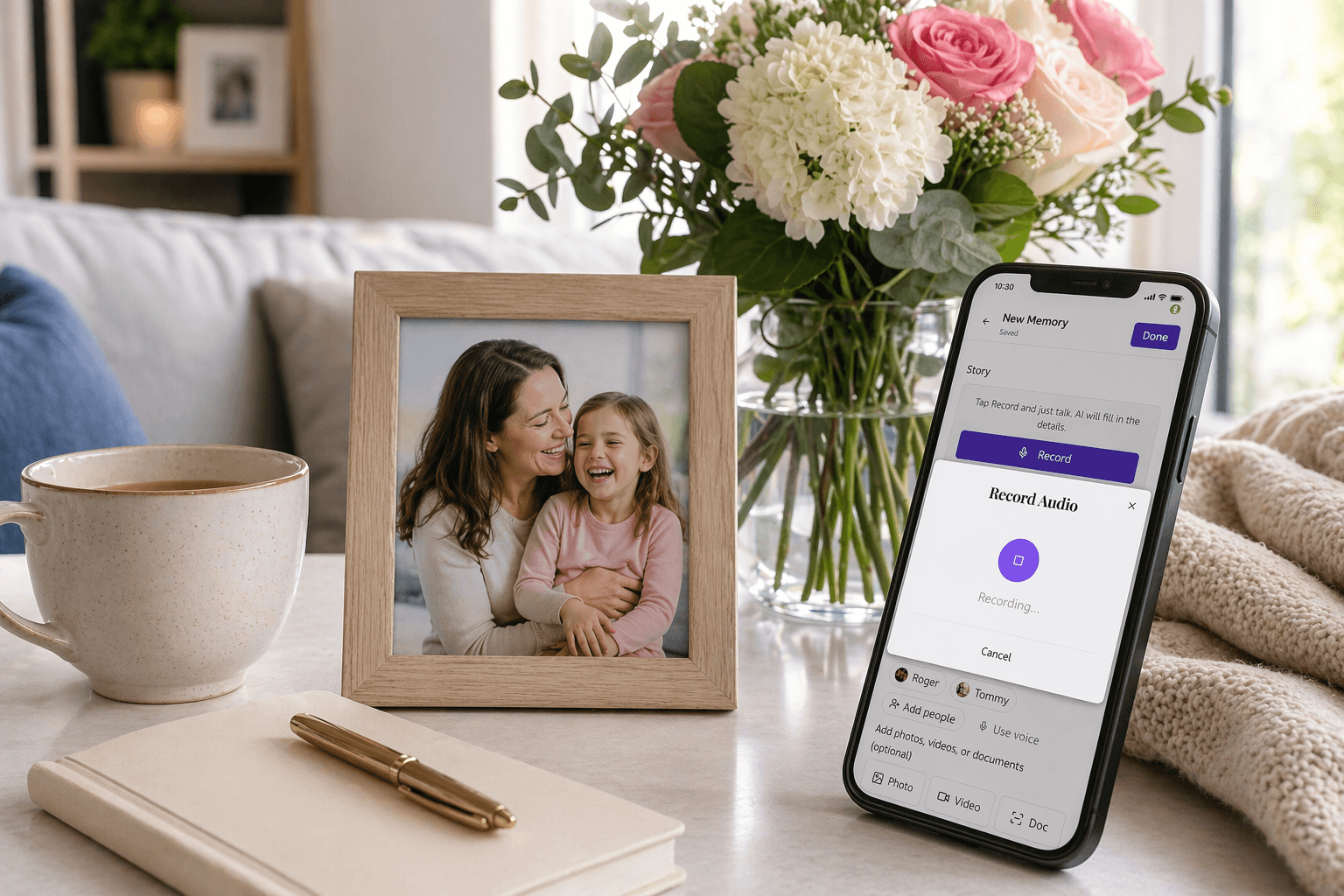
The Mother's Day Memory Ritual: A 30-Minute Annual Tradition That Outlasts Every Other Gift
Flowers wilt by Tuesday. Brunch is forgotten by the next weekend. But a 30-minute recording of your mom's voice, saved every Mother's Day for the rest of her life, becomes the only family heirloom that gets more valuable with time.
Patrick Moore • April 2, 2026
How-To Guides
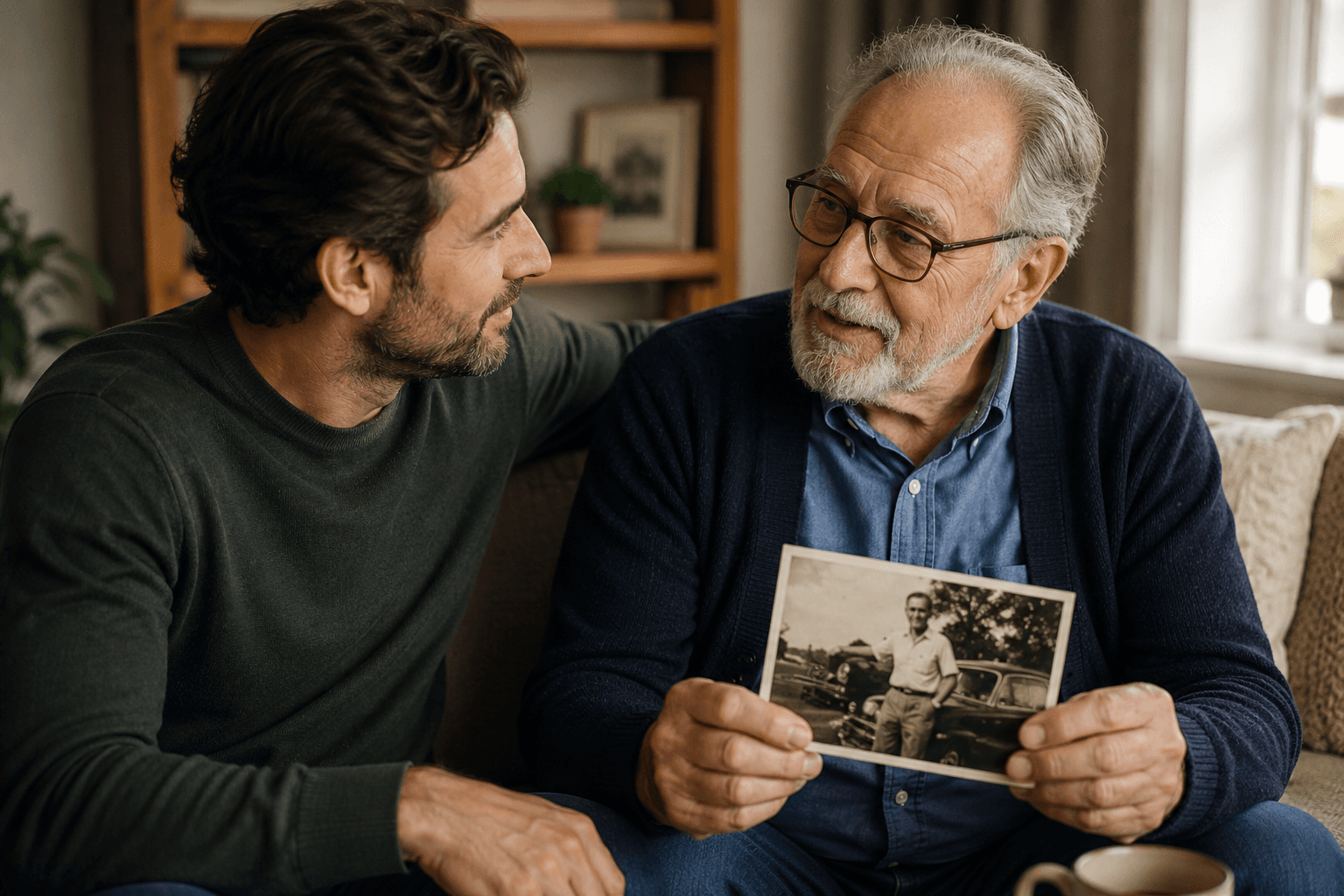
Your Dad Is the Last Person Who Remembers Your Grandfather. Ask Him This Sunday.
Most Father's Day posts ask you to record your dad. This one asks something different: spend Sunday asking him about his father. He is, for most of us, the last living person who really knew the man your kids will only ever see in a frame. When he goes, the only stories left of your grandfather go with him.
Patrick Moore • May 15, 2026
Preserve your family's memories in one private place.
Start free in minutes. No credit card required.