Baby Names That Honor a Grandparent
You want to honor a grandparent in your baby's name — but you don't want a tiny Mildred or a junior. Here are the gentle, modern ways families do it well.
Patrick Moore, Founder • May 14, 2026
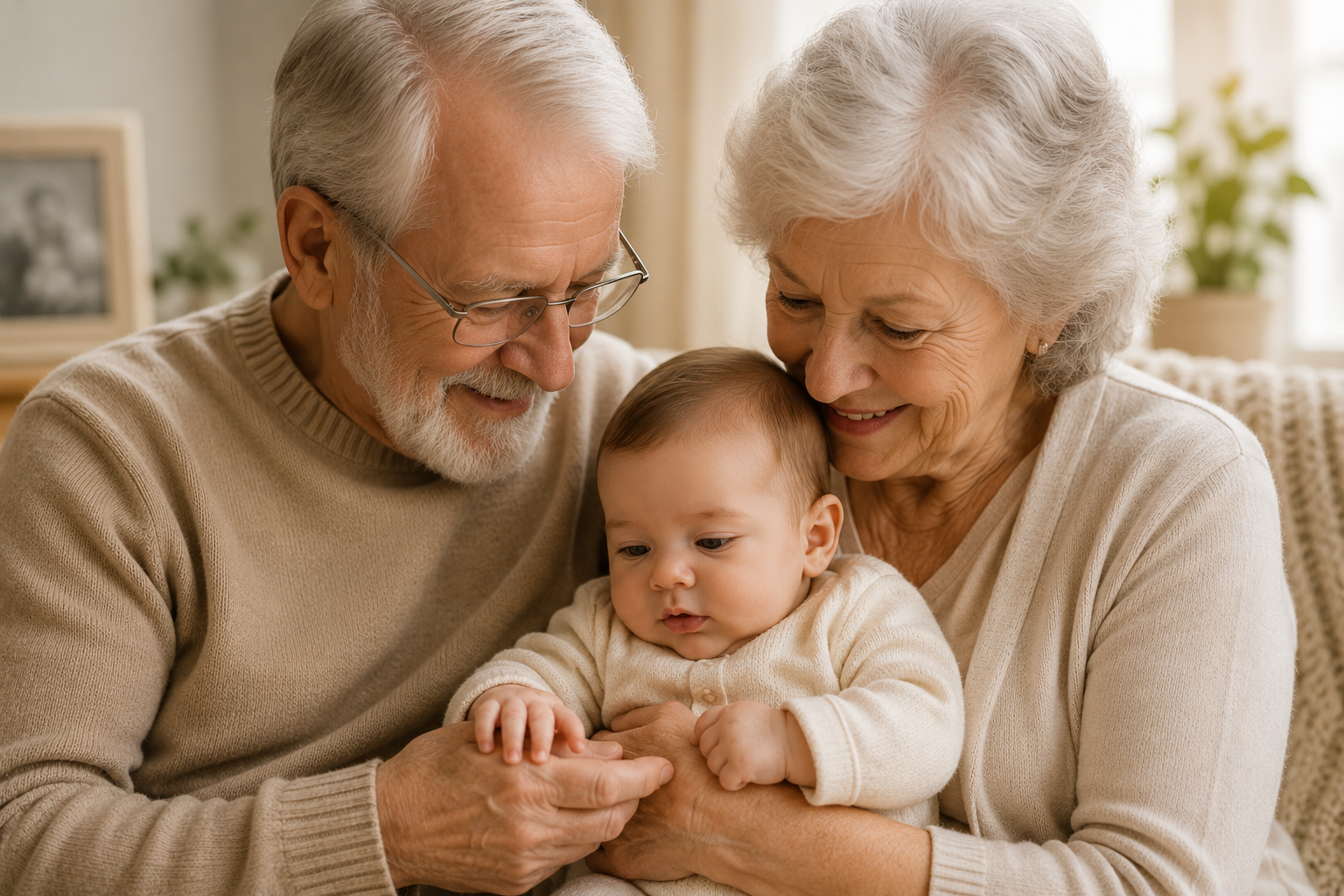
You want to name your baby after your grandmother. You also do not want to name your baby Mildred.
That's the quiet conflict almost every honoring-a-grandparent conversation hits. The love is there. The wish to carry the name forward is there. But "Gertrude Jane" on a 2026 birth certificate is a lot to hand a kid before they can even hold their own head up.
The good news: there are at least a dozen ways to honor a grandparent in a baby's name that don't involve a 1920s revival. Most families do this without realizing there's a whole tradition of near-namesake naming — borrowing the sound, the meaning, the initial, the era, or the legacy — without the full name itself. Here's how to think about it, plus dozens of working examples.
If you want a fast tool while you read, our Baby Name Generator lets you filter by initial, meaning, and origin — exactly the levers you'll want when you're triangulating a grandparent's name into something usable today.
The short answer
You can honor a grandparent without using their exact name by borrowing one element of it — the initial, the sound, the meaning, the saint's name, or the maiden name. The honoring is in the intention, not the letter-for-letter match. Tell the family why you chose what you chose, and the name carries forward what you wanted it to.
The six approaches, ranked by how popular they actually are
When you talk to parents who've done this well, almost every example fits into one of six patterns. Some are obvious. Some you've probably never thought of.
1. Same initial
Your grandmother was Margaret. Your daughter is Maeve, Mira, or Marlowe. Same opening letter, totally different name. The most popular and the most forgiving approach.
2. Same meaning
Your grandfather was Robert ("bright fame"). Your son is Albert, Bertram, or Roland — different name, same root meaning. Works beautifully for kids who'll later ask why.
3. Same sound
Grandma Eleanor becomes Elena, Elle, or Nora. Same musicality, modern shape. This is where most "honoring" actually lives in 2026.
4. Middle name slot
First name is whatever feels right today. Middle name is the full grandparent name. Mildred lives, but in the quiet position. This one solves a lot of arguments.
5. Maiden name as first name
Grandma's maiden name was Sloane, Avery, Reese, or Quinn. Suddenly that's a great first name. Honors a whole lineage, not just the person.
6. The story name
Pick a name connected to something about the grandparent — their birthplace, their faith, their flower, their favorite poet. The link is the love letter.
Now let's walk through how each actually plays out, with real swap examples for the names most likely to be involved.
When you love the letter but not the era
This is the move when Grandma's name is wonderful but unmistakably from another century. You preserve the M, the J, the E. The rest gets to live in 2026.
A few that work especially well:
For a "Margaret" — Maeve, Mira, Maren, Marlowe, Margot (the same name, but it ages differently), Magnolia, Madeline, Maisie, Mae as a standalone.
For a "Dorothy" — Daisy, Della, Delphine, Dahlia, Davina, Dove. (Dorothy itself is, honestly, due for a comeback — but if you want the spirit without the full revival, the Ds carry it.)
For a "Robert" — Reid, Rhett, Reuben, Rowan, Ronan, Roman, Remy, Rhys, River.
For an "Eleanor" — Elena, Elle, Eloise (closer to the original), Ellis, Ember, Esme, Eden, Ines (the E carries, and the bones of Eleanor are in there).
For a "Henry" — Hugh, Hayes, Hudson, Hollis, Hank, Harlan. (Henry itself, by the way, has never really left — it's been a top favorite for the last decade.)
The trick: you tell your child, when they're old enough, we named you with an M because your great-grandmother was Margaret. That's the honor. The letter is the bridge.
When you love what the name means more than how it sounds
This is the elegant move. It requires a little research — knowing what the original name actually meant — but it produces names that feel rooted, not borrowed.
| Feature | Physical | Digital |
|---|---|---|
| Robert | "Bright fame" | Albert, Bertram, Roland, Rupert |
| Margaret | "Pearl" | Pearl, Daisy (the symbolic flower), Marina, Greta |
| William | "Resolute protector" | Liam, Wyatt, Owen, Edmund |
| Mary | "Beloved" or "wished-for child" | Amara, Mira, Marisol, Maeve |
| Joseph | "He will add" | Asher, Caleb, Ezra, Theo |
| Helen | "Light" or "bright one" | Lucia, Nora, Aurora, Elin |
| Richard | "Strong ruler" | Atlas, Ari, Leo, Rex |
| Catherine | "Pure" | Cora, Caia, Kira, Junia |
Robert
- Physical"Bright fame"
- DigitalAlbert, Bertram, Roland, Rupert
Margaret
- Physical"Pearl"
- DigitalPearl, Daisy (the symbolic flower), Marina, Greta
William
- Physical"Resolute protector"
- DigitalLiam, Wyatt, Owen, Edmund
Mary
- Physical"Beloved" or "wished-for child"
- DigitalAmara, Mira, Marisol, Maeve
Joseph
- Physical"He will add"
- DigitalAsher, Caleb, Ezra, Theo
Helen
- Physical"Light" or "bright one"
- DigitalLucia, Nora, Aurora, Elin
Richard
- Physical"Strong ruler"
- DigitalAtlas, Ari, Leo, Rex
Catherine
- Physical"Pure"
- DigitalCora, Caia, Kira, Junia
A name that shares meaning carries the same blessing the grandparent's name carried. That's not a small thing. When the child is twelve and asks what their name means, you tell them: the same thing your great-grandfather's did.
Maiden names: an underused gift
Here's an idea most families don't think of until someone points it out: your grandmother's maiden name might be a perfect first name for your baby in 2026.
Last names that have quietly become first names: Sloane, Avery, Reese, Quinn, Blake, Hollis, Sawyer, Mercer, Bellamy, Reeves, Whitaker, Carrington, Pierce, Sutton, Caldwell, Ellery.
If your grandmother was Margaret Sloane Whitfield, you don't have to use Margaret. You could use Sloane, or Whitfield (as a middle name), or Whit, or any of those last-names-turned-firsts that connect your child not just to one person but to a line.
This works especially well for honoring a grandparent you didn't know. The first name carries the whole family's history, not just the one face you've seen in photos.
A small piece of advice from families who've done this
If you go the maiden-name route, write down the full story somewhere your child will find it someday. Otherwise the name becomes just another sound. Make sure the why is preserved — that's where the honor actually lives. A private family archive built for exactly that kind of context — the photo, the name story, the voice recording of why you chose it — lives in one place at the end of this article.
When the family wants Mildred and you don't
The middle name is the great compromise of modern naming. It's where families have settled disputes for generations.
Your aunt wants you to name the baby after her mother. The name is something you would never put on a first-day-of-kindergarten name tag. The middle name slot lets you honor the request without saddling your kid with a daily-use name they didn't choose.
Some examples that work beautifully:
- Maeve Mildred Carter — Maeve up front, the honored name tucked inside, Carter (a family surname) bringing up the rear. The kid is Maeve at school. Mildred lives on every legal document and in every story you tell about her.
- Owen Reginald Booth — Owen sounds entirely 2026. Reginald is the gift to Grandpa. Booth might be a family name or just a strong middle.
- Lila June Dorothy — Sometimes a double middle. Lila uses the L from a great-grandmother. June from another. Dorothy from the third. Three honors in one name.
You can stack two or three middle names if your record-keeping office allows it. Many families do.
On naming a baby after someone who has died
This question carries weight. Different cultures answer it differently, and there's no universal right answer — but here are the threads worth knowing.
In Ashkenazi Jewish tradition, babies are typically named after a deceased relative, not a living one. The name passes forward as a way of keeping the person's memory present. The custom is to use the same Hebrew name or to translate the meaning into a contemporary equivalent.
In Catholic tradition, naming after a deceased relative is also common, often by using their saint name or a name connected to their patron saint.
In Greek and many Mediterranean traditions, the first son is traditionally named after the paternal grandfather, the first daughter after the paternal grandmother — alive or not.
In many Asian cultures, directly reusing a name (especially across generations) can carry different significance — sometimes considered respectful, sometimes considered ill-luck. Worth checking with your specific family tradition.
In Western secular contexts, there's no taboo and no requirement. Most families who do it find it meaningful precisely because the name keeps the person present in daily life. A few find it heavy — the constant reminder isn't always comforting.
The most useful question to ask yourself isn't should I. It's: when my child is fifteen and asks why we chose this name, will the answer feel like a gift or a burden? If it's a gift, do it. If you're not sure, the same-initial or same-meaning route gets you most of the honor with none of the weight.
The "named for" formula that solves almost everything
Here's a phrase that has saved a thousand family conversations:
"We named her Mira, for her great-grandmother Margaret."
That tiny word — for — does enormous work. It tells everyone listening that the honor is real, that the connection is intentional, and that the new name is also genuinely the new name. You're not pretending Mira is Margaret. You're saying Mira exists because Margaret did.
Some families put this on the birth announcement. Some put it on a small calligraphy card framed in the nursery. Some just say it, every time someone asks.
It's the difference between replacing a name and carrying one forward.
How to pick a name that honors well
List the elements
Write down the grandparent's full name. Underneath, list every element: the initial, the sound, the meaning, the era, the cultural root, the saint, the maiden name, the middle name. You're looking for the part you want to carry.
Pick one element, not all of them
The honor is in one clear connection, not five fuzzy ones. A name that gestures at six things gestures at none. Choose the element that feels most like the person.
Generate candidates
With the element in hand, brainstorm 8–12 modern names that share it. The Baby Name Generator linked at the top of this post handles the heavy lifting if you filter by initial, origin, or meaning.
Run the three tests
The playground test ("Can a kid yell it across a yard?"). The boardroom test ("Does it work at 35?"). The story test ("Can you explain why?"). A name that passes all three is the keeper.
Tell the family before the baby comes
If a relative is going to be hurt that you didn't use the exact name, you want that conversation to happen before the birth. "We're naming her Mira, for Grandma Margaret" lands very differently three months early than three days after.
Write down the story
Record yourself saying why, or write it in your child's baby file. Names with stories age into heirlooms. Names without stories age into questions. This is the kind of thing we built Memory Murals for — see the link at the end of this post.
When the family really, really wants the exact name
Sometimes the pressure is intense. A surviving grandparent is hoping. A mother is grieving and a name would help. An older relative has made it clear they're expecting it.
You're allowed to honor that pressure. You're also allowed to honor your own taste. Both can be true.
A few moves that have worked for real families:
- Use the full original name as the middle, with no apology. The middle name slot is exactly for this. Your child is not stuck with it as their daily identity, and you've genuinely honored the request.
- Use a translation. Mildred in English becomes Mireille in French. Hyacinth becomes Giacinta in Italian. Helga becomes Eleni in Greek. Same root, different shape — and culturally meaningful in its own right.
- Use the modern English version. Wilhelmina becomes Willa. Constance becomes Connie or Nia. Theodora becomes Thea. You're not abandoning the name — you're updating it. Lots of these revivals are happening already.
- Honor a different aspect. If you can't use the name, use the city the grandparent was born in, the saint's day they were named for, the flower in their garden. Sometimes the near-honor is the loveliest honor of all.
The short answer
You don't have to choose between honoring a grandparent and naming a baby you love saying out loud. Pick one element of the original name — the initial, the meaning, the sound, the era, or the maiden name — and build forward from there. The honoring lives in the intention and the story you tell, not in the exact letters. Tell your child the story. That's the part that lasts.
The honor isn't in the name. It's in the telling.
Here's the part most baby-name articles miss: the name itself is only half of what honors a grandparent. The other half is the story.
When your child is six and asks why their name starts with M, you have a choice. You can say "we just liked it." Or you can say "we named you Maeve because your great-grandma Margaret was a force. She walked across half of Poland when she was sixteen years old. She raised four kids on a teacher's salary. She made the best pierogies in three counties. And we wanted you to carry a piece of her with you."
That second answer is the inheritance. The name is just where the inheritance lives.
Most of the families who tell us they're glad they honored a grandparent in their baby's name don't actually talk much about the name itself. They talk about the conversations the name started — with their parents, with their kids, with the grandparent who is still alive or with the memory of the one who isn't.
If you want help preserving those conversations — the why behind the name, the voice telling the story, the photos that go with it — that's exactly what Memory Murals was built for. A private family archive where your child's name story lives alongside everything else that made them who they are. Free to start, no algorithms, no public feed. Just the part you actually want to keep.
For a related angle, we wrote a companion list on baby names that mean memory, legacy, and remembrance — perfect if the grandparent you're honoring has already passed and you want a name that names what they meant to you. And if you'd like more name lists with meaning, our deep cut on nature-inspired baby names beyond the obvious goes in a different direction with the same intent: pick a name that means something.
The name is the beginning. The story is the rest.
Get 50 questions to ask your parents — before the stories are gone
The exact prompts families use to draw out the stories nobody ever wrote down. Free, straight to your inbox.
No spam. Unsubscribe anytime.
Frequently asked questions
Is it bad luck to name a baby after a deceased grandparent?
It depends entirely on your family's tradition. In Ashkenazi Jewish tradition, naming a baby after a deceased relative is considered the standard and is meaningful. In Catholic and Greek Orthodox traditions, it's also common and welcome. In some East Asian cultures, directly reusing a name can carry different significance — sometimes respectful, sometimes seen as bringing the older person's fate forward. There is no universal answer. Ask older relatives in your specific family or community what the practice is. In Western secular contexts, there is no superstition against it, and many families find it a powerful way to keep the person present.
Is naming a baby after a grandparent still a tradition in 2026?
Yes — and it's actually rising again as families look for ways to anchor their kids in something deeper than trend names. The shift, though, is toward partial namesakes rather than exact ones. Same-initial, same-meaning, and middle-name honors are far more common today than full first-name reuse. The intention is the same as it's always been; the form is more flexible.
What's the best way to name a baby after a grandparent without using their exact name?
The most popular approach is keeping the same first initial but choosing a modern name underneath it. The second most popular is using a name that shares the original's meaning — for example, naming a child Pearl, Marina, or Greta to honor a Margaret (whose name means 'pearl'). A third is using the grandparent's maiden surname as a modern first name — Sloane, Avery, Reese, Quinn — which honors not just the person but the whole line they came from.
Should I name my baby after a grandparent who is still alive?
In most Western traditions, yes — there's no taboo, and many living grandparents are deeply moved by it. In Ashkenazi Jewish tradition, the custom is the opposite — names are typically not given while the older person is still living. If your family follows a specific tradition, it's worth asking before you decide. If you don't, naming a baby after a living grandparent can be one of the most meaningful gifts you give them while they're still here to know about it.
Can a baby be named after two grandparents at once?
Easily. The two most common ways are stacking middle names (first name + Grandma's name + Grandpa's name + surname), or blending elements — same initial from one grandparent, same meaning from another. Some families also use a hyphenated name, though that's less common in the United States. The trick is making sure each honor is clear; a name that gestures at four things tends to dilute. Pick the elements that feel most alive to you.
What if my partner wants to honor their grandparent and I want to honor mine?
This is the most common naming-honor conflict, and the middle-name slot was practically invented for it. First name honors one side, middle name honors the other. A second middle name (legal in most U.S. states) can include both grandparents on the same side if needed. Talk about it early — naming-honor disputes tend to get harder the closer you get to the birth, not easier. Naming the unborn baby together is also one of the first parenting decisions you'll make as a couple, so the process itself matters.
How do I tell my family which grandparent we honored — and which we didn't?
Be specific and warm, not apologetic. 'We named her Mira, for Grandma Margaret' goes a long way. If you didn't use a particular grandparent's name and you're worried about hurt feelings, address it directly: 'We thought a lot about Grandpa Robert too, and we'll find another way to honor him — maybe in a future child's middle name, or in something else.' Naming is one of the few moments in a family's life when people feel acutely seen or unseen. A few sentences of explanation can prevent decades of quiet resentment.
About the author
Patrick Moore, Founder of Memory Murals
Patrick Moore is the founder of Memory Murals. He built it after realizing how much of his own family's history had quietly slipped away — to help families preserve their stories, voices, and photos while they still can.
Related Stories
Lists & Roundups
Nature-Inspired Baby Names Beyond Luna and River (26 Hidden Gems)
Luna, River, and Willow are beautiful — and everywhere. If you want a nature name that won't have three other kids in the class, keep reading.
Patrick Moore • April 10, 2026

Insights
Baby Milestones You'll Forget If You Don't Write Them Down
You'll remember the first steps. You won't remember the exact day they figured out how to clap. Here's why the small milestones matter most — and how to make sure they don't disappear.
Patrick Moore • April 17, 2026
Lists & Roundups
Baby Names That Mean Memory, Legacy, or Remembrance
Names that literally mean memory, remembrance, or legacy — drawn from Hebrew, Latin, Greek, Sanskrit, and more. For babies born into a story that started long before they arrived.
Patrick Moore • May 15, 2026
The first year is the one you'll want back.
Record the voices, keep the photos that matter, and write down why you chose the name. Free to start.