
Apple's Facial Data Lawsuit & Your Family Photos
A recent lawsuit against Apple highlights a growing concern: how are our most precious family photos being used? We explore what facial recognition in apps like Apple Photos means for your family's privacy and contrast it with a private-by-design approach to memory keeping.
Patrick Moore, Founder • August 3, 2026

You tap on a photo of your grandfather from twenty years ago. In the Photos app on your phone, you type his name, and like magic, a folder appears with dozens of pictures of him, spanning decades. You see him as a young man, a new father, a doting grandparent. The technology is breathtakingly convenient.
It surfaces memories you might have forgotten, connecting the dots of a life story across thousands of images. But a quiet unease can creep in. How does it know? What part of your grandfather’s likeness has been cataloged, measured, and stored to make this possible?
This isn't just a hypothetical question. As technology gets more adept at understanding our most personal data, we're forced to confront what this convenience costs. A recent lawsuit brings this question into sharp focus, right into the heart of our family photo albums.
The short answer
The lawsuit against Apple alleges the company collected biometric data—unique digital maps of people's faces—from user photos without explicit consent. This matters for family privacy because it involves creating permanent, identifiable data of loved ones, including children who cannot consent. The core issue is the loss of control over deeply personal information that is being used for purposes beyond simple photo organization, turning intimate memories into data for corporate systems.
The Convenience of a Face, The Cost of a Feature
At the center of this story is a feature most of us have used: the “People & Pets” album in Apple Photos. It automatically scans your photo library, identifies recurring faces, and groups them together. It’s a powerful tool for organizing a lifetime of memories.
However, a significant legal challenge has emerged questioning the methods behind this magic. According to AppleInsider, a $32.5B class-action lawsuit has been filed, alleging that this feature collects and stores users' biometric data without their informed consent.
The term “biometric data” sounds technical, but it’s deeply personal. It refers to a unique digital measurement of a person's physical characteristics. In this case, it’s a detailed map of your mother’s smile, the specific distance between your child's eyes, the unique contours of your father’s face. It's a digital fingerprint of a person's identity.
This is where the concern for families intensifies. When you use features like this, you aren't just tagging a photo; you are participating in the creation of a permanent, identifiable digital record of your loved ones. For parents, this means a biometric profile of their children is being created long before those children are old enough to understand or consent to it.
More Than a Name Tag: Why Facial Data is Different
For generations, we’ve written names on the backs of photographs. How is this any different? The difference is in scale, permanence, and control. A handwritten name is an inert piece of text. A biometric scan is an active, machine-readable data point that can be cross-referenced and analyzed in countless ways.
Effortless Organization
There's no denying the utility. Automatic facial recognition can sort through a chaotic library of 50,000 photos and instantly pull every picture of a specific person. It helps us rediscover moments and build timelines of our family's history with incredible ease.
A Permanent Digital Fingerprint
Unlike a name, you can't change your face. Once a biometric map is created and stored on a corporate server, you lose control over its future. It becomes a permanent asset that could be used for purposes you never imagined, from improving commercial AI to unforeseen forms of surveillance.
This isn't about being paranoid; it's about being prudent. The story of our family is our most sacred possession. The decision to use tools that catalog our children's faces should be a conscious one, made with a full understanding of the trade-offs. We believe that when it comes to your family's story, privacy is the foundation of trust.
The "Big Tech" Approach to Your Life Story
This issue isn't unique to Apple. Many of the largest technology companies that offer "free" photo storage operate on a similar model. Your data—including your photos, the people in them, and the stories they contain—is often the price of admission. It's used to train and refine artificial intelligence systems, improve ad targeting, and develop new features.
The Unseen Cost of 'Free'
The incredible convenience of automatic tagging and sorting on platforms like Apple's iCloud Photos or Google Photos comes with a hidden cost. Your family's most personal data is often used to train the company's AI systems. In this model, you are trading the privacy of your most intimate moments for features, making your family's legacy a part of the platform's dataset.
This business model creates a fundamental conflict of interest. Is the service designed purely for your benefit, or are your memories also serving the company's broader strategic goals? For anyone looking to create a private and secure family archive, this is a critical question to ask.
Owning Your Family's Narrative
When we started building Memory Murals, we made a foundational decision: your family's story is not, and will never be, our product. It belongs to you alone. This principle informs every feature we build and, just as importantly, every feature we choose not to build.
We don't use automatic facial recognition. Tagging people in your photos is a manual process. This isn't an oversight; it's a deliberate design choice that puts you in complete control. It treats the act of naming a loved one in a photo with the intention it deserves—as a small act of remembrance, not an act of data harvesting.
Our philosophy is built on a different relationship with your memories.
Private by Design
We will never scan your photos for faces, objects, or anything else. We don't train AI on your family's stories. Your archive is encrypted and invisible to us.
You're the Customer, Not the Product
Our simple subscription model ($99.99/year or $12.99/month) means our only responsibility is to you and the preservation of your memories. We don't have advertisers or data brokers to please.
Deliberate, Not Automated
Manually tagging a photo of a grandparent or adding a story to a picture of your child's first steps keeps you connected to the memory itself, rather than outsourcing that connection to an algorithm.
Secure and Contained
We use strong security practices, including encryption in transit (TLS) and at rest (AES-256), to protect your archive. Your family's legacy is never pooled with other users' data.
This approach draws a clear line between a public-facing data platform and a truly private digital family archive. One is built for scale and data analysis; the other is built for sanctity and peace of mind.
The Choice We Make for Our Children
The photos we take of our families are more than just pixels on a screen. They are the first draft of our children's history, the evidence of our love, and the stories our descendants will look to when they want to know who they came from.
The tools we choose to preserve these stories matter immensely. Choosing a platform isn't just a technical decision; it's a statement of values. It's a choice to build an archive that puts privacy first, a space where your family's story can unfold safely for generations. If that's a choice that resonates with you, you can start building your private family archive today.
Ultimately, the Apple lawsuit is a symptom of a much larger conversation. It asks us to weigh convenience against control, features against freedom. As we document our lives with more detail than ever before, the most important question isn't what the technology can do, but what we, as stewards of our family's legacy, should allow it to do.
Get 50 questions to ask your parents — before the stories are gone
The exact prompts families use to draw out the stories nobody ever wrote down. Free, straight to your inbox.
No spam. Unsubscribe anytime.
Frequently asked questions
What is the Apple Photos lawsuit about?
The lawsuit alleges that Apple collected and stored biometric data—unique facial scans—from users' photos without their explicit consent. This is a privacy concern because this data can uniquely identify individuals, including children. The class-action suit, which AppleInsider reports at $32.5B, focuses on this collection of sensitive facial features information through the "People" album feature in the Photos app.
Does Apple Photos scan my face?
Yes, Apple Photos scans photos on your device to identify and group pictures of the same people. This process creates a digital map of facial features, which is considered biometric data. The convenience is that it automatically creates albums for each person, but the controversy centers on whether users have given clear consent for this specific type of data to be created and stored.
Is facial recognition in photo apps safe for my family?
Safety depends on your definition of risk. While convenient, facial recognition creates a permanent digital identifier for your family members. The primary risk isn't about someone "hacking" a single photo, but how this large-scale biometric data is stored, used, and potentially shared or accessed in the future. For children especially, it means creating a biometric profile they haven't consented to.
How can I protect my family photos' privacy?
The best way is to choose services that are private by design. Look for platforms where you are the paying customer, not the product, as this means their business model doesn't rely on using your data. Opt for services that don't use automatic facial scanning and provide clear privacy policies. Manually organizing photos in a secure, private archive gives you full control.
What's the difference between tagging a photo and facial recognition?
Manually tagging a photo is simply adding a text label, like writing "Grandma June" on the back of a print. Facial recognition is an automated process where software analyzes the geometric structure of a face to create a unique biometric identifier, or "faceprint." This faceprint is then used to automatically find that person in other photos. The key difference is the creation of sensitive biometric data.
About the author
Patrick Moore, Founder of Memory Murals
Patrick Moore is the founder of Memory Murals. He built it after realizing how much of his own family's history had quietly slipped away — to help families preserve their stories, voices, and photos while they still can.
Related Stories

Insights
Why Privacy is the Heart of Memory Murals
In an age of oversharing, Memory Murals was built on privacy. Learn why your family's story deserves a space free from ads, algorithms, and public scrutiny.
Patrick Moore • December 10, 2025
How-To Guides
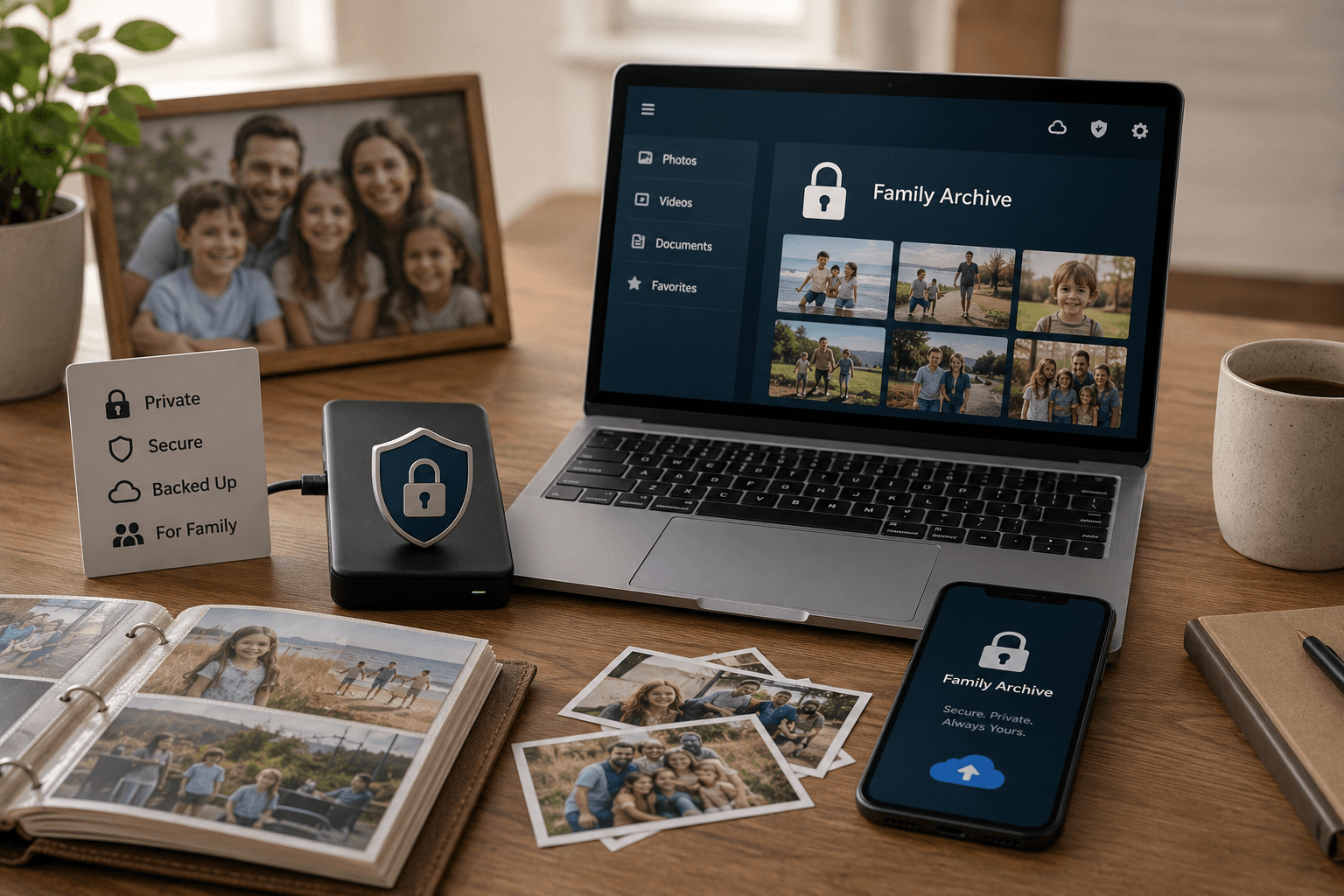
How to Create a Private, Secure Digital Family Archive (2026 Step-by-Step)
Most family photos today live somewhere a stranger's algorithm can scan them or a forgotten password can lock them away forever. Here's how to build a private archive only the people you choose can see — and that doesn't belong to anyone but you.
Patrick Moore • May 27, 2026
Insights
Google's New Privacy Policy: Is Your Family's Public Data Training AI?
Google recently updated its privacy policy, clarifying it uses publicly available information to train its AI models. For families, this raises questions about photos and stories shared online. This post explains what the change means for your digital memories and how to protect what's most precious.
Patrick Moore • August 1, 2026
Preserve your family's memories in one private place.
Start free in minutes. No credit card required.