
Using AI to Save Memories Before Dementia
For families facing the possibility of a loved one's dementia, time feels precious. New AI tools offer powerful ways to capture life stories before they fade, but they also raise critical questions about privacy. Learn how to navigate these options and find a secure, family-centric approach to preserving your legacy.
The Memory Murals Team • August 19, 2026
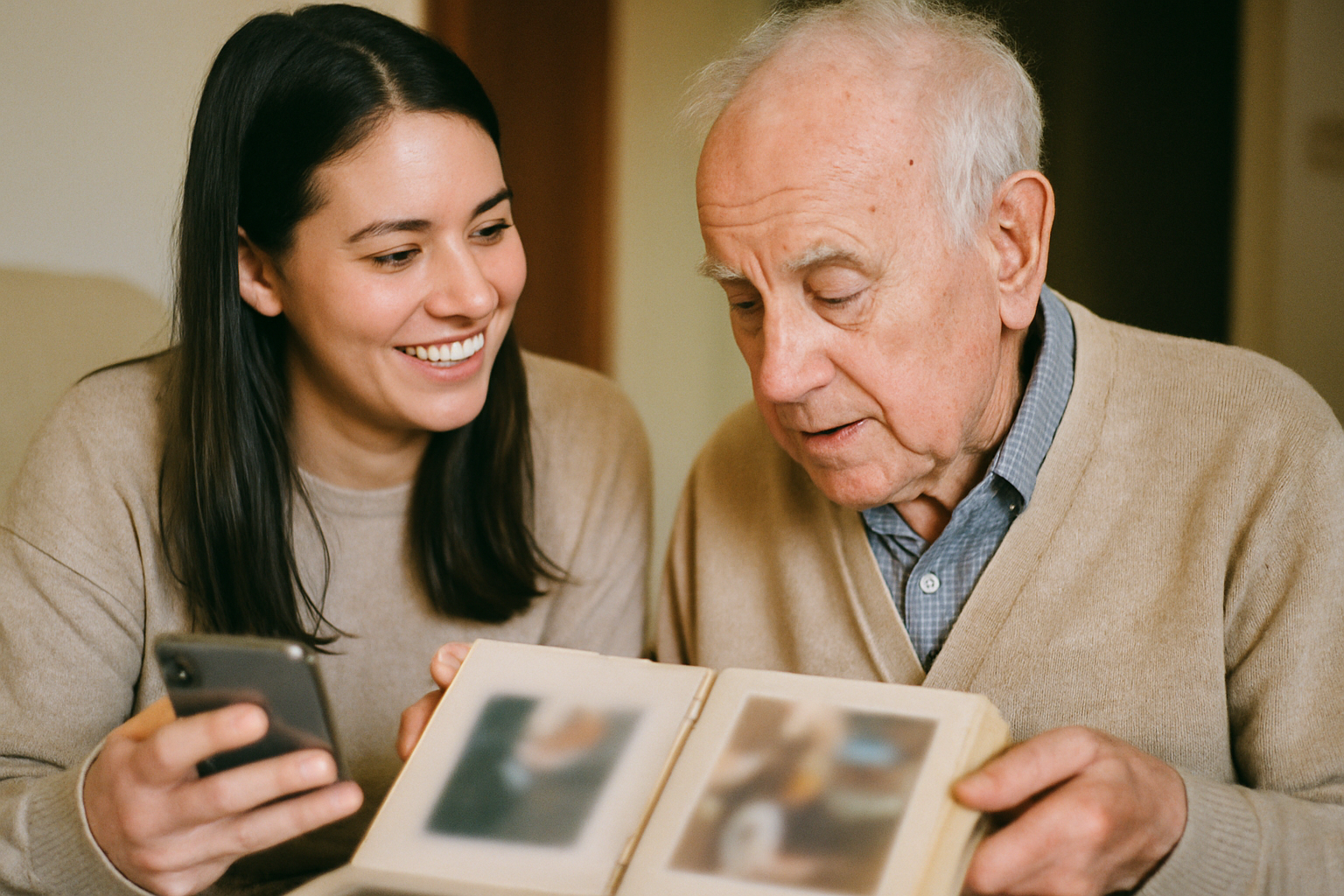
Picture your dad at the dinner table, telling that one well-worn story about his first car—the '68 Mustang with the fickle transmission. You’ve heard it a hundred times. You love it. But you also know it’s just one of a thousand stories, a highlight from a life rich with details you’ve never heard.
There’s a quiet urgency that settles in as our parents and grandparents age. It’s the feeling that the library of their life has a finite number of check-outs left. For families who see the early signs of cognitive decline or receive a dementia diagnosis, that urgency becomes a pressing, vital mission: how do we save these stories before the connection to them is lost?
In the past, this meant frantic scribbling in notebooks or setting up a clunky camcorder. Today, artificial intelligence offers a new set of tools, promising to help us capture, organize, and preserve these memories more easily than ever. But as with any powerful new technology, it’s essential to approach it with thoughtfulness and care.
The short answer
New AI tools are preserving senior memories before dementia strikes by automating difficult tasks. They can transcribe spoken stories into searchable text, identify people across decades of photos, and even help prompt conversations. This technology makes it easier to build a rich family archive. The most important factor, however, is choosing a platform that is private by design, ensuring your family's sensitive stories are never used for data training.
Why Capturing Memories Now is So Critical
A dementia diagnosis isn't just about forgetting where the keys are. It's a progressive condition that slowly unravels the narrative thread of a person's life. Early on, long-term memories might remain sharp, providing a precious window of opportunity. This is the time to capture not just the 'what' but the 'how' and 'why'—the feelings behind the facts, the tone of voice when telling a funny story, the specific details that make a memory uniquely theirs.
Waiting too long can mean losing those nuances forever. The goal isn't to conduct a high-pressure interrogation, but to create a space for gentle reminiscence. By starting early, you can turn memory-keeping into a joyful, connecting activity rather than a frantic race against time. This process itself can be therapeutic, strengthening bonds and honoring a life well-lived. For guidance on how to begin, see our post on preserving a parent's stories after a dementia diagnosis.
The Emerging Role of AI in Preservation
Artificial intelligence is no longer science fiction; it’s a practical assistant that can dramatically simplify the work of building a family archive. Instead of spending hundreds of hours manually tagging photos or typing up transcripts, you can leverage AI to do the heavy lifting.
Here are a few ways AI is being used:
- Automated Transcription: You can record hours of conversation with a parent, and AI can convert that audio into a searchable text document in minutes. This makes it incredibly easy to find specific anecdotes later.
- Photo & Video Analysis: Modern AI can identify people, places, and even objects in your family photos. You could search for “every photo of Mom at the beach” or “all videos from Christmas 1992,” and the system will find them instantly.
- Intelligent Story Prompting: Some platforms use AI to generate thoughtful questions that can spark memories a person hasn't revisited in years. This can be less intimidating than a blank page or a formal interview.
- Voice Cloning & Avatars: More advanced (and controversial) tools can create a synthesized version of a loved one's voice, allowing you to interact with an “avatar” of them. While fascinating, this technology, like that offered by services such as HereAfter AI, raises deep questions about authenticity and privacy.
Efficiency and Scale
AI can process and organize vast amounts of information—decades of photos, hours of audio—that would be overwhelming for a single person to manage. This makes creating a comprehensive archive achievable.
New Forms of Interaction
AI can uncover hidden connections and themes in your family's stories that you might have missed. Smart search and automatic tagging create new ways to explore and engage with your history.
Critical Privacy Concerns
This is the biggest issue. Many mainstream AI tools are built by harvesting user data. Are your private family stories being used to train a corporate AI model? The answer is often yes, unless the service explicitly states otherwise.
Impersonal and Inaccurate
AI is not human. It can mis-transcribe names, misunderstand context, or lack the emotional intelligence to navigate sensitive topics. Over-reliance on AI can make the process feel sterile and disconnected.
Not All AI Tools Are Created Equal
The fundamental difference comes down to a company's business model. If a service is free or offered by a large tech company, it's wise to assume your data is the product. Your family's history—your grandmother's voice, your father's personal reflections—may be fed into massive language models, anonymized or not, to improve their services for others.
For something as intimate as a family archive, this is a significant trade-off. These aren't just data points; they are the essence of your family's legacy. They deserve a sanctuary, not a training ground.
A Critical Question to Ask Any Service
Before uploading your family's most precious memories, ask this: "How do you use my data?" If the answer isn't a clear, unambiguous commitment to privacy and a promise not to use your stories for AI model training, you should be extremely cautious. True privacy means your archive is for your family's eyes only.
How Memory Murals Uses AI Thoughtfully
When we built Memory Murals, we started from the principle of privacy. We believe AI should be a powerful tool that serves you, not the other way around. Our implementation of AI is designed to be an assistant, helping you curate and preserve your family's legacy while keeping you firmly in control.
Here’s how our approach is different:
AI-Powered Transcription
Record your dad telling a story on your phone, upload the audio file, and our system will generate a searchable text version. It's perfect for finding that one specific detail years later, and the original audio is preserved right alongside it, capturing the irreplaceable sound of his voice.
Smart Search & Tagging
Our AI helps you find what you're looking for without hours of manual labor. It can identify faces to help you tag who is in a photo, and our search can find themes and keywords across all your stories and notes. Find every memory that mentions “the old farmhouse” in seconds.
Guided Story Prompts
If you're not sure where to start, our app offers gentle, non-intrusive questions to help get the conversation flowing. Drawing from a library of prompts like these 50 questions to ask your parents, they are designed to open doors to memories, not force them.
Private by Design
This is our most important feature. Your family's archive is completely private and secure. We use AI to enhance your experience within your archive, not to harvest your data. It's a closed loop, just for your family. Your memories will never be used to train any external AI models. Period.
The race against memory loss is a deeply human one. Technology can help, but it should never overshadow the purpose: to honor a life and preserve its stories with love and dignity. The goal isn't to create a perfect, AI-generated replica of a person, but to use these powerful new tools to safeguard the real, messy, beautiful human stories for the next generation.
It’s about capturing the way your mom’s voice cracks when she talks about her childhood dog, or the specific details of the day your grandfather met your grandmother. These are the treasures. AI can help you gather them, but you are the one who knows their true worth. If you're ready to start building that private sanctuary for your family's stories, you can begin your Memory Mural today.
Get 50 questions to ask your parents — before the stories are gone
The exact prompts families use to draw out the stories nobody ever wrote down. Free, straight to your inbox.
No spam. Unsubscribe anytime.
Frequently asked questions
What is the best way to preserve memories for someone with dementia?
The best approach is to start early, before symptoms advance. Use familiar photos, music, and gentle questions to spark conversations. Record their voice telling stories, as audio can be a powerful comfort later. AI tools can help transcribe these recordings and organize photos, but the focus should always be on creating a calm, enjoyable experience for your loved one. A consistent, low-pressure routine is more effective than a single, high-stakes interview.
How can AI help with memory preservation?
Artificial intelligence can automate many of the tedious tasks of memory preservation. It can transcribe hours of spoken stories into searchable text, identify and tag people in thousands of photos, restore faded or damaged images, and even generate personalized story prompts. This assistance allows families to spend less time organizing and more time connecting with their loved ones, capturing the memories that matter most.
Are AI memory apps safe for seniors' private stories?
Safety and privacy vary widely between apps. Some services may use your family's data to train their AI models, effectively making your private history part of their product. To ensure safety, choose a service with a clear, transparent privacy policy. Look for platforms that are private by design, meaning they commit to never sharing, selling, or using your family's memories for anything other than your own personal archive.
Can you record someone's life story before they get dementia?
Yes, and it is one of the most meaningful gifts you can give your family. Starting before a diagnosis, when memories are sharp and easily accessible, allows you to create a rich, detailed archive of their life in their own words. The key is to make it feel like a natural conversation, not a formal interview. Ask open-ended questions and approach the process with curiosity and love. This creates a legacy for future generations.
Related Stories
How-To Guides
How to Preserve a Parent's Stories After a Dementia Diagnosis — A 2026 Guide
A diagnosis doesn't take everything at once. Here's a 2026 practical guide to recording your parent's stories at every stage — what to capture first, how to interview without pressure, and where these recordings should live.
The Memory Murals Team • May 14, 2026

How-To Guides
How to Record Your Parent's Voice Before Dementia Takes It
After a dementia diagnosis, voice fades in a specific order — vocabulary, then patterns, then the laugh. Here's a 7-step plan to record your parent before that order runs out.
The Memory Murals Team • April 23, 2026

Insights
Screen Time & Cognition: New Study Challenges Digital Habits Myths
For years, we've heard warnings about the dangers of screen time. But a surprising new study suggests a link between self-reported screen use and better cognition. This post explores what this new research means for how we think about our digital lives and the preservation of our family memories.
Patrick Moore • August 29, 2026
Keep what's left of their voice.
A private place for the recordings, photos and stories — no feed, no algorithm, nobody else's eyes on it.