
45 Questions to Ask a Vietnam Veteran Before It's Too Late
The men who went to Vietnam are in their 70s and 80s now, and most were never asked. These 45 questions — the draft, the year-long DEROS countdown, the homecoming the country got wrong — are the ones their families will wish they'd asked, with the framing that actually gets them answered.
The Memory Murals Team • July 14, 2026
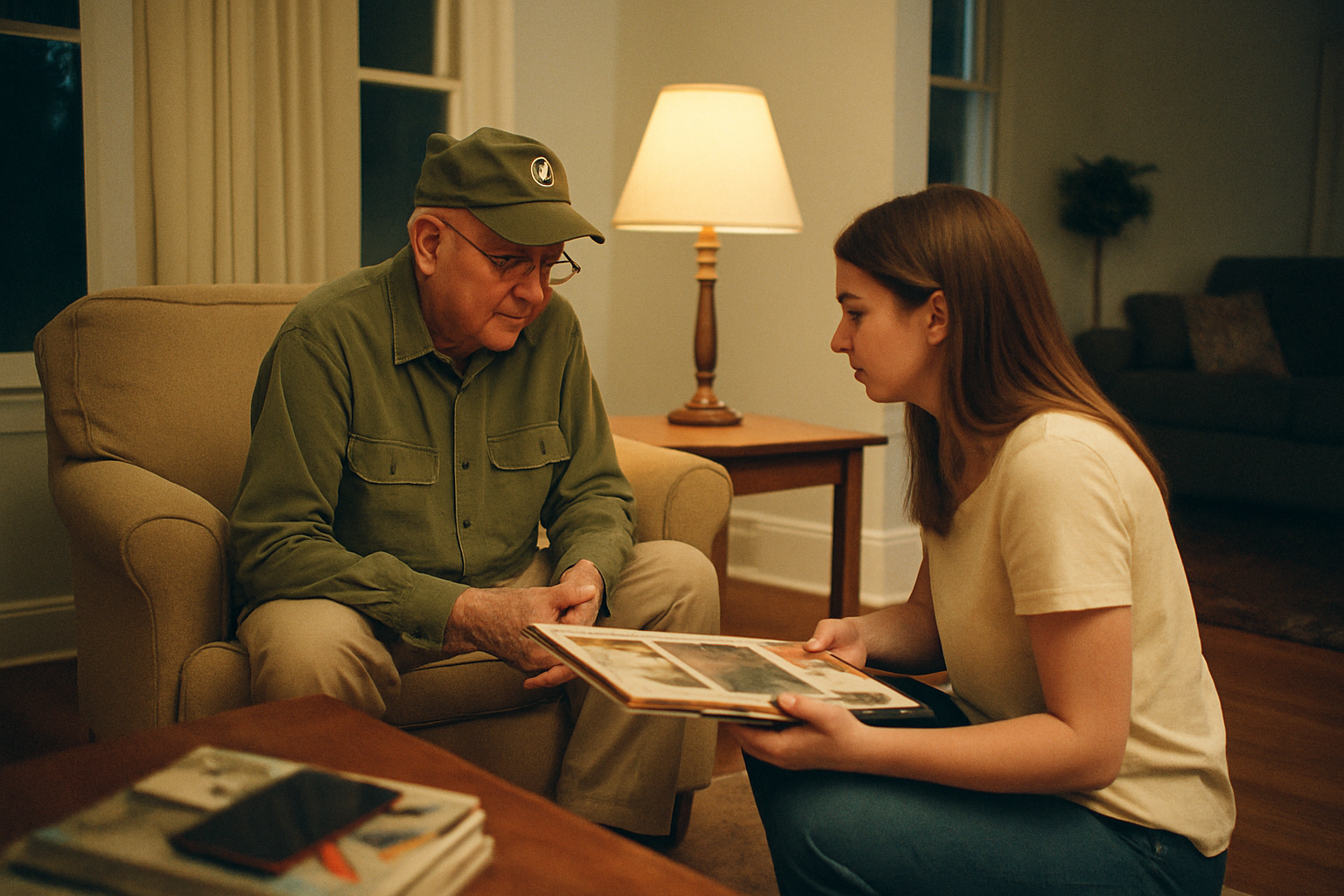
The men who went to Vietnam are in their seventies and eighties now, and most of them were never asked.
Not really asked. Not the way that gets an answer. Somebody at a barbecue once said "so you were over there, huh," and he said "yep," and that was the end of it for fifty years. He came home to a country that didn't want the story, so he folded it up and put it in a drawer, and the drawer has been closed ever since.
You can open it. But not with "tell me about the war." That's the one question guaranteed to close it tighter.
These 45 questions are built for the Vietnam veteran specifically — the draft that decided his life, the year-long countdown he lived by, the freedom bird, the homecoming the country got wrong. They're sequenced from safest to hardest, and each comes with why it matters, because a Vietnam veteran almost never tells a story without a reason. Your job is to give him the reason.
This is the Vietnam-specific companion to our broader guide on questions to ask any veteran in your family — start here if the man you're asking about served in Southeast Asia.
Before you ask
Don't sit him down across a table with a recorder running and call it an interview. That framing shuts a Vietnam veteran down faster than almost anything. Ask one question at a time, in motion — in the truck, at the workbench, on a walk. Let the silence after the question do the work. If he doesn't answer, don't fill it. With this generation, the real answer almost always comes in the second pause, not the first.
How it started — before he ever left home
1. "Do you remember your draft lottery number?"
Why it matters: After the December 1969 lottery, a man's future came down to a birthday pulled from a glass jar on live television. Most men who went through it can still tell you their number, because for one night everything hung on it. The number is a doorway to exactly where he was standing when he heard it — whose living room, which friends, what everyone said.
2. "Did you enlist, get drafted, or join the Guard to steer your own path?"
Why it matters: There were three roads into that war, and the one he took shaped how he felt about every day after. Some enlisted to pick their branch or their job before the draft picked for them. Some were drafted and went. He'll tell you which he was — and the why behind it is usually the first real story of the interview.
3. "What did your parents say when they found out you were going?"
Why it matters: This question reaches the people who aren't in the room anymore — his mother at the sink, his father who maybe served himself and went quiet. Watch his face when he answers. For a lot of these men, the grief they never showed for their own parents comes out right here, sideways.
4. "What was the country saying about the war while you were deciding?"
Why it matters: No American generation shipped out into a louder argument. The evening news, the campus protests, the dinner-table fights. Ask what it was like to put on the uniform while half the country was on TV saying he shouldn't. It's a tension this generation carried alone and rarely gets to describe.
5. "Did you know anyone who went to Canada, or refused to go?"
Why it matters: Everyone from that era knew someone who chose differently — a cousin who left for Toronto, a classmate who burned the card. His feelings about those men, fifty years later, tell you a great deal about how he made his own peace with going. Ask gently. The answer is rarely simple, and it's rarely neutral.
Becoming a soldier and crossing the ocean
6. "Where did you do basic, and what was that first morning like?"
Why it matters: Every veteran remembers the first day of boot camp the way you remember your first day of school — only sharper, because it was engineered to break him on purpose. The drill sergeant's name. The haircut. The smell of the barracks at 4 a.m. Specific, sensory, and easy to talk about.
7. "Did they run you through jungle school before you went over?"
Why it matters: Many went through Tigerland at Fort Polk or similar training built to imitate Vietnam — mock villages, staged ambushes, heat on purpose. Asking about it opens the strange rehearsal for a war he hadn't seen yet, and the gap between what they told him it would be and what it was.
8. "What was the flight over like?"
Why it matters: Most men flew to war on a chartered commercial airliner, with civilian flight attendants serving meals, and landed into a combat zone. The surreal politeness of that flight — a stewardess's smile, then the door opening onto Vietnam — is a detail nearly every Vietnam veteran remembers and almost no one thinks to ask about.
9. "What did Vietnam smell like when they opened the door?"
Why it matters: Ask any man who landed at Tan Son Nhut, Bien Hoa, Cam Ranh, or Da Nang and he'll tell you the heat and the smell hit him before anything else — jet fuel, diesel, rot, and wet green all at once. Sensory memory is the most durable kind. This question puts you on the tarmac beside the kid he was.
10. "Were you the new guy — and who took you under his wing?"
Why it matters: Every replacement arrived alone as the "new guy," green and unproven, and his life often depended on some short-timer deciding to teach him what the training didn't. Ask who that man was. The answer is frequently the first name he's said out loud in decades, and one of the most important of his life.
What the days actually looked like
11. "Were you out in the field, on a firebase, or on a big base?"
Why it matters: "Vietnam" was a dozen different wars depending on where you stood — humping the boonies, manning a remote firebase, or working a sprawling base with a mess hall and a movie screen. His answer sets the entire frame for everything else, and it corrects the single picture most families carry in their heads.
12. "What was your job — what did the Army actually train you to do?"
Why it matters: Movies show riflemen. Reality was medics, radiomen, door gunners, mechanics, cooks, clerks, and truck drivers. His MOS tells you what his days truly held. Most people assume constant combat; most veterans were doing something else most of the time, and the something-else is where the real stories hide.
13. "How did you sleep over there — the heat, the rain, the sounds?"
Why it matters: The monsoon that never stopped, the heat that never broke, the sounds you learned to sleep through and the ones that snapped you awake. The body remembers a year of that. It's a safe, physical question that quietly opens onto fear without ever naming it.
14. "What did you eat, and what would you trade for?"
Why it matters: Every man has opinions about C-rations — the ham and lima beans nobody wanted, the pound cake everybody fought over, the trades and the black-market Cokes. Food is one of the safest doors in, and it almost always swings open onto something else: the cooks, the shortages, the meal he couldn't eat after a bad day.
15. "What did you carry that wasn't issued?"
Why it matters: A letter from his mother. A photograph gone soft at the creases. A transistor radio, a Bible, a poncho liner he still owns. Soldiers always carried something unauthorized, and the something usually mattered more than anything the Army handed him. No autobiography ever asks this. It should.
16. "What music got you through it?"
Why it matters: This was the first rock-and-roll war — AFVN on the radio, cassettes from home, a transistor passed around a bunker. Ask what was playing over there, and which song still stops him cold on the car radio today. Music is a time machine, and for this generation it's wired straight to Vietnam.
17. "How did mail work — and who wrote to you?"
Why it matters: Mail call was the center of gravity of the whole tour. The letters that came, the ones that stopped coming, the girl back home, the box of cookies that arrived as crumbs. Ask if he kept any of the letters. Ask if you can read them, or scan them before they're gone.
18. "Where did you go on R&R, and what did you do with those five days?"
Why it matters: Five days in Sydney, Bangkok, Hawaii, Tokyo, or Hong Kong — the surreal whiplash of a hot shower, clean sheets, and a real meal in the middle of a war. R&R stories are often the ones a Vietnam veteran tells most easily, because he's allowed to be happy in them. They also reveal who he chose to spend that precious time with.
The questions that take the most courage to ask
19. "Do you remember the first time you were shot at?"
Why it matters: He does. Every combat veteran remembers the first time the war became real and personal. Don't ask this on day one, and don't ask it at a dinner table. Ask it once you've earned some trust, then go quiet and let him decide how far to go.
20. "What was the worst of it — the fear, the heat, the boredom, or the waiting?"
Why it matters: By naming several answers, you give him permission to pick the honest one instead of the expected one. Many veterans will tell you the boredom and the waiting were their own kind of torment. It's a question that widens the frame past the combat cliché and lets the real texture of the year come through.
21. "Did you trust your rifle?"
Why it matters: Early in the war the M16 had a reputation for jamming at the worst possible moment, and men died because of it — a scandal that reached Congress. Whether he cursed it or trusted his life to it, the answer opens the very concrete, very technical relationship a soldier has with the tool that keeps him alive.
22. "Did you lose anyone close to you over there?"
Why it matters: If the answer is yes, every other answer in the interview is shaped by it. Don't push for the details of how. Just ask for the name, and write it down. Saying that name out loud, in his hearing, may be the first time anyone has in fifty years — and it may be the whole point of the conversation.
23. "Were you wounded? Is there a Purple Heart in a drawer somewhere?"
Why it matters: Many were, and many never told their families. Medals sit in sock drawers, unmentioned for decades. This question gives him permission to acknowledge what happened to his body, visible or not, and the answer often explains things about him his family never understood.
24. "Was there a decision over there you still turn over?"
Why it matters: The war put nineteen-year-olds in moments where a choice they made cost lives. Some men carry one specific decision for the rest of their days and have never told a soul. He probably won't the first time you ask, either. Ask gently, and mean it, and be willing to ask again a year from now.
25. "What did you see over there that you're glad you saw?"
Why it matters: This one surprises families. Amid everything, men saw astonishing things — a sunrise over the highlands, a Vietnamese kid who made them laugh, a country of staggering beauty. The trauma story leaves no room for these, and he may never have been invited to tell them. Make room.
The men he served with
26. "Who was your best friend over there, and where is he now?"
Why it matters: This is one of the most reliably story-rich questions you can ask. Almost every man had one. Sometimes the friend came home; sometimes he's a name on a wall. Either way, ask what he was like, what made him laugh, what he ate for breakfast. The small details are what bring him back for a minute.
27. "Who was the funniest man in your unit?"
Why it matters: Every unit had one — the guy who kept everyone sane with a joke at the worst possible time. This question almost always pulls a real laugh out of a veteran who hasn't touched that part of his memory in years, and laughter is one of the few doors that opens without a fight.
28. "Was there a sergeant or an officer who kept you alive?"
Why it matters: Somewhere in his year there was probably a leader who knew what he was doing and got his men home because of it. Ask the name, ask the moment, ask whether the man is still living. Admiration comes out more easily than grief, and it often leads straight to the harder stories.
29. "Was there a leader who let you down?"
Why it matters: Just as common, and almost never discussed at home — the officer who got men killed, the order that made no sense, the institution that broke its promises. An honest answer here frequently explains a lifetime of his attitudes toward authority, and it tells him you can handle the parts that aren't heroic.
30. "Did you ever save someone, or have your own life saved?"
Why it matters: Some men answer yes. Some say no and mean yes. The story behind either answer is usually one he's never volunteered without being asked. Don't press if the first answer is short — let it land, and come back to it another day.
31. "Is there a name on The Wall you look for?"
Why it matters: The Vietnam Veterans Memorial means something to this generation that no other monument does. Whether he's stood in front of it, refuses to go, or has names on it he traces with his fingers — his answer is never neutral. If he hasn't been, the conversation about why is often the deepest one you'll ever have with him.
32. "Is there anyone from those days you wish you could find again?"
Why it matters: A medic, a radio operator, a kid from another unit who shared a foxhole one bad night. Many veterans have one person they've thought about for fifty years and never tried to find. Sometimes helping him find them — through a unit association or a reunion group — is the greatest gift you can give.
Leaving the war and landing in a country that had changed
33. "What was your DEROS — and were you counting the days?"
Why it matters: Every man had a Date Eligible for Return from Overseas, the exact day his tour was up, and most kept a short-timer's calendar and counted down out loud. Because men rotated individually, he likely arrived alone and left alone. The countdown opens the strange, lonely arithmetic of the Vietnam tour — a war you served one personal year of, not one shared campaign.
34. "What was the freedom bird like — that moment the wheels left the ground?"
Why it matters: Ask about the flight home and most veterans describe the same thing: a cheer that erupted the second the plane lifted off Vietnamese soil. It's one of the purest moments of joy in his whole story, and it sits right beside what came next — which is why it's the perfect setup for the hardest question on this list.
35. "How fast did you go from the war to your parents' driveway?"
Why it matters: This is the wound specific to Vietnam. A man could be in a firefight one week and standing in his own kitchen 48 hours later — no ship home with his unit, no decompression, nobody who'd been there. That whiplash explains things about him his family has quietly wondered about for fifty years. Ask, and a lot of it makes sudden sense.
36. "Did anyone tell you to change out of your uniform before you got home?"
Why it matters: Many were advised to travel in civilian clothes to avoid confrontation, and some met hostility in the airport anyway. The country that sent him didn't know how to receive him. This is the single question that most reliably reaches the grief this generation was never allowed to set down.
37. "Did anyone at home understand — or even ask?"
Why it matters: Most say no. A few say one person did — a grandfather who'd seen his own war, a wife who just let him be quiet. The question opens a wound that's also a relief to finally name: that he came home to a country with no idea how to hear him. Many Vietnam veterans have waited their entire lives for someone to simply ask.
38. "When you got back, did you talk about it — or just put it away?"
Why it matters: For most, the answer is that they put it away, sometimes for decades, because there was nowhere to put it down safely. Asking this gently tells him the drawer can be opened now, on his terms, with someone who won't flinch. Sometimes that permission is the whole gift, even if he's not ready to use it yet.
The long tail of a year that never quite ended
39. "Were you exposed to Agent Orange — and should the family know for our health?"
Why it matters: Framed as protecting his kids and grandkids rather than as an accusation, this is a question most Vietnam veterans will answer. Many fought the VA over it for decades. The answer matters for your family's medical history, and asking it tells him you take seriously what was done to his body.
40. "How long was it before you could say the word 'Vietnam' out loud?"
Why it matters: For many men it was years, even decades. The question acknowledges the silence without judging it, and it invites him to describe the moment the silence finally cracked — often a reunion, a documentary, a grandchild's school project, or a friend's funeral. That moment is usually a story in itself.
41. "Have you ever been back to The Wall in Washington?"
Why it matters: Whether he's made the trip, plans to, or can't bring himself to go, the answer is loaded with meaning. Many veterans describe standing at the Vietnam Veterans Memorial as the moment something finally loosened. If he hasn't gone, asking whether he'd want to — maybe with you — can open a door that's been shut his whole life.
42. "Did you ever go to a reunion, or reconnect with your unit?"
Why it matters: Some men found their way back to the only people who truly understood, sometimes forty years later, and describe it as getting a piece of themselves returned. Others never went and aren't sure why. Either answer tells you something true about how he carried the years — and reunion groups still exist if he's ever ready.
43. "When did people start thanking you for your service — and how did that land?"
Why it matters: This generation lived the whole arc, from a hostile or indifferent homecoming to a country that now says thank you at airports. Ask how that shift felt from the inside. For some it's healing; for some it rings hollow after all the silent years. The honest answer is one of the most revealing things he can tell you.
44. "What do you want your grandkids to know about that year of your life?"
Why it matters: This reframes the entire conversation. He's not talking about himself anymore — he's recording something for his great-grandchildren. Many men who refuse to discuss their service will talk for the kids. The framing changes what's possible, and the answer is the one you'll want preserved in his exact voice.
45. "If you could talk to the kid who got on that plane, what would you tell him?"
Why it matters: This is the master key, and the right place to end. It folds the whole year into a single answer. Some men cry here. Some laugh. Some go quiet for a long time. Whatever comes next is the line that belongs at the end of the recording — the one his great-grandchildren will hear when they ask who he was.
The Library of Congress wants his story too
The Veterans History Project at the Library of Congress accepts oral history submissions from any U.S. veteran of any era, Vietnam included. Record the interview and you can donate a copy to be permanently archived alongside the stories of millions of others. It's free, and the kit they send tells you exactly how. This isn't a substitute for keeping the recording for your own family — it's the second copy, the one that outlives all of us.
Millions
Americans who served in-country
Of the millions of living Vietnam-era servicemembers, only a fraction deployed to Vietnam. The combat-zone cohort is now in its seventies and eighties.
70s–80s
Average age of a Vietnam veteran today
The largest war-era cohort still living — which also means the next generation of veterans we lose at scale.
Don't just ask — record
These conversations don't repeat themselves. The Vietnam veteran in your family will tell some of these stories exactly once, on a Sunday afternoon, in a way he's never told them before — and if you're not recording, you'll keep the feeling and lose the words.
The exact words are the part that matters. The cadence. The pause before the answer. The thing he almost didn't say and then did. The first time he says his best friend's name out loud in fifty years.
Your family’s stories deserve a safe place
Photos, voice recordings, and the stories behind them — private, ad-free, free to start.
Start preserving memories freeFree plan available • No credit card required
If he's a man of few words to begin with, don't force a formal sit-down — our guide on interviewing a father who isn't a talker works just as well for a quiet Vietnam vet. Start with one question, in motion, and let the silence do the rest.
If you only have time for one question this week, sit beside him — not across from him — and ask number 10: "Were you the new guy, and who took you under his wing?" Then go quiet. The rest of the list will keep for another Sunday. The name of the man who kept him alive might not.
Get 50 questions to ask your parents — before the stories are gone
The exact prompts families use to draw out the stories nobody ever wrote down. Free, straight to your inbox.
No spam. Unsubscribe anytime.
Frequently asked questions
How long was a tour of duty in Vietnam?
For most U.S. servicemembers it was 12 months (13 for Marines). Each person had a DEROS — Date Eligible for Return from Overseas — a specific day they counted down to, and men rotated in and out individually rather than as a unit. That's why a Vietnam veteran often arrived alone, served alongside men on different countdowns, and flew home alone. Asking 'what was your DEROS, and were you counting?' opens that whole experience.
Should I ask a Vietnam veteran about Agent Orange?
Yes, but frame it as a family-health and legacy question, not an accusation. Many Vietnam veterans dealt with Agent Orange-related illness for decades and have strong feelings about how long the VA took to acknowledge it. Ask whether he was exposed, whether it's affected his health, and whether his kids and grandkids should know for their own medical history. Framed as protecting the family, it's a question most are willing to answer.
Why won't Vietnam veterans talk about the war?
Two reasons stack up. Like most combat veterans, they protect their families from what they saw — and, specific to Vietnam, they came home to a country that was hostile or indifferent, learned fast that nobody wanted to hear it, and put the uniform away. Many have waited fifty years for someone to ask with genuine respect instead of judgment. Often the willingness to ask is the whole unlock.
What is a Vietnam veteran's draft lottery number?
Starting with the December 1, 1969 drawing, the draft ran by televised lottery — the 366 birthdays of the year were drawn from a glass jar and assigned a sequence number, and low numbers were called first. Many men can still tell you theirs decades later, because for one night their entire future hung on the date they were born. Asking 'do you remember your number?' is a doorway to exactly where he was standing when he heard it.
What was the 'freedom bird' in Vietnam?
The freedom bird was the chartered jet that flew a soldier home at the end of his tour — usually a commercial airliner with civilian flight attendants. Veterans describe a cheer erupting the instant the wheels left the runway. The whiplash of the freedom bird is its own story: a man could be in the field one week and standing in his parents' driveway 48 hours later, with no unit, no decompression, and nobody who understood.
Is it too late to record my Vietnam veteran father's stories?
Not yet, but the window is closing. Vietnam-era veterans are now in their mid-70s to 80s and make up the largest war-era cohort still living — which also means they're the next generation we're losing at scale. Memory and hearing fade before the stories do. If there's a Vietnam veteran in your family, the honest answer is: record him this year, not eventually. Audio on a phone is enough to start.
What's the Library of Congress Veterans History Project?
The Veterans History Project (loc.gov/vets) is a free federal program that accepts oral history submissions from any U.S. veteran of any era, including Vietnam. They send you a kit with release forms and recording guidelines; you record the interview, fill out the paperwork, and mail it in, and the Library of Congress permanently archives it. Keep your own copy for the family and donate the second copy to history.
Related Stories
Lists & Roundups
40 Questions to Ask a Veteran in Your Family Before It's Too Late
WWII veterans are passing at roughly 130 a day. Vietnam vets are now in their 70s and 80s. These 40 questions are the ones their families will wish they'd asked — with the gentle framing that gets them answered.
The Memory Murals Team • May 17, 2026

Lists & Roundups
50 Questions to Ask Your Dad Before It's Too Late (And Why Each One Matters)
He taught you to ride a bike and pretended the burnt pancakes were fine. But do you know what scared him? What he almost did differently? What he wishes he'd said? These 50 questions unlock the man behind 'Dad.'
Patrick Moore • April 18, 2026

Lists & Roundups
50 Questions to Ask Your Parents Before the Stories Are Gone (The Complete List)
The 50 questions families actually use to draw out the stories nobody ever wrote down — organized into eight conversations, from their childhood bedroom to what they hope you keep doing after they're gone.
Patrick Moore • July 8, 2026
Preserve your family's memories in one private place.
Start free in minutes. No credit card required.